



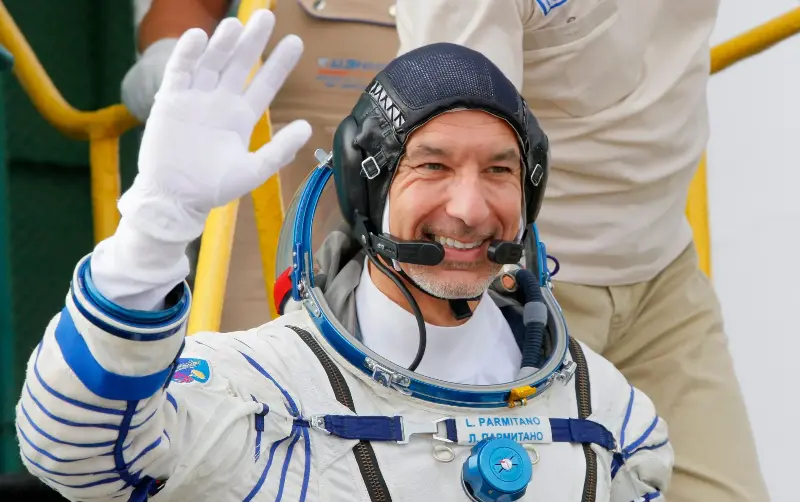
My time in space has changed my relationship with the night sky. After the Volare mission in 2013, when I was in orbit for 166 days, I found looking at the stars to be an almost melancholic experience because I yearned so deeply to be back there. Then I went up again for 200 days at the end of 2019 for the Beyond mission, and I made a real effort to experience each moment fully. Now, I can look up and feel joy again.
The Artemis II crew are all really good friends of mine (Christina Koch and I spent 200 days in orbit together, so she is my space sister), and I can imagine some of what they must be feeling, although my take-off wasn’t anything like theirs. The SLS (Space Launch System) is the most powerful rocket ever made, and even on my much smaller Soyuz rocket, I felt this tremendous acceleration pushing me into my seat and squashing my chest. It is exhilarating.
By now they will be adjusting to the weightlessness. Humans are incredibly adaptable, but it always takes a couple of days to get used to it. The sensation itself is indescribable, because there is literally nothing else that feels like that. If you have ever dreamt of flying without wings then that is the closest you’ll get to it, although it’s better because it is real. I always tell my daughter that it’s like you are covered with pixie dust from Peter Pan.
My friends in space will also be getting a very different view to the one I had. I was at the International Space Station, which is about 250 miles from Earth, whereas they’re going hundreds of thousands of miles into orbit.
From the space station, we have an optical horizon of about 6,000 miles, which means that you can see from around the southern UK to northern Africa in one view. It is fantastic, because in the day with just the naked eye you can see mountains and harbours and the outline of cities, and if you use any kind of lens you can see in great detail.
I’m from Sicily, so I am always fascinated by islands and places where the water interacts with the land, because it creates incredible swirling movements in the sea. But in the 366 days I spent in orbit, there was not a single time I looked out and thought, “Not interested”, as every view is incredible.
That being said, most of us loved looking at the Mediterranean, because it is absolutely recognisable: you can see Italy, Greece and the Black Sea. It is so dynamic and you know exactly where you are, as opposed to, say, Central Asia, where it takes a while to understand what you are seeing.
I also loved looking at the clouds and taking pictures of them. I was lucky to fly in summer the first time and in winter the second time, so I saw the continents in such different ways. During the Northern Hemisphere summer, you see the glaciers in South America, which are extraordinary, although that time of year can be very cloudy in Asia, so I was excited to see it in the dry season.
I have been on four space walks in total. It is a wonderful thing to do, but it is also hard for me to describe, because our vocabulary comes from our experience and there are things in our universe we simply can’t imagine.
Once, I was attached to the robotic arm and it was nighttime. I was staring out at the void with my back to Earth and, maybe it was my imagination or my brain creating a framework for me, but it felt as if I was looking at the universe as a 3D structure for the first time. I was able to see the void and the stellar material as the shapes they are, and it was like I was drowning in this vast blackness, but it was actually quite wonderful. I felt infinitely small, but at the same time so connected to it all. I had the strong sense that while the universe is vast, we are a part of it – and just because we are small, doesn’t mean we are meaningless.
On my second space walk I had a terrifying experience. There was a mechanical failure in the suit that meant my helmet started filling with water. I was isolated outside of the space station and on my own doing a night task. I couldn’t see because the water was in my eyes, and couldn’t talk because the microphone was wet. My nose was also filled with water but there was a gap where my mouth was so I could keep breathing, but I didn’t know how much time I had, as each breath could easily have been my last.
It was a real emergency, but luckily I was able to stay calm and make my way back using a 3D picture of the station in my head. I managed to get to the airlock in time to repressurise before my mouth was covered with water – I feel very grateful that the training I received allowed me to do that.
The space station itself is huge – it has the volume of a Boeing 747 – which is quite large considering that only six or seven people live there at a time. The days are structured and we always spend about two and a half hours exercising to keep our muscle mass up so we can return fully operational – it’s either weight lifting, running or cycling, and soon there’s going to be a rowing machine up there.
It also takes a few days to adjust to sleeping in zero gravity, because it feels odd trying to sleep without a pillow or a bed. Your body has to get used to not having the same signals that it’s time to wind down, but after a few days you really relax and sleep well.
I know that the astronauts in Artemis II have had a few issues with the toilet – to be honest, I would have been surprised if there hadn’t been a problem. It is a complex engineering feat to create a working toilet in zero gravity, and there will always be a few teething problems; the crew understands that.
Food, of course, is not amazing, but you know what you are going to get, and it is all about managing expectations: I was a bit disappointed by the quality of the coffee, but other than that, it was exactly what I expected. I hate to say this, because it sounds almost dismissive of Earth, but I didn’t miss anything because I knew my time up there was limited and I wanted to experience it in its entirety. I miss being in orbit much more than I missed Earth.
I was also never ready to come back down. Stepping back on Earth, you feel really heavy – your body gets used to the wonder of weightlessness, and I didn’t have a day up there where I wished I wasn’t weightless, as I loved it so much.
In Houston, we are thinking about the astronauts all the time, and I will be speaking to them regularly over the next 10 days. One thing I know is that they won’t feel disconnected from Earth – oddly enough, the farther you travel, the closer you feel to our planet because you see how precious and how unique it is in this black void.
I have returned from space thinking it is almost criminal to view Earth in a possessive way instead of thinking of it as its own system. We want to use its resources but we need to remember that the entire planet is a unit – it is a spacecraft flying in the cosmic void – and we are stewards, because we are the only animals on this planet who have the ability to create actionable damage, which means we have a responsibility to be good stewards for ourselves and other living creatures.
As told to Melissa Twigg