



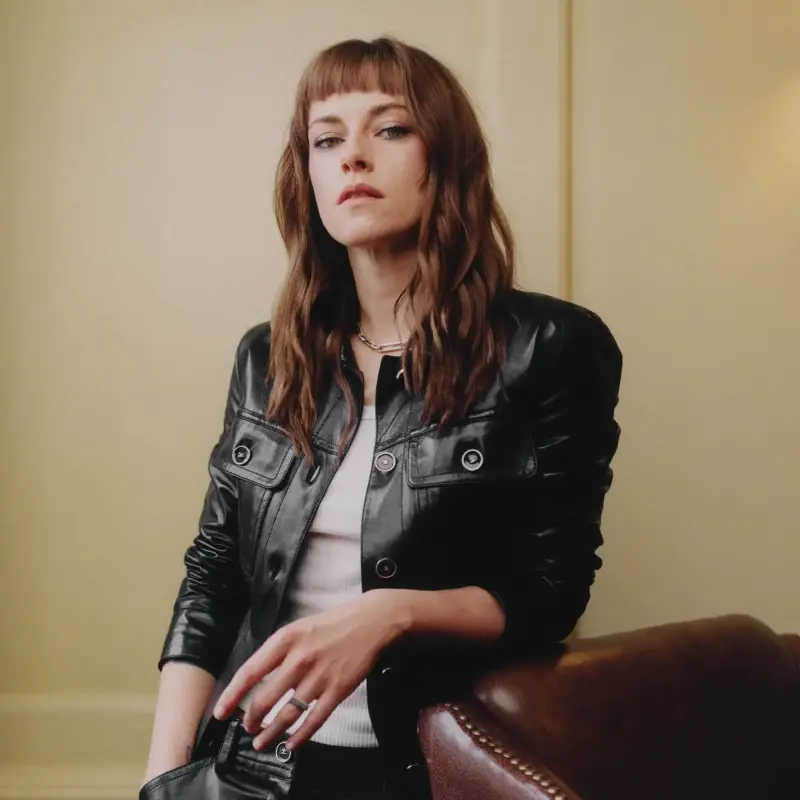
Kristen Stewart is in London for the premiere of her new film, The Chronology of Water. The night before I interviewed her, she was posing for the cameras, alongside cast members including British actress Imogen Poots, in a tiny monochrome mini dress by Chanel. Today, she’s in a private members’ club in Soho to do promotional interviews. So far so normal for one of Hollywood’s biggest names.
What makes this special, though, is that Stewart is not here as the star of the show. Instead, she’s its director. More than that, the way she describes it, she dragged the film kicking and screaming into being over eight long, fractious, combative years. “I was like an absolute animal,” she says now, hunched over a table in the top-floor bar. “I would have done anything. Nobody could have knocked this movie off course. People tried. I mean, Jesus Christ! Absolutely everyone.”
Throughout a career that began in childhood, Stewart has veered between huge blockbuster successes – the Twilight series, Charlie’s Angels and Snow White and the Huntsman – and quirky independents such as Spencer, Clouds of Sils Maria and Still Alice. For her directorial debut, she chose quite a challenge and one at the grittier end of the spectrum.
The Chronology of Water is her own adaptation of a memoir by the Oregon-based writer Lidia Yuknavitch, who escaped an abusive father partly through competitive swimming before falling into drug and alcohol addiction. She eventually faced up to these with help from Ken Kesey, the Beat Generation author of One Flew Over the Cuckoo’s Nest. Both the book and the film deal with the hardest of subjects – incest, rape, miscarriage – in a series of flashes back and forwards.
The main character is played with tremendous guts by Poots. “There was a huge audition process,” recalls Stewart. “I thought we could discover someone. But what ended up was, I think, the most intelligent approach: to hire the best actress in the world and watch her dig her teeth into this thing.” Poots is, as Stewart says, “a tsunami” in the role. It’s an intermittently beautiful and painful watch. Stewart chose the book partly because its switchback structure lends itself to cinema. Ultimately, she says, “the book is so genius because it’s not about what happens to her, it’s about how she reorganises those things in a way she can survive”.
This closely reflects how she describes the process of making the film: “This movie is the body of a woman. It was abused. It was really, really difficult to allow it to live,” she says with cold rage in her voice. “People are surprised to hear that, I guess, because I’m a successful actor and it seems like you can do anything you want. No, not like this.”
Stewart had to battle every step of the way to give the film its own chance of survival in what she calls “a misogynist system designed against it”. Luckily, she’s a fighter, prepared to call out “the blame and the shame and the gaslighting and the lying”, not only in Hollywood but in society at large. “I mean, we’re allowed to take our clothes off in public, but we have targets on our back for sure,” she says. “I don’t want to lean into victimhood, but we [women] need to stand together strongly and acknowledge we’ve received the s--t end of the stick in certain ways.”
In January 2024, with prospects for the film still rocky, she announced in a Variety cover story that she wouldn’t do any more acting – “I will quit the f-----g business” – if Chronology wasn’t completed. Looking back at the 2025 Cannes Film Festival, where it was first seen, she was pleased with the results of her “public temper tantrum”. “Thank God I stamped my feet,” she says, “because if I didn’t, it wouldn’t have happened.”
But things are still tough. “We have very, very little money to scrape together to put this thing out there and get the word out,” she says now. “I think we have five production companies that put it together. We needed to combine our efforts and focus our cashola.” That said, now the film is finished, she’s “gleefully giddy every single time” she watches it. “To me, it’s an absolute thrill ride,” she says.
Stewart’s own life seems quite a rollercoaster, too. Now 35, she grew up in Los Angeles with parents who worked behind the scenes in the film industry – her father as a stage manager and television producer; her mother a script supervisor. Stewart started acting aged eight and, at 11, held her own opposite Jodie Foster in the thriller Panic Room. She’s apparently had her pick of film roles ever since, but says directing is her first choice now.
At a Variety awards ceremony in January, where she was named one of 10 directors to watch, she said she would even consider returning to The Twilight Saga – but as a director. “Imagine if we had a huge budget and love and support! I will do the remake. I’m committed.” She was only partly joking. “I want to direct because I love acting so much. I am so wholeheartedly in love with and obsessed with the technical aspects of what we do,” she explains.
And as for the responsibility of having a whole film rest on her shoulders, she says it’s worse if you’re the star rather than the director. “It’s hard to be an actor,” she says. “It hurts a little bit, in the best way. I’m a bit of an exhibitionist and I’m a bit of a masochist also. It’s difficult to lay yourself bare, but it feels good.” When it works, “it’s heaven,” she says. “But it’s always scary. I am so much more scared of dropping the ball for other people. There’s so much more responsibility when it comes to supporting someone else’s vision.”
This was clearly true of Spencer, Pablo Larraín’s dreamlike film about a grim 1991 Christmas at Sandringham, in which Stewart played Princess Diana on the verge of collapse. It was a staggering piece of casting that could have gone disastrously wrong, but ended up with Stewart netting an Oscar nomination for best actress. “I told Pablo he was insane and he should probably hire someone else, but he refused to accept that,” she says. “There were some massive distinctions between her and me. It was the statuesque thing [Stewart is about 5ft 5in]. It was the eye colour – I have green eyes; she has very famously blue eyes that match her ring. So I was like, ‘Should we make the engagement ring green, then?’” Those details, she says, “were pulling me under and Pablo was like, ‘You really must detach from those things – this is about spirit.’”
Indeed, according to Stewart, Larraín saw “a little bit of overlap in terms of our experience. And there was something about my energy.” At the time, Princess Diana was the most photographed woman in the world, and Stewart can’t have been too far behind in the Twilight years. “She was plucked, plucked to death [by paparazzi],” says Stewart. “And her rebellious qualities felt so desperate, and so young and so vulnerable.” Who can understand that better than a teenage movie star? “It does kind of soul suck,” Stewart agrees. By the end of filming, she says: “I did feel a bit like a shell, and I think she did too. That was the point.”
‘I can cry about her at any moment’
Stewart says she felt “haunted” by the late Princess. “I still am,” she says. “I can’t drive round this city, and Paris for that matter, without thinking about her. All the love that poured out of this woman… I can cry about her at any moment.”
Her uncanny portrayal of Diana was helped by voice and movement coaches, as well as a wig and a wardrobe filled with impeccable Chanel gowns. “The clothes were part of the armour,” she explains. “They allowed me to step into her physical space and create images of her in this prison of a castle yet wearing lavish, stunning pieces of clothing. That is a poem in itself.”
Princess Diana did indeed wear a lot of Chanel, but surely not as much as Stewart herself, who has been a face of the fashion house since 2013, when Karl Lagerfeld staged a Métiers d’Art show in Dallas. Style-wise, when not in costume, Stewart swings between scruffy androgyny – baggy T-shirts and ripped jeans for mooching around LA with her wife of nine months, the screenwriter Dylan Meyer – and the prettiest pink tulle, lacy minis and gowns by Chanel on the red carpet. She has starred in the brand’s campaigns and walked its couture runway. “I like the duality,” she says. “Clothes can unlock layers, and if you lean into your default uniform, it becomes monotonous.”
Working with the designers at Chanel – first Lagerfeld then Virginie Viard – is, she says, “a different version of revealing your identity. Which is very similar to acting.” She has yet to meet Matthieu Blazy, Chanel’s new creative director, but says the collection he unveiled in October “blew my mind – I watched that show and was like, OK, I’m sold”. When we meet, she is wearing a black all-leather look from Blazy’s first collection and certainly looks comfortable in it. “The pieces had an elevated ease that was so Coco,” she says. “They were so free-flowing and playful, but serious.”
There is always a hint of rebellion about Stewart, not least when she flouted the rules about wearing stilettos at the Cannes Film Festival to go barefoot. “I take my shoes off when necessary,” she says drily. “You can’t tell anyone what to put on their body – man, woman or child. It’s completely archaic. Especially now.”
Chanel does more than dress Stewart for films, premieres and the interview circuit. The fashion house’s links with cinema go back to 1931, when Gabrielle Chanel travelled to Hollywood to dress Gloria Swanson, among others, at the invitation of Samuel Goldwyn. It supports film festivals and pays for the restoration of lost classics such as Last Year at Marienbad, for which Chanel herself designed the costumes. The Chronology of Water is not a dressy film – its heroine is happiest naked and submerged in a pond – but Stewart says without the support of the fashion house, she and the cast “wouldn’t have been able to travel round the entire world and attend all these festivals – and that does matter”.
As for her movie’s future following its difficult birth, she says: “It’s almost like having a baby and sending them to school and going, ‘I can’t have all the conversations for you, you’re going to have to interact with the world,’ and I’m very, very comfortable with that.” Stewart says she has eight more films she wants to get cracking on as a director right now, this minute. She’s “stepping into this new phase of my life where I want to kick-start my own engines”. Take a deep breath.
The Chronology of Water is in cinemas now.
With thanks to Soho House, London. Stewart wears Chanel.