



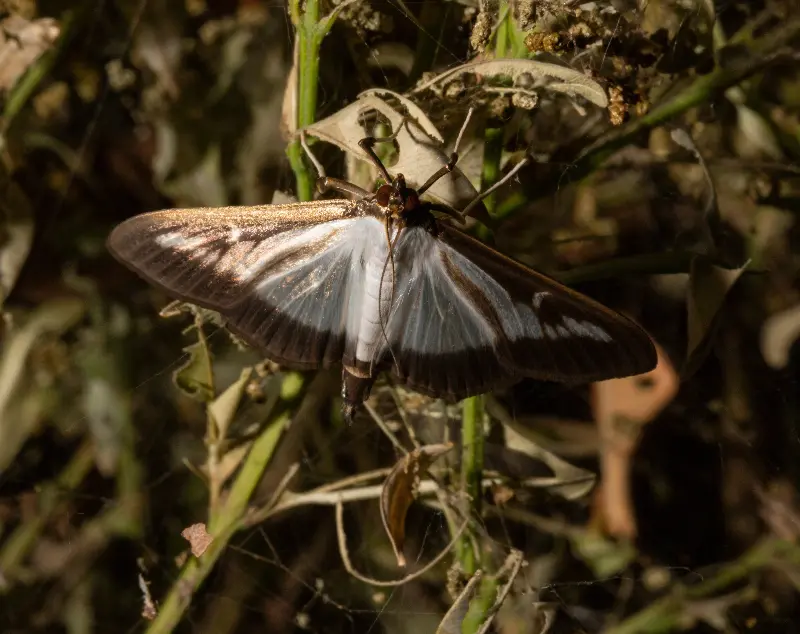
Many gardeners are taking stock of their box plants. First they were infected with box blight (Cylindrocladium buxicola); then, when we thought we had sorted this by changing to the highly resistant varieties of box and/or spraying, combined with good cultural care, in flies the box moth (Cydalima perspectalis).
This caught gardeners unaware, munching the foliage and leaving plants totally defoliated. But there is hope, and I have honed my strategy in my garden in order to keep a fair amount of my favourite box plants, as well as removing my less important plants and those most prone to blight and moth. In new gardens I am planning for clients, I tend to use alternatives.
How to spot whether you have box moth or box blight
Most of us, including me, will have both pests. The blight manifests itself with severe browning of leaves and bare patches, usually on the top of a hedge, while the moth gives rise to skeletal-looking plants eventually, but the leaves look munched and slightly twisted in the early stages.
The effect of box moth
The box moth arrived in the south of the UK in 2007, thought to have been carried in on imported plants. Now it has spread as far north as Edinburgh.
The moth has devastated native box woodlands in southern France, northern Italy, Germany and other countries, leaving only skeletal trees. The trees do re-leaf, but after a few years they are very weak. The native vegetation alters due to increased light levels and the delicate natural balance is destroyed.
However, there is hope. Steven Oostendorp, aka the Buxus Doctor, looks after box most of the time. The gardens he tends include Paleis Het Loo and the Twickel Estate in Holland, both burgeoning with beautiful box.
He has good news: “In recent years, we have seen a clear decline in the number of boxwood caterpillars, especially in areas where the caterpillar has been present for a longer period.
“During my observations in Eibergen [in the Netherlands], I noticed that the numbers of caterpillars were significantly lower than in previous years.
“As a result, the caterpillars simply didn’t have the strength to completely defoliate the plants due to their limited numbers.”

How to beat box moth
Since Brexit, it seems the products we can use in the UK have not been approved and updated as they have in Europe. Spinosad (available here as Tracer) is the key product used in Belgium, France and other European countries, but in the UK it can only be used by those who have done PA1 and PA6 pesticide training courses, and when used on plants produced for sale or replanting.
But it is the most effective control there is; it is also organic certified and, ironically, far less harmful than many of the legally available retail products allowed here. The downside is that it affects bees while still wet on the leaf, so it is recommended to be used in the evening. Once it has dried on the leaf (which takes three hours or more, depending on the weather), it is harmless. I am certainly going to use this where I can.
DiPel is widely used by professional growers and gardeners, as is XenTari: many people do not realise this product, a biological pesticide based on a bacteria, also kills a wide range of moths and butterflies. Despite widespread use by gardeners, few people realise technically it can only be used by someone with their PA1 and PA6 spray exams. Box lovers could consider taking these exams themselves: it takes about two days and costs up to £500.
Box specialist Chris Poole recommends the Box T Pro Press, which is a mating disrupter and works by pulling in frenzied males. Poole finds this best when used in conjunction with DiPel, which gives him a success rate of about 80 per cent. However, it is expensive – and many European growers think it is not nearly as effective as the spinosad options. Again, in the UK, you need your PA1 or PA6 exam to apply it.
For domestic gardeners, Provanto Ultimate Bug Killer is probably the best solution – although, ironically, it’s probably the least environmentally-friendly one.
The timing of the spray is crucial – you need to apply it as early as possible. The problem is that the caterpillars, which are light green with black stripes and white dots, are not easy to see when they are small. When they are full size (4cm long), they are easier to spot and you might see blackbirds and jays with several in their beaks, but by then the damage is done, so vigilance is needed.
Many gardeners use pheromone traps which pull in the male moths – these can be used as an indicator, telling you when you need to spray, not as a control. Some find, however, that this is not overly helpful. Steven Oostendorp has created a link for UK gardeners on his website, Buxus Dokter. If you fill in your email address there, he will send you an email telling you when you should spray.
The second method is on the European Topiary and Boxwood Society (EBTS) website. Look under “All you need to know about box moth and caterpillar”, and you will see Karel Goossens’ timeline for treating the box. Additionally, I find cutting the box after the end of May is helpful, as you can see the first signs of new damage on the fresh growth far more easily than on clipped plants. As I only treat affected areas, this is highly useful.
As with any procedure, once you get into the routine and find the best treatment for you, it becomes straightforward.
I think the best solution is to slowly change to the blight-resistant varieties; I can now forget all of the above where I am growing these.
Blight-resistant varieties to try
The Belgian expert Bjorn Gehesquière trialled some 33 different species and cultivars of box, and found some had great natural resistance, including Buxus microphylla ‘Faulkner’, B.m. ‘John Baldwin’ and B.m. ‘Rococo’.
The Belgian grower Didier Hermans of Herplant has spent many years breeding new varieties of box resistant to blight, with great success. I planted ‘Heritage’ but he also sells ‘Renaissance’, ‘Babylon Beauty’ and ‘Skylight’. If you plant these, you will not get blight, whatever the weather.
These varieties also seem to be more tolerant to moth damage too; it’s thought that this may be because the foliage is tougher, as there is a lot of Asian box in the breeding. ‘Heritage’, however, does go slightly yellow/brown in dry summers with my thin soil. With hindsight, I would probably have chosen ‘Renaissance’. I have taken lots of cuttings of these and am increasingly replacing the less resistant varieties with them in my garden.
Hermans says: “In all our projects (almost 1 million plants in gardens and 3 million in nurseries), we see higher tolerance to the box tree moth from the blight-resistant varieties. Only the young leaves are eaten and the plant remains green. This is indeed a nice side effect of our cross-breeding program with wild Asian species.”
Research and breeding is being carried out to improve this.
Alternatives to box
If you want to steer clear of box altogether, one plant that was widely recommended is Ilex crenata. I find this totally impossible to keep alive long term. Apparently it works brilliantly in the acid soils and hard winters of northern Japan, but most gardeners here find it impossible.
My favourite for a formal, low hedge is yew. Up until now, I have been using Taxus baccata plants, which if planted in a run of four to six plants per metre can easily be kept to about a foot high.
But Richard Burt of Provender Nurseries flagged up a better, lower form he sells called Taxus baccata ‘Renkes Little Green’, a bushier dwarf yew that was noticed on a German nursery in 2001 by the grower Renke zur Mühlen.
This unique plant never grew tall like its neighbours and never developed a leader, so it was propagated up and Fokko zur Mühlen, Renke’s son, says they are now selling many thousands of this useful low hedging plant, which never berries or flowers like the familiar English yew. I’ve ordered a batch and will try it out; it forms a great low hedge in two to three years, needs cutting once a year and can be planted at between four and six per metre.
I have tried Euonymus ‘Green Spire’, but although it is similar to box, I’m not a big fan. It is affected by winter weather: the leaves discolour, turning brown/black and causing branch dieback. It can get sunburn in hot summers too.
For a looser-looking low hedge, I use Sarcococca hookeriana (Christmas box). Its glossy leaves and fragrant white flowers in late winter are a big bonus. I gently clip it in spring when the flowers are over.