



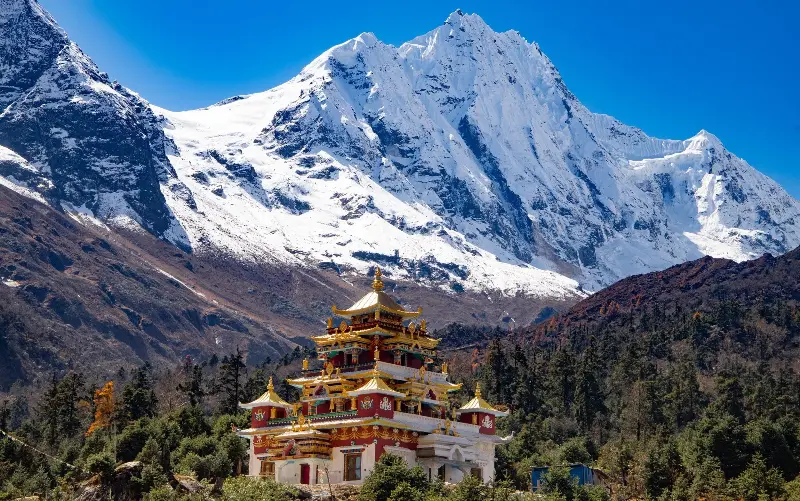
Nepal is the mountains, and more than the mountains. The jagged peaks of the high Himalayas run along the north edge of this small, landlocked country like a seam, laced with breathless trekking trails that draw hikers in their thousands – but that’s only part of the story.
The foothills of the Himalayas – the so-called Middle Hills – are dotted with medieval townships studded with intricate religious architecture that would give Tuscany a run for its money.
Then there’s Kathmandu, a fairytale city of tangled bazaars and hidden bahal courtyards, dotted with some of the world’s most spectacular Hindu and Buddhist temples.
Where the mountains meet the plains, you’ll find the Terai – a sprawl of tribal villages, trading towns and densely forested national parks stalked by Bengal tigers, Indian elephants, gharial crocodiles and one-horned Indian rhinos. Guided walks, jeep safaris and canoe rides will get you within inches of the wildlife.
It’s a beguiling package, attracting growing numbers of adventurous visitors – tourism to this former royal kingdom grew by 13 per cent in 2024.
Nepal holds ten of the highest mountains in the world, and though many visitors are drawn by the epic heights of Mount Everest, there are currently hundreds of mountains open for expeditions throughout the country.
To combat overtourism on the famous trek, the Nepalese government recently announced it will waive mountaineering permits to 97 other peaks for the next two years.
Whether venturing to these under-explored summits or labyrinth-like bazaars, there is plenty to tempt travellers to explore less-explored corners of this land of mountains and magic; here’s where to start.
Where to go
Kathmandu
Before you sprint for the mountains, take a few days to soak up the timeless rhythms of Nepal’s capital – the grandest of three feuding city-states that jostled for control of the Kathmandu Valley until the unification of Nepal in 1769.
Kathmandu is a city to explore on foot, getting lost in tangled medieval markets and stumbling across secret courtyards and centuries-old stone carvings that would be hidden away in museums anywhere else in the world.
At the city’s heart is Durbar Square, crammed with one of the world’s most astonishing collections of royal palaces and temples. This is the spiritual heart of the nation, where butter lamps flicker, temple bells chime and a living child goddess appears on a balcony daily to bestow blessings.
Fringing Kathmandu are the towering stupas at Swayambhunath and Boudhanath, circled constantly by Tibetan Buddhist pilgrims.
The sensory intensity is offset by characterful hotels, shops selling anything you might ever need for your trek, and restaurants serving everything from wood-fired pizzas to Korean barbecue ribs in Thamel, Kathmandu’s traveller hub.
The Kathmandu Valley
Kathmandu shares its basin-shaped valley with rivals Patan and Bhaktapur – each with their own dramatic Durbar Squares and their own collections of towering, tiered temples, lavishly carved royal palaces and timeless monuments.
More ancient temples stud the valley floor, which rises to ridge-top lookouts such as Chandragiri, Dhulikhel and Nagarkot, offering visitors a first tantalising glimpse of the Himalayas.
Active travellers explore on foot, or by mountain bike, taxi or local bus, dropping into towns and villages that have changed only superficially across the centuries.
Pokhara
Travellers treat Pokhara like Nepal’s second city. This small country town owes its celebrity status to the mountains of the Annapurna mountain range, which soars over the town like a painted theatre backdrop.
Even non-hikers appreciate Pokhara’s laid-back vibe, good eating and tranquil setting by Phewa Tal lake.
Short local hikes will lift you above the landscape for front-row views of mountains such as Machhapuchhare and Annapurna I, while longer routes transport trekkers to such legendary destinations as Jomsom and Muktinath, the Annapurna Sanctuary and the Buddhist former kingdom of Mustang.
The Terai
Home to half of Nepal’s 30 million people, the dusty plains of the Terai feel closer to India than to the rest of Nepal.
Here, you’ll find magnificent national parks such as Chitwan and Bardia, where encounters with tigers are common, and sightings of crocodiles, rhinos or elephants are all but guaranteed.
Elsewhere, tribal villages preserve ancient art forms (with homestays offering deep immersion into the local culture) and revered temples mark the sites where the Hindu god, Rama, was married in Janakpur, and where Siddhartha Gautama, the historical Buddha, was born, in Lumbini.
The Prithvi Highway
The highway linking Kathmandu to Pokhara carves through deep valleys covered in tumbling rice terraces, providing access to white water rafting rivers and townships such as Gorkha, home to the palace-temple where Prithvi Narayan Shah – the king who unified Nepal – was born.
Above the highway lies Bandipur, a historic ridge-top town that blends Himalayan views and ancient Newari architecture with an almost European pavement-café vibe.
Nepal’s trekking regions
Nepal’s two most famous trekking zones are the Everest region, north east of Kathmandu, and the Annapurna region near Pokhara.
Both offer close-enough-to-touch views of 8000m-plus peaks, and excellent trekking infrastructure all the way up to the base camps used by the world’s top mountaineers.
But these are just appetisers for the hundreds of miles of trekking trails weaving across the rest of the country. Close to Kathmandu, trekking routes through the lofty Langtang Valley are accessible by bus or 4WD, while jaw-droppingly beautiful Manaslu is reached via the Kathmandu–Pokhara road.
Easy-to-obtain permits, experienced guides and porters, and inexpensive teahouse lodges lining the most popular trails make Nepal one of the easiest places in the world to trek.
Expert-led agencies can get even first-timers to the top of Nepal’s trekking trails, with the promise of a warm bed and a hot meal at every overnight stop.
With expensive climbing permits, mountaineering expeditions scale the highest peaks, supported by Sherpa porters and guides, while camping tours trek through the high-altitude deserts of Mustang and Dolpo, where ancient Buddhist villages from the days of the Salt Route spill from the dust-coloured landscape.
How to do it
Where to stay
In Kathmandu, backpackers throng hip hostels such as Flock and pocket-friendly guesthouses such as Thamel Eco Resort and the International Guest House.
Moving upmarket, the garden-ringed Kathmandu Guest House has been a Kathmandu landmark since 1968, while the Yak & Yeti Hotel sprawls around a Rana-era mansion and super-stylish The Dwarika’s Hotel recreates the grandeur of a Newari palace.
In Pokhara, guests love the imaginative style – and views – at Temple Tree Resort & Spa and the lakeside Fish Tail Lodge, while Hotel Adam is the top choice of budget travellers.
In Bandipur, seek out the iconic Old Inn, spread across a maze-like Newari townhouse.
How to get there and how to get around
Flying to Kathmandu usually involves a change of planes in India or the Middle East. On arrival, buses and chartered taxis or 4WDs can get you to most places in the Terai and Middle Hills, but the high mountains can only be reached on foot. Access trailheads by bus or 4WD, or on domestic flights to high-altitude mountain airstrips.
When to go
Nepal has a monsoon climate, with heavy rainfall from June to September or early October. The peak trekking season runs from October to November, with a second trekking window from February to March, before temperatures soar ahead of the monsoon. Winter trekking is possible too, but it can get very cold at altitude.
What to book
Outdoors Nepal
For a sampling platter of Nepali experiences, G Adventures offers a 12-day luxury circuit around central Nepal, with Annapurna trekking, a Chitwan safari, Seti River rafting and Kathmandu Valley sightseeing from £2,815, including upscale accommodation and domestic flights (international flights are extra).
Luxury trekking
Abercrombie & Kent takes the Nepal experience into luxe territory. Tailor-made 12-day Lodge to Lodge treks around Everest start at £11,995, including local transport, Kathmandu Valley sightseeing and accommodation in luxury trekking lodges (international flights are extra).
Everest and more
Intrepid Travel’s Everest Base Camp Trek crosses Nepal over 15 active days, rising from Kathmandu to the basecamp used by mountaineers bound for the summit of Mt Everest (Sagarmatha). Packages including Kathmandu hotels, domestic flights, guides and porters and teahouse accommodation along the trails start at £1195, without international flights.