



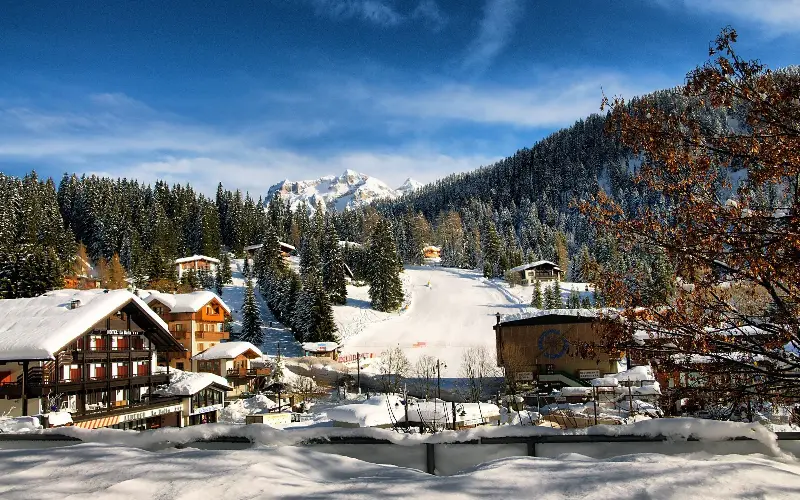
I may be about to incur the wrath of Italy’s old-money elite. Because I have a secret for you – and that secret is Madonna di Campiglio.
This is where Italy’s quietly wealthy families come to ski – leaving flashier types and tourists to hit the slopes at better-known Cortina d’Ampezzo, so beloved by international A-listers. But that may be about to change with the launch of a new hotel in town.
Casa Cook Madonna opened officially before Christmas and I was one of its first guests.
It would be easy to walk past the entrance. Other hotels in town preen with their carved wooden shutters and brightly painted folk designs – proudly displaying their four-star status.
But, with its simple black stone exterior, Casa Cook seems instead to hide away. Inside, too, it breaks with tradition: the lobby is a bar and lounge area decked out in Bauhaus modernist style (with a tiny check-in desk hidden round the corner). Rooms come with marble sinks, waterfall showers, and 3m-wide windows that would make other ski hotels seem dark and pokey.
“Casa Cook is something different for us. It is our first experience of an international brand,” Alberta Voltolini from the Madonna di Campiglio tourist board told me.
Historically, this has been a ski resort run by Italians for Italians, and still around 50 per cent of winter visitors are domestic. But, Voltolini believes, this new hotel could change that. And if it does attract more British visitors, that can only be a good thing for us. Because, as I learned, Madonna di Campiglio (simply Madonna, as the locals call it) is a spectacular place to ski.
Casa Cook is less than a five-minute walk to the nearest gondola but there are stations dotted across town, so no matter where you stay you won’t be far from one.
Once on the slopes, there is a good array of pistes to explore. Your ski pass (adults from €323 for five days) gives you access to 156km of interconnected runs across the three ski areas of Madonna di Campiglio, Pinzolo and Folgarida-Marilleva.
“Madonna is great because you can ski from place to place, whereas in Cortina you need to take a shuttle bus to connect ski areas,” Giorgio Zoanetti, a local instructor, told me.
As an intermediate skier, the resort was ideal for me. It is dominated by cruisey blue and red runs perfect for practising swooshing turns. It’s good for beginners too, with a dedicated learners’ area. There are some challenging black runs (including the Canalone Miramonti, a World Cup slalom run) but experts will find their choice of slopes somewhat limited. As for snowboarders, there’s the impressive Ursus Snowpark, generally considered one of the best in Europe.
The slopes were relatively quiet in late December – although Zoanetti warned that they do get busy over the Christmas period and during Carnevale (an Italian pre-Lent holiday).
Luckily, Madonna has a plan for that. Starting this season, it will be limiting ski pass sales on peak days, including December 28 to January 5 and Carnevale week February 15 to 22 (the first Italian ski resort to do this). On these days, lifts and slopes will usually open around an hour earlier, creating more opportunities to beat the crowds.
In a similar vein, the resort will shut one of the slopes (Vagliana) at noon and regroom it. That means that from 1pm, skiers can leave their lunches to hit snow as fresh as if it were the first run of the morning – weather permitting of course.
All of this is designed to ensure visitors continue to enjoy the premium experience that Madonna di Campiglio has offered until now. And, given the clientele, that makes sense.
“Our guests are elegant but sporty,” Voltolini told me. “Maybe we don’t get actresses and starlets, but lots of important Italian business owners come here because it’s more private than other resorts.”
Zoanetti added: “Lots of wealthy people from Milan and Brescia have second homes here. They come for the weekend to ski.”
Despite this, most of the mountain bars and restaurants remain rustically charming, serving hearty portions of canederli dumplings (made of bread, cheese and meat) and hearty stews with polenta.
Here, too, Casa Cook is trying to do something different. Its menu was designed by three Michelin-starred chef Jacob Jan Boerma; it plays on local flavours but is unashamedly modern.
Post-skiing, we feasted on creamy salmon-avocado tartare and seabass carpaccio spiked with zesty orange as well as a local ravioli with earthy forest mushrooms.
Breakfast, too, was an elegant affair. You can order hot dishes such as perfectly poached eggs royale and pillowy omelettes after grazing on the buffet of cream tarts, Italian cheeses, and hams.
And there’s no need to worry about children putting sticky fingers on your croissant, as the hotel is adults-only.
“We expect most of our guests will be international and many will already have stayed at a Casa Cook hotel,” says general manager Davide Sbardellini.
The brand started life as the upmarket, design-led (but still affordable) arm of Thomas Cook, known for its package holidays, although now it is owned by Goldman Sachs Asset Management. Casa Cook Madonna marks the group’s first foray into the mountains, as it has only done beach clubs until now.
However, the hotel has the same sense of seclusion and creature comforts as its sibling properties. My destination-specific favourite of those creature comforts? A partnership with ski rental shop Olimpionico Sport 2, which means your boots and skis are dropped off and collected at the hotel, rather than having to lug them across town.
As for getting there, if you aren’t a Milanese entrepreneur with a second home in town, you’ll most likely have to fly. Bolzano and Verona airports are a 1h45- and 2h15-minute drive away respectively. There’s also a Flyski Shuttle from the airports of Verona, Bergamo and Milan.
On my final day, I spent the afternoon meandering Madonna’s pretty pedestrianised centre, perusing antique shops, cheesemongers and chocolateries. Cortina might have Dior and Louis Vuitton, but the A-listers can keep all that.
Marianna Hunt travelled as a guest of Casa Cook Madonna, which offers doubles from €280 (£243) in winter, and Trentino Marketing.