



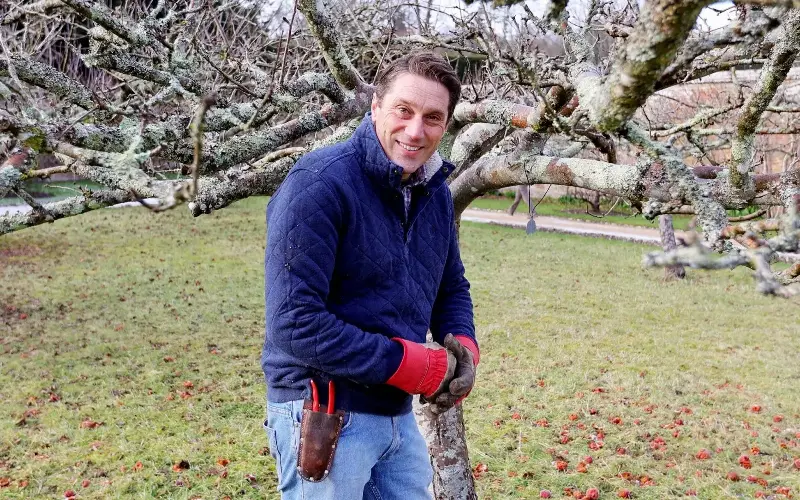
Fruit trees work incredibly hard for us, providing beautiful blossom in spring and a delicious bounty later on. Pruning them correctly is the least that we can do to show our appreciation, but some gardeners have a deep-rooted fear of pruning, perspiring at the thought of removing the wrong bit or by wielding those secateurs at an ‘incorrect’ time of year. These pruning-based palpitations can be treated quite simply: by understanding how your apple tree grows and by following a few simple steps.
When and why to prune
Established, free-standing apple trees should be pruned every winter to keep them healthy and productive, and to maintain the tree at a manageable size in terms of scale and the practicalities around picking fruit. Maintaining an open-centred crown with well-spaced branches will also reduce disease and damage to the branches.
Your apple tree will be grafted onto a rootstock – the part of the tree that includes the roots and lower trunk, which governs the size of the tree. The scion is the young shoot or bud which is grafted or fused with the rootstock to determine characteristics, flavour and cultivar/type of the apple tree, i.e. Cox’s Orange Pippin, and is associated with the main canopy and stems of the tree.
When buying an apple tree, do pay attention to the rootstock that your tree is grafted onto, as this will save a lot of heartache in the long run. The table below illustrates the height that your tree can reach, depending on its rootstock – however, an annual prune will help to keep your tree compact and aesthetically pleasing.
The aim of winter pruning is to maintain an open-centred, goblet-shaped crown with well-spaced main branches radiating from the trunk. This allows light to reach all parts of the tree and ensures good air flow through the canopy, resulting in better-quality crops and fewer pests and diseases.
Winter pruning should be carried out while the tree is dormant. Dormancy occurs after leaf fall, usually November, and before new growth (bud burst) in early March. The timing of dormancy will differ depending upon where you garden in the country: trees growing in the north will often have a slightly longer dormant period.
Step-by-step pruning guide
Golden rule
Remove no more than 20 per cent of a tree in one year. You’re aiming for a natural-looking, symmetrical and balanced canopy, and to provoke a mild response from the tree following the prune. If you remove more than 20 per cent, you may encourage an explosion of new growth, resulting in a poorly shaped tree and hardly any apples for a year or two. I’ve seen many “bad hair day” trees that have been gone at too hard over the years and result in poor cropping and an ugly shape. Remember, there’s always next year, but you can never stick a branch back on!
To rejuvenate a tree, stagger this process over several years to maintain a productive and balanced canopy which is easier to manage.
Step one
Take off any old and shrivelled fruit; some of these fruits may be diseased and it’s not worth the risk of keeping them around the tree. These should be put into a black bin or incinerated. Any remaining, healthy fruit should be composted or put out on a bird table.
Step two
Remove around 80 per cent of water shoots, or last year’s growth. Cut them off flush with the junction with the larger stems, focusing on upright growth. Clear out the centre of the canopy to improve air circulation and leave any that are growing at an angle or those that will fill in a space in the canopy. Vertical growth will become vigorous and compromise the shape of the tree. More horizontally angled growth will be slower growing and more likely to produce fruiting buds.
Step three
Remove any dead, diseased or crossing branches (to avoid rubbing and wound creation) as well as crowded areas, to allow plenty of light and air around the branches.
Step four
Look for any downward-growing branches low on the tree that receive little light and could cause an obstruction. Prune to a more upward-growing branch or back to the main trunk. When these branches are laden with fruit they become difficult to work around and will produce inferior fruit.
Step five
Keep standing back and assessing where you cut next. You want to achieve a balanced canopy that’s not heavy on one side or the other and is visually appealing. Your apple tree needs to look symmetrical and be an integral garden feature, rather than a butchered and stumpy tree with a totem pole-like presence in the garden.
The tools for the job
Most fruit pruning can be carried out by using a sharp pair of secateurs and a folding pruning saw. I have always been a fan of Felco secateurs as they are easy to maintain and last for a very long time. Many garden centres will sell this brand and will allow you to try the different sizes and styles to find one that suits you. You’ll be using this tool on a regular basis, so the ergonomics are crucial to avoid strain and injury. These secateurs are more expensive but to my mind are worth the investment.
I am also a long-term fan of Silky pruning saws. These folding saws are easy to carry around in your pocket and although they are very sharp they can be folded away when not in use to stay safe. Blades can be replaced when they become blunt. The folding and angled feature of the saw allows you to make cuts in congested areas of the tree and cut close to the junction of the branch.
Problem solving
When pruning, you may notice signs of apple canker on the stems – affected growth should be cut out where possible. Canker presents itself as sunken areas on the bark or exaggerated wounds that can secrete sap in the spring, causing dieback of branches and young trees. This fungal disease should be removed and incinerated to avoid spread. Cut back to a healthy shoot or branch.
Lichens and other growths are more noticeable in winter, but these do no harm. The presence of lichen around the branches of your tree is often a sign of clean air and should be welcomed rather than seen as a problem.
Flowers and young developing fruit can suffer late frost damage in spring, which may affect fruit production. Although a lack of fruit can be down to poor pollination, those sharp, spring frosts can be the reason for a poor yield in certain years. Where practical, cover the blossom and young fruit with fleece to offer extra protection.
Be aware of biennial-bearing apple trees, when a tree crops unevenly, producing a bumper crop one year followed by a poor crop the next. This pattern is due to the cultivar or type of apple, so if this is a pattern that you’ve noticed over the years, there’s little that can be done and it’s certainly not your fault.
Mistletoe can grow well on apple trees and should be seen as a benefit; however, this saprophytic plant can overwhelm trees and should be thinned (ideally around Christmas time) to inhabit no more than 20 per cent of the tree.