



Ever since David Attenborough’s understandably breathless excitement on his 1979 Life on Earth series, an encounter with a mountain gorilla has been high on many a wish list.
Our second closest relatives after chimps (they share 98.3 per cent of our DNA), they are only to be found in the forested highlands of Rwanda, the Democratic Republic of Congo and Uganda – the latter having, as it were, the lion’s share of them.
Even in the Ugandan highlands, however, they are not easy beasts to find. The numbers might gradually be growing, but this is very much an endangered species with, at the last count, just over 1,000 still living in the wild. Not surprisingly, even when you reach their remote habitats, they can still prove elusive.
To find gorillas, in fact, you need an entire team. At Uganda’s Bwindi National Park, I find guides, trackers and porters, all of them dressed in camouflage fatigues. Some carry machetes, others rifles. Of course, they would never shoot any animals, but they might fire into the air to scare off rogue forest elephants. And then there is the (thankfully unlikely) possibility of soldiers coming over the border from Congo – we’re looking for gorillas here not guerrillas, after all.
It is the trackers who know where to find them. Unlike the big cats on the savannah, there are no devices on gorillas and their trackers are human, out in the forest almost all of the time and so able to tell the guides where to lead their group. It is the trackers, too, who over a period of two to four years habituate the gorilla families to human contact, gradually edging closer to them until they perceive humans as just another creature in the forest.
And it is quite a forest. The Bwindi Impenetrable Forest National Park, to give it its full title, lives up to its name. In 321 sq km of dense forest, I find myself scrambling through shoulder-high vegetation, sliding down steep muddy banks and scrambling up them again, chased on occasion by vicious ants (not something you want in your socks).
This was, I was later informed, a trek of “moderate difficulty”. The altitude of around 2,000m can leave you breathless, too, and none of it would be manageable without the porters who haul people up hillsides that I’d swear are almost vertical. It’s a superhuman task, but they can take even the least able to attain their goal. Shortly after I set off, another party took a woman strapped onto a stretcher, with a team of 16 taking turns to carry her. Such is the hold of gorillas on our imaginations.
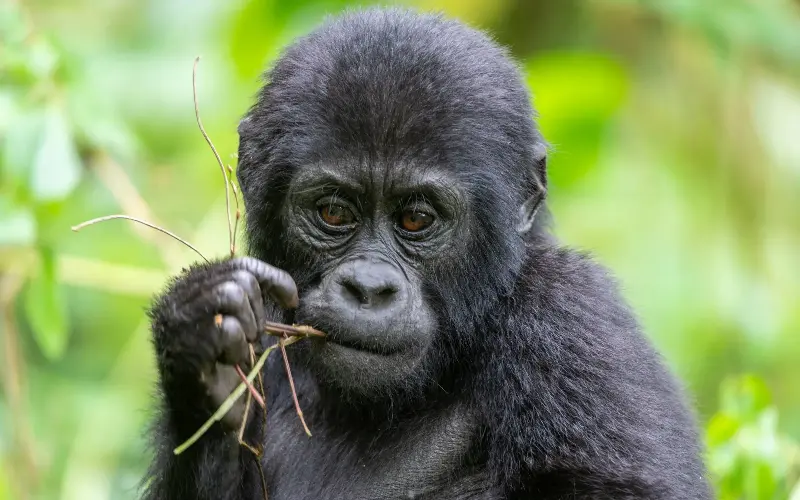
My small group of seven is lucky and, after about 45 minutes, we arrive sweaty and muddy to find the Rushegura family. Unmoved by our disarray, they gaze at us solemnly, while continuing their normal rhythm of feeding and grooming, resting and playing.
This is the biggest family in the region with 17 members, including two silverbacks (one dominant male, plus his brother, who may at some point challenge for the leadership or start a new group of his own). There are numerous females, some with very young babies clinging to their backs, and plenty of juveniles.
There is an atmosphere of immense tranquility. Everyone is busy feeding (being 98 per cent vegetarian, the rest of the diet being those ants, they need 15-20kg of greenery a day). And, though we’re told not to get too close, no one has told the gorillas this. Taking a liking to a plant behind you, the big males will walk determinedly past, almost close enough to touch.
Gorillas are social creatures, with each other and even, at times, with us. The very young are immensely playful and curious, watching us with big eyes and sometimes daring to come and give you a pat. (Occasionally, older members of the family want to do the same, but this is not so much fun – they don’t, you might say, know their own strength.)
The juveniles meanwhile just want to show off and start competing with each other to see who can turn the most somersaults as they scramble down the hills. As we are leaving after our hour (strictly adhered to because, my guide Amos tells me, the family need their peace and privacy), I find myself almost falling over a young female as our paths literally cross. She’s intent on a plant she’s spotted in the distance and I’m trying not to slip over in the mud. Her fur brushes gently against me. It will be, as Amos says, an everlasting memory.
Indeed, it is. Gorilla tracking is not, though, for the faint-hearted, and I am delighted to peel off my dirty, sweaty clothing and sink into the bath provided in my room at the charmingly rustic Mahogany Springs Lodge. Other creature comforts include a laundry service, a wood fire, a hot water bottle at night and cleaning my boots ready for the exertions of the next day. There’s even the possibility of a massage – not, perhaps, what you might expect in one of Africa’s oldest and densest rainforests.
It’s not the only change in the forest. Lawrence Muruhuura, who works for Conservation through Public Health, has been studying the gorillas, their health, their behaviour and their contact with humans for the last 20 years. Just as it did everywhere, Covid brought its own challenges here, he tells me. When the trackers – they still visited daily so the gorillas didn’t de-habituate – first turned up wearing masks, the animals were alarmed and ran away.
Now, though, they are used to this and the very young have never seen humans without masks. Visitors still have to wear them as the gorillas can be affected by human diseases, such as colds and flu or skin diseases like scabies.
Had the lack of visitors made the young more curious about us when we reappeared, I wondered? “Possibly,” he replied, “but it could be simply that the gorillas are becoming more and more accustomed to us and are getting used to the idea that we’re all living side by side. Just think of Ruhondeza.”
Ruhondeza was, explained Lawrence, a silverback always known for being a bit slow – hence his name, which means “sleepy fellow” in the local Rukiga dialect. Head of the Mubare family in the Bwindi Park, and one of the earliest to be habituated after the park was first protected in 1991, he became less able to protect his family as he grew older and, after an attack by a group of non-habituated gorillas, he found himself alone.
He was thought to be well over 50 when he died, and his final months were spent living at the forest’s edge near the local community in Rubona village who kept an eye on him. When he died, he was buried with suitable honours near the park’s offices and his passing was widely mourned. It’s understandable – few of us can encounter a gorilla without feeling a heart-stopping connection to these mysterious cousins.
Fortunately, Uganda is making it ever easier to meet them. Their permit costs are far lower than Rwanda’s ($800/£605 compared to $1,500/£1,135) and now there is a direct flight to Entebbe from London Gatwick. In the meantime, the country’s president has said his aim is to treble tourism in the country.
Clearly, the gorillas will play a big part in his plan, though the other card up Uganda’s sleeve is that it is the only country on the planet to have not just the Big Five – lion, leopard, elephant, buffalo, rhino – but what they call the Big Seven, with the addition of the two main African primates, gorillas and chimpanzees.
Funnily enough, gorillas aren’t the only primates interested in getting to know us better. In Kibale Forest, where they specialise in chimp tracking, there are tales of one young male who became so adept at snatching items from passing bikes and scooters that he was exiled to a local zoo. Another story doing the rounds among Ugandan guides features a chimp who went into a shop and started trying on dresses. Apocryphal surely? But then I was shown a video…
Essentials
Audley Travel has an eight-night tailormade trip to Uganda from £8,500 per person (based on two travelling), including three nights in Murchison Falls National Park and three nights at Bwindi Impenetrable Forest. The price includes flights, transfers, accommodation, excursions, safari activities, chimpanzee and gorilla treks and permits.
Direct London Gatwick to Entebbe flights started in May this year with Uganda Airlines. There are four flights a week with prices from $750/£568 return.