



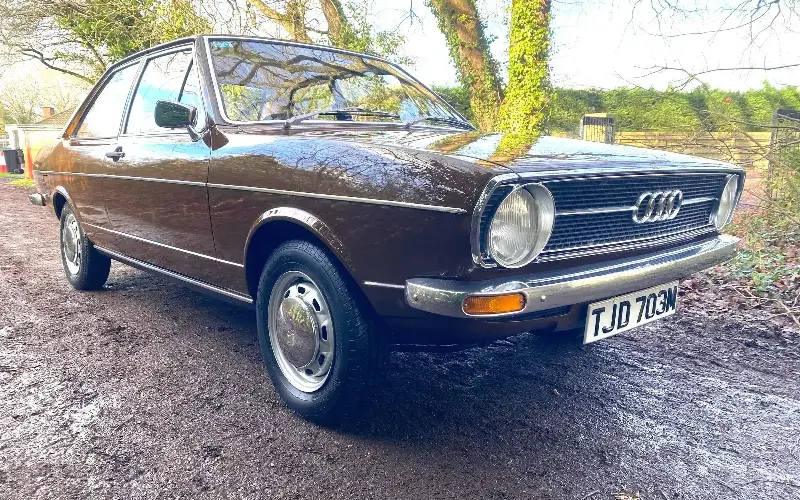
In 1973, a 1.3-litre 80L was not a cheap prospect, despite it being Audi’s entry-level model in the UK. At £1,275, the 80 was £25 more expensive than a Ford Cortina 1600GT 2-Door, and cost £58 more than a Morris Marina 1.8 TC Coupe. Nor did it boast a vinyl roof, Ro-Style wheels and other accoutrements that would cut a dash in the Berni Inn car park.
However, the typical Audi buyer would have ever so slightly disdained the Ford, the Morris and all motorists who valued go-faster stripes over genuine quality. The 80L shunned frivolity (apart from its fascia decorated in wood-effect plastic) and the owner had the distinction of driving a car embodying “new dimensions in design and engineering”.
The 80 also represented one of the most radical changes to a brand’s image in motoring history. Ten years earlier, the now revered four-ring badge was mainly associated with small, cheap two-stroke vehicles that emitted clouds of blue smoke. By 1973, the Audi 80 was a car for architects, town planners and anyone who appreciated engineering integrity over fancy wheels.
The four rings originally stood for the marques of the Auto Union: Audi, DKW, Horch and Wanderer. After the Second World War, only DKW was revived and by the 1950s its two-stroke saloons were a first car for many German families. However, when Volkswagen acquired the Auto Union in 1964, the two-stroke format was already regarded as an anachronism and there seemed to be no prospect of future cars bearing the four-ring badge.
But in 1965, Auto Union introduced the 1.7-litre four-stroke F103. To further mark a change from the past, the DKW marque was no more, as the new model revived the Audi name. The F103 rapidly proved very popular with German motorists who wanted a car that was a cut above a Ford or an Opel.
In 1968, Audi consolidated the F103’s success with the larger 100 and commenced work on its successor. The resulting 80 B1 debuted in July 1972, and its styling was clean-cut without being clinical: “Meticulous design down to the smallest detail,” claimed Audi. Power came from new 1,296cc and 1,470cc overhead-camshaft engines, the former giving the B1 a 92mph top speed.
As with its predecessor, the B1 was front-wheel drive and, as part of the Volkswagen Group’s economies, the Eighties engines and much of its bodywork would be shared with the 1973 Passat. Your friendly local Audi dealer could boast about the 80’s suspension with negative scrub radius and how it was Car of the Year 1973.
By then, a growing number of motorists in this country regarded Audis as worthy alternatives to Alfa Romeo, BMW, Lancia, Triumph and Rover. UK sales of the 80 began in March 1973 and this newspaper noted how its suspension meant one test car “pulled up safely after being braked heavily on a greasy surface with one brake disconnected”.
When Autocar tested the LS version, it found the 80 was not cheap by the standards of its rivals, “but its high standard of finish and execution should ensure a welcome from those who appreciate technical innovation and quality engineering”. Meanwhile, Audi boasted that the 80 was “designed to offer you the best of everything in a car”, while the L version “supplements economy with luxury”.
Luxury as defined by the 80L meant a glovebox lamp, a cigar lighter, a clock, “padded armrests front and rear” and a “nonglare rearview mirror”. If you wanted a fuel-cap lock and an intermittent wiper setting, there was the more expensive GL, but few L buyers were concerned with mere frivolities. It was an Audi and that was all that mattered.
The 80 B2 replaced the B1 after the last of 1,103,766 units departed the factory in August 1978 and, as with many entry-level models, the L’s survival rate is very limited. The car data website How Many Left suggests that only five remain on the road, making it rarer than the average Quattro.
Today, this example owned by Ian Poulter is a fascinating reminder of the B1s that tempted Britons away from British Leyland, Chrysler UK, Ford and Vauxhall. In August 1972, The Telegraph’s motoring correspondent noted: “Despite its unfamiliar and perhaps effeminate-sounding name, the German Audi has considerable success in Britain.” It was indeed another world.
We use the fascinating howmanyleft.co.uk for figures of surviving examples but some cars present more of a challenge than others, so the figures are rarely authoritative. Some pre-1974 records were lost before the DVLA centralised the process, while some cars have their model type misnamed on the V5 registration documents. A further issue is the omission of the exact model name or generation, or distinction between saloon and estate bodystyles.