



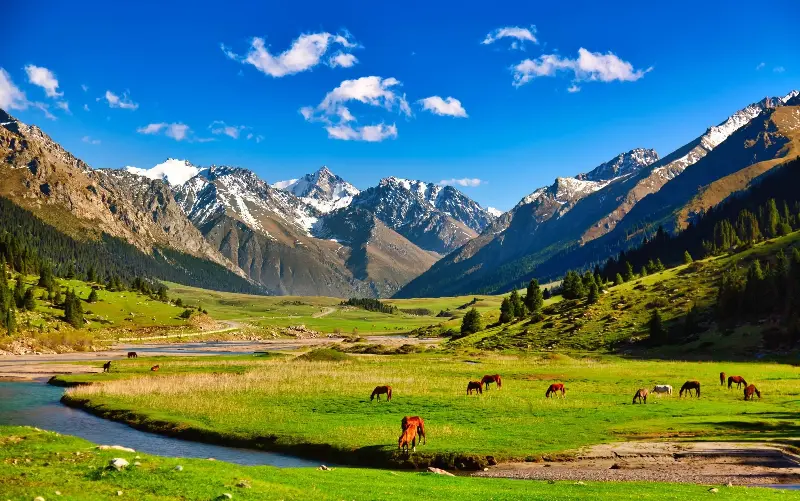
If Sleeping Beauty had woken up in Kyrgyzstan, she’d have been very confused. It would have taken her months to work out where she was. Everything’s written in Cyrillic, and there are alpine meadows, the deep-red canyons of Morocco, and perhaps even the odd Highland glen.
Then there are all those cowboys and minarets. Often, it seems that there are more horses than people. You can buy wolfskins at the airport, and Scotch at the garage. But this country can also be strikingly modern, with pervasive Wi-Fi, and even the odd brand-new Chinese motorway.
Soon, however, there are the unmistakable signs of Central Asia. In restaurants, one can order a whole lamb (for the equivalent of £150), or a sheep’s head. There are also the yurts – everywhere – and people hunting with eagles. But the real giveaway is the national sport, ulak tartysh. It’s violent (think polo-cum-Rollerball) and played with a dead goat. Welcome to The ’Stans.
Minarets and mountains
There’s never been a better time to go. Caught between Russia and China, Kyrgyzstan is surprisingly stable. There are also daily flights – via Istanbul – and the tours, booked locally, are exciting and inexpensive. Even better is the development. The guidebooks can’t keep up. Towns described a few years ago as “dowdy” and “Soviet” no longer feel like that. Kyrgyzstan has entered the age of plate glass and colour.
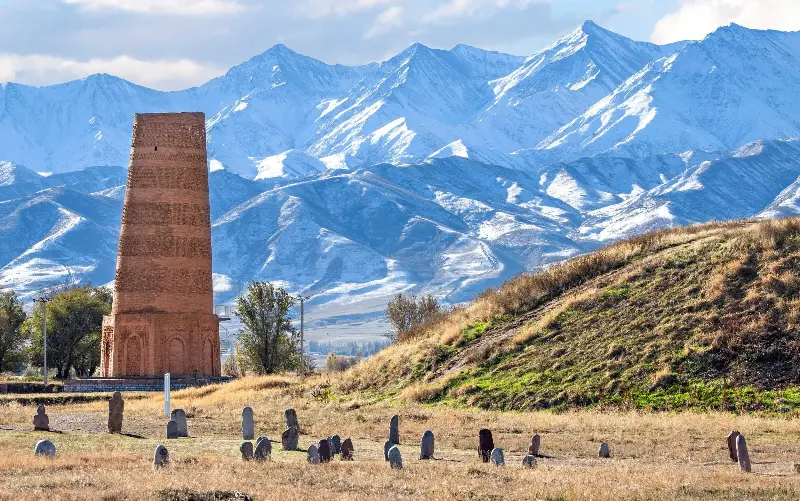
We, however, were soon immersed in the 10th century. Our family tour (costing £3,300 for three), covered more than 1,200 miles in 10 days, and began with the Burana minaret. It stands eight storeys high, but, 1,000 years ago, was twice as tall. At the bottom of the stairs was a local with a slightly surly golden eagle.
In a country that rises to more than 7,400m (24,400ft) above sea level, Burana is about as low as it gets (1,000m). Everyone has come pouring through these valleys: Arabs, Persians, Mongols, Kyrgyz and Russians. I particularly liked the things the ancient Karakhanids had left behind: giant heads (gravestones), this minaret, a sabre, tweezers and a dancing bunny pendant. Life, it seems, was both deadly and kitsch.
During our first few days, we drove around Issyk-Kul. It’s huge – about the size of Lincolnshire. It was like being by the sea, except walled-in by glaciers and alpine meadows. Our journeys here were long but were richly rewarded with gigantic waterfalls, canyons or huge mud-brick cemeteries like miniature cities (complete with mosques and medinas).
The canyons could be startlingly magnificent. Ak Sai looks like a whole section of the horizon peeled back and crumpled like paper. Meanwhile, Jeti-Ögüz is a meaty version of Mount Rushmore, a fabulous ox-blood red. Best of all was Skazka. An entire mountainside has been gouged out by the wind. It’s like entering a city of pink and orange monsters, created from some weird Neapolitan fudge.
A magical world
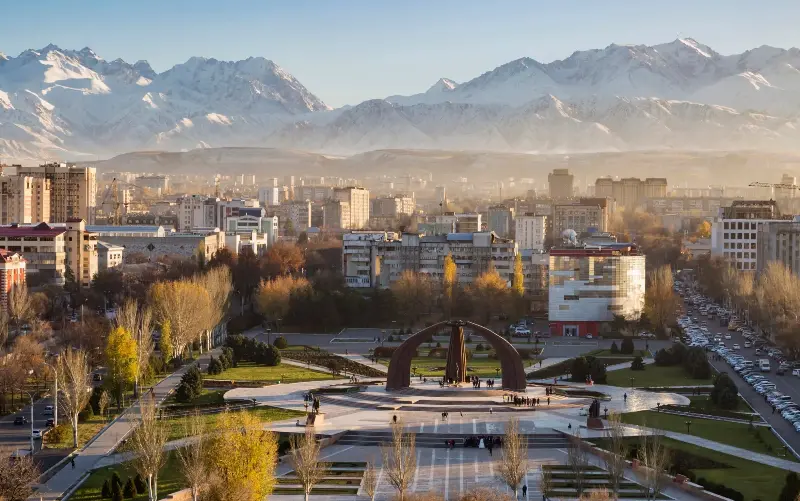
There were several real cities on this journey. All were laid down by Russian colonists in the 1800s. Bishkek, the capital, still feels too big for its population, and has vast empty streets like runways. But it’s a quirky place with its mini-forests, a gigantic flying saucer (the circus) and a few public buildings on a Moscow scale.
The other places felt more like overgrown villages. Being nomadic by tradition, the Kyrgyz have never truly filled their towns. But Karakol has a delightful Hansel-and-Gretel cathedral, made entirely from wood. Naryn has more of a pioneer feel, with its red mountains and a river like boiling cement. Its attractions include the bazaar, a statue of Lenin, and an old Russian tank.
It always felt good to be heading off into the mountains. These were long, exhilarating drives, covering hundreds of miles at an altitude of more than 3,000m. Our driver, Bekz, was from a nomad family and was faultlessly kind. He picked his way along river-bed roads with great skill and had a keen eye for eagles and marmots. He also spoke reasonable English, which he’d learnt picking asparagus in Dundee.
At altitude, a magical world opened up. We passed through huge herds of horses and yaks, and villages of yurts. Up here, the cowboys – or chabandar – often rode bareback with packs of dogs just like wolves. It was odd, the things you’d find abandoned on the mountainside, such as old railway carriages or collective farms. Then, with a bit of hiking, extraordinary turquoise lakes appeared, fed by the ice.
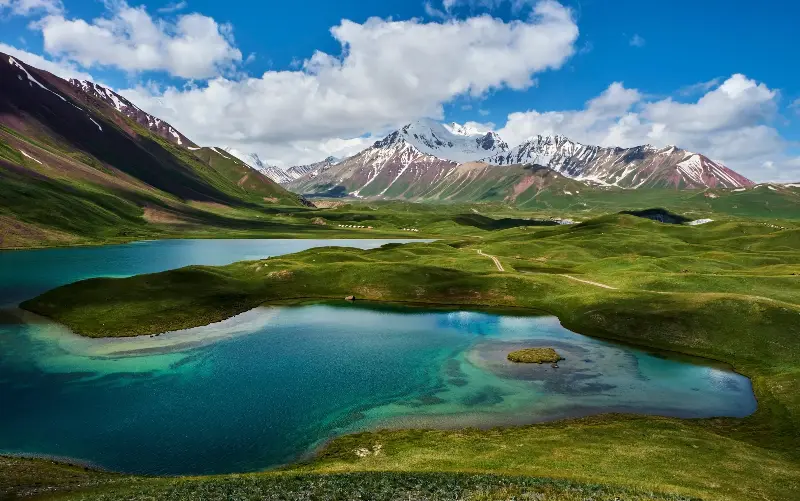
To reach one lake, Ala-Kul, we needed horses. First, we had to ascend the Altyn Arashan valley; three hours by horse and an hour on foot. My horse was fine until the ride back. Five minutes from home, it bolted, taking me through a conifer. Eventually, I managed to rein it in and rode back to the tree, where my glasses were still hanging in the branches.
Eccentric accommodation
Our accommodation was always interesting. One night we spent in a magnificent mountain refuge, called Elza’s, with its own hot springs. We also spent three nights in yurts, which is like sleeping in a great woolly hatbox. Last thing at night, one of the cowboys’ children would come in with a bucket of coal and stoke the stove.
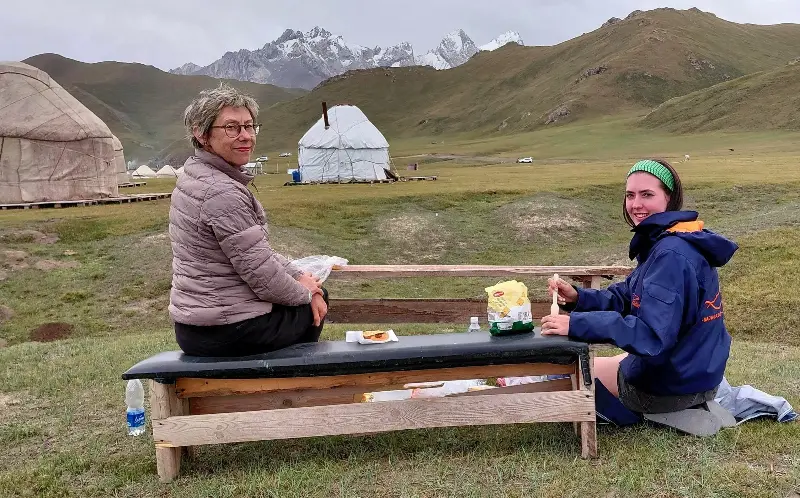
Mostly, we stayed in hotels. The best was the Khan Tengri (in Naryn), which had fountains and gardens and a hint of grandeur. The others were spotless if slightly eccentric, with all their Barbie-pinks and chrome. At one, we were the first-ever British guests and were challenged to a game of chess.
Perhaps my favourite place was a homestay. Kalmak Ashuu was hidden away up a lush green valley (very Swiss) called Chong Kemin. The elderly owners were like characters from a nursery rhyme, and – inside – their home felt like a huge tent, furnished with enormous felt rugs and a 20ft sofa.
For our last few days, we headed south along old Silk Routes. They’re as busy as ever, with car transporters rumbling up from China. A two-day detour took us up to Song-Kul, another lake at more than 3,000m above sea level. Nibbled, treeless and smoothed by the wind, it’s a beautiful, simplified world. This is how golf courses would look on Mars.
Heading south, the landscapes became ever more extreme: wilder, grander and higher. We left the highway, and drove 80 miles along dirt roads into the Tien Shan range.
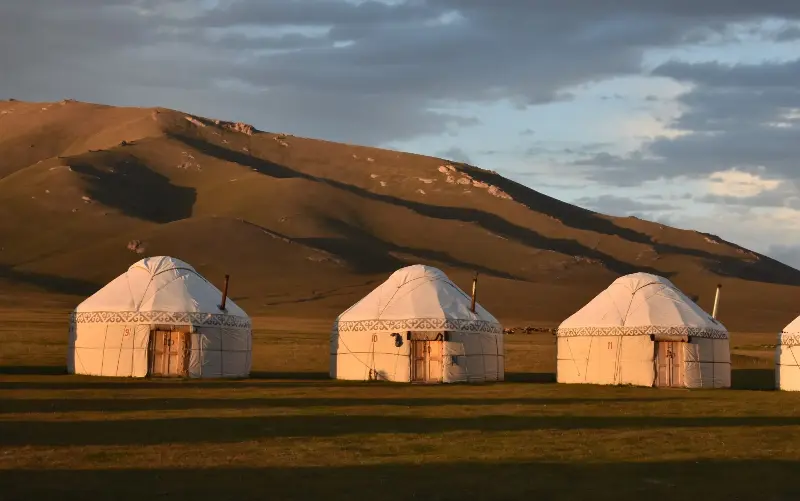
Beyond lay China, and there was an army checkpoint at 3,400m. In this great nothingness, children appeared at the roadside, selling fermented mare’s milk in old Fanta bottles, as if we needed fortification. We camped at the head of the valley, and then hiked up to our last lake, Kol-Suu.
It was a fitting end to our journey. It’s said the lake was formed in the 1980s by a landslide blocking off a canyon. You could say it’s like Kyrgyzstan itself, both postcard-pretty and utterly awesome. We loved it and could hardly tear ourselves away. What a perfect place to ponder our world (unless, of course, you’re Sleeping Beauty).
How to do it
John Gimlette travelled as a guest of Kyrgyz Trip. A 10-day tour costs £1,100pp (based on three travelling), and includes all meals, transfers, entrance fees, accommodation and a driver/guide, but not flights. Both Pegasus and Turkish Airlines operate London-Bishkek flights via Istanbul from around £900 return.