



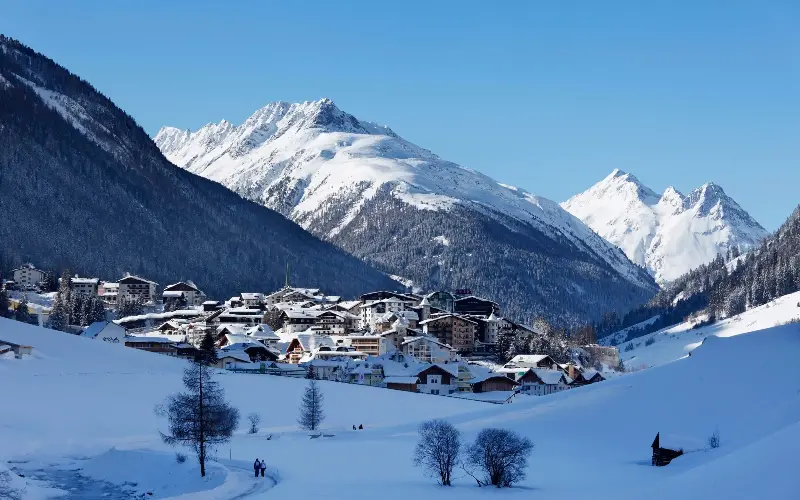
Ischgl has long been a premier Austrian destination for German visitors, but in recent years Britons have caught on to the quality of its pistes and standout events.
Its famous Top of the Mountain concerts, which bookend the season, have attracted international stars including Elton John, Bob Dylan, Tina Turner, Mariah Carey, the Beach Boys and Kylie Minogue, while its closing “Spring Blanc” festival adds four major concerts alongside sun-downer parties and dining experiences.
The slopes are snow-sure, scenic, sunny and mostly above the treeline. They are extensive, too: the 239km Silvretta Arena ski area crosses the Swiss border into the Engadin resort of Samnaun, making it ideal for intermediates who enjoy covering lots of ground before ending the day with some of the most renowned après ski in the Alps.
Stay on track with the essential facts from the resort below, and scroll down for our insider guide to a day on the pistes, expert ratings and advice. For further Ischgl inspiration, see our guides to the resort’s best restaurants and après ski.
In this guide:
Resort guide
An old farming village turned sophisticated tourist centre, Ischgl remains traditionally Tyrolean in style, albeit with some contemporary touches, including the Dorftunnel – an airport-style travelator that connects the two ends of the resort.
Three heavyweight gondolas whisk skiers up the slopes. One at each end of the resort serves the main mid-mountain hub of Idalp at 2,320m, while a third goes to Pardatschgrat at 2,624m.
Unlike many Austrian resorts, Ischgl not only offers hotels with high standards of cooking and prices to match, but also a wide variety of independent restaurants. For fine dining, the Paznaunerstube in the Hotel Trofana Royal has earned four Gault Millau toques, while refined mountain dining can be found at the contemporary Alpenhaus VIP and Gampenalpe.
Since the coronavirus pandemic, efforts have been made to clean up the resort’s image, though its après ski still caters largely to testosterone-fuelled males aged 30 to 50 – older than the revellers who pack into the Mooserwirt on the slopes above the famed party resort of St Anton. Even so, there is an enjoyably buzzing atmosphere throughout winter, and it is possible to escape the wildest of the partying by choosing accommodation away from the main street.
Other après-ski activities include a 7km toboggan run that drops 950m, open two nights a week, and the Ischgl Skyfly – parallel 2km zip-wires from Silvretta mid-station to the village, ridden with skis or board attached in a harness. MoonBiking tours are also available, while the resort’s Silvretta Therme spa has a large sauna complex, fitness centre and ice rink spread across five floors.
For 2025/26, Ischgl joins the international Ikon Pass network, partnering with over 60 ski resorts across the world.
Piste guide
Ischgl’s high altitude, combined with sophisticated snowmaking that outdoes almost anywhere else in the Alps, pretty much guarantees at least adequate snow cover over its long season (from late November to early May).
Two of the three main access gondolas whisk up to the centre of the ski area at Idalp (2,320m), while the Pardatschgrat gondola feeds into a network of lifts and runs that stretches across the Swiss frontier and down to the village of Samnaun at 1,840m.
The ski area’s 46 lifts are constantly being updated. The two-seater Velileck on Pardatschgrat, in situ since 1978, is now a six seater with weather hoods and heated seats; on the Samnaun side, the upgraded eight-seater Visnitz from Alp Trida to Visnitzkopf has heated seats and hoods, and carries 900 more passengers per hour than the four-person chair it replaced.
In addition, three similarly protected eight-seater chairlifts will be operating in the Silvretta Arena by winter 2026/27. The Höllboden C1 and Sassgalun C3 will be installed for 2025/26, followed by Höllkar C2 the year after.
With the exception of the lower runs immediately above the resort, nearly all pistes are above the treeline, so it’s best to head to those lower runs to avoid white-out conditions when the weather closes in.
Beginners
Beginners need to buy a full lift pass, and ride either the Silvretta, Fimba or Pardatschgrat cable cars from town up to the mountain base at Idalp. The ski school meets here and broad, gentle nursery slopes are served by a moving carpet, T-bar and chairlift.
After first turns, learners can progress to some marginally more challenging blue runs on the east side of the bowl. The runs down to town are red and can become icy and crowded in the afternoon rush hour – first-weekers are strongly advised to catch the gondola down at the end of the day.
Intermediates
With the Silvretta Arena’s 239km of extensive, snow-sure and sunny terrain on which to play, intermediates can have a ball here. Some of the blacks would be marked red in other resorts, and piste highlights include a glorious red of 1,000 vertical metres served by a giant cable-car, the Piz Val Grondabahn.
Expert and off-piste
There is an overall absence of truly steep slopes for experts – the most challenging run is route 14a from the top of the Greitspitz, with a gradient of up to 70 per cent – but the off-piste and touring opportunities with a guide are excellent.
Snowboarders
The Jeep Snowpark Ischgl is one of the best terrain parks in Europe. Its presence is a deliberate lure for all the 20-something snowboarders and twin-tip skiers who – music apart – might otherwise have considered Ischgl to be too middle-aged and expensive for their taste.
The park is one of the longest in the Alps, well maintained and constantly updated. It has a host of kickers, ramps and rails and is served by three chairs. Separate beginner, intermediate and king-sized lines are matched to varying technical skills. There is also a halfpipe and a boardercross course. Samnaun has the Obstacle Freestyle park, specifically designed for experts.
Who should go?
The atmosphere in the village and at the foot of the pistes is electric, making Ischgl a great choice for night owls who want lively après ski – particularly over New Year. Its restaurant scene is often overlooked, as is its terrain park, both of which are big draws. For skiers, the slopes suit mileage-hungry intermediates who enjoy covering lots of ground.
Where to stay
Ischgl has a wide choice of smart hotels – more than is typical of an Austrian resort – though prices tend to be higher than in the Tyrolean heartland of the Kitzbüheler Alps, with which Britons are more familiar. The most convenient places to stay are near, but not on, the main street, away from late-night noise and with mountain access lifts just a short walk away. For a more homely and personal atmosphere, consider one of the friendly two-star guesthouses in the nearby suburb of Waldorf, or a small apart-hotel in Mathon, a satellite village 4km from the resort centre.
How to get there
Ischgl is well served by UK-based ski operators, including Crystal (crystalski.co.uk), Inghams (inghams.co.uk), Ski Solutions (skisolutions.com), Snowtrex (snowtrex.co.uk), i-ski (i-ski.co.uk) and Skiworld (skiworld.co.uk), which mainly offer half board hotel packages. Innsbruck is the most convenient airport, and skiers can connect to Ischgl via Landeck-Zams train station. From here, a regular public bus (number 260) runs up the Paznaun valley, though services stop in the early evening.
When to go
Snow-sure Ischgl enjoys a relatively long ski season that typically starts in late November and lasts until May. As well as its lofty location offering excellent snow – the highest peak, Greitspitz, has a top lift station at around 2,870m – the resort has state-of-the-art snowmaking facilities for when the cover needs bolstering. The famous start- and end-of-season Top of the Mountain concerts (November 29, 2025, and May 2, 2026) attract an A-list of international stars. These are also periods for discounted ski passes. The second marks the start of the “Spring Blanc” celebrations, which also includes parties, winter sports and culinary events.
Know before you go
Essential information
- British Embassy Vienna: (00 43 1 713 1575; gov.uk), Jauresgasse 12, 1030 Vienna
- Emergency services: Dial 112
- Tourist office: See ischgl.com, the website of the Ischgl Tourist Association, for weather reports, lift status, webcams, traffic details and local event listings. Pick up maps, leaflets and other information from the office just off the main roundabout in the centre of town.
The basics
- Currency: Euro
- Telephone code: Dial 00 43
- Time difference: +1 hour
Local laws & etiquette
- Formal greetings are the norm when meeting someone, and you’ll hear ‘Grüss Gott’ (greeting the almighty), or the more worldly ‘Guten Morgen/Tag/Abend’, just about everywhere you go, and it’s customary to return the salutation.
- Tips are not included, nor is it usual to leave them on the table. After the waiter has given you the bill add roughly 10 per cent and ask for it to be added to the total.
- A simple thank you is ‘Danke’; ‘Bitte’ means both ‘please’ and ‘you’re welcome’.