



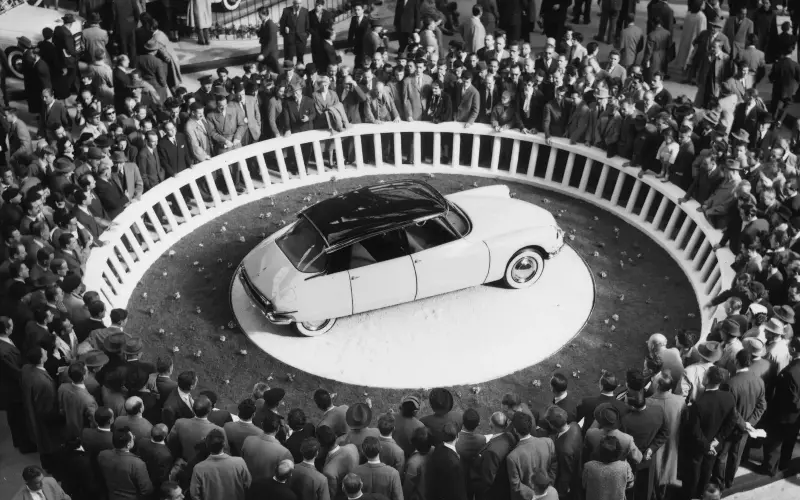
To most people, the name of Slough is less associated with cars than with Mars Bars, Thunderbirds, The Office and a not very complimentary poem by John Betjeman. It was also once home to one of the very few cars that deserved to be called “iconic”. From 1956 to 1966 one of the world’s greatest vehicles, the Citroën DS, was assembled at the French firm’s factory on the Slough Trading Estate.
Citroën opened its Slough plant on February 18 1926, following the McKenna Duties, which imposed a 33.3 per cent tax on foreign “luxury goods,” including cars. Kits were sent from France for assembly in the UK, with the finished product either for the home market or Commonwealth countries. By 1950, Renault followed Citroën’s example and, over the next 11 years, assembled UK-market 4CVs and Dauphines in Acton, west London.
The DS made its bow in October 1955, with a Slough-produced version eight months later. At least 51 per cent of its components had to be locally sourced to avoid import duty, so its wheels, radiator, 12-volt Lucas electrical system, Smiths instruments, fuel tank, paint and exhaust system were all from British companies. The first examples were exported to Australia and New Zealand.
Citroën, in its Slough publicity brochure, claimed that components were “selected to meet British taste and answer British requirements”. The model expert Jamie Piggott of the DS Workshop observes that this translated into an apparent need to neuter the design for the UK. He draws particular attention to the hide upholstery and to the “plank of wood on the dashboard to appeal to Wolseley owners”.
Such furnishings would hopefully deaden the shock of the Citroën’s overall appearance when compared with the average large British saloon. Underneath, the French car’s front-wheel-drive and idiosyncratic hydropneumatic suspension were light years ahead. Neil Stewart’s 1960 Slough-built DS is a prime example of a Citroën aimed at go-ahead and well-heeled barristers and surgeons. The price was £1,695 9s 2d, making the DS slightly more expensive than a Jaguar Mk2 with the 3.4-litre engine.
Citroën GB also applied the leather-and-wood treatment to the cheaper ID, with a detuned version of the 1,911cc engine, no power-assisted steering and a manual four-on-the-column gearlever, rather than the DS’s semi-automatic gearbox. Slough assembly began in 1958 and The Telegraph thought the ID had “fewer things to go wrong”. Paul Stevens’ father bought his 1960 Sherwood Green example new for £1,485 15s and his son inherited it 11 years ago.
Stevens finds his ID is constantly the object of curiosity, with people taking pictures or merely staring in amazement. As for its road manners, he says: “There is no synchromesh on first gear and it is pretty high geared. Sometimes I have to double-declutch. But the Slough-built cars are quite capable of motorway driving at 70mph-plus.”
Perhaps the most imposing vehicle to hail from Slough was the Safari estate. Piggott owns a 1964 Regency Red example, featuring practical features such as an integral roof rack and two folding seats in the luggage compartment. The Safari cost £1,698 5s 5d, compared with £1,306 for a Vauxhall Cresta PB Estate or £1,565 for a Humber Super Snipe Estate, but it was unique as a UK-built, front-wheel-drive, eight-seater. Citroën GB was far from hyperbolic when it described the Safari as “the most remarkable estate car”.
By September 1964, Citroën had ended complete assembly in Slough and used the works only for fitting the electrical system, painting and trimming. Its British operations had lost a considerable proportion of their export markets when South Africa and Australia opened their own assembly plants. In addition, the 1962 General Agreement on Tariffs and Trade (GATT) Conference meant reduced import duties.
The last hurrah came in September 1965, with the Slough-assembled DS Pallas; “the most magnificent Citroën ever made”. The new flagship boasted a 2,175cc engine, self-levelling Cibie quartz-iodine auxiliary lights and a rev counter. The top speed was 112mph and, naturally, the seats were trimmed in the finest leather available to humanity, although Citroën GB dispensed with the wooden facia.
At £1,977 3s 9d, the Pallas was slightly more expensive than a Rover P5 3-Litre Coupé for £1,935, but the two had very different images. The Rover was the sort of car John Steed from The Avengers might have favoured when his Bentley was being repaired. This 1966 Pallas from the DS Workshop was ideal for a villain from The Saint who wished to rule the world, or at least Elstree Studios.
Citroën closed the factory on February 18 1966, after building a total of 8,670 DS models, 1,933 of which were exported. The company found that selling French-built cars in this country meant an £80 price reduction and allowed it to offer a more elaborate line-up.
In all, according to the Citroënvie! website, more than 57,000 Citroëns were manufactured and assembled in Slough; from the early Type C to the final DS21. In between, the Traction Avant Light Fifteen, Big Fifteen and Big Six models, the 2CV and the unique-to-the-UK, 2CV-based Bijou coupé.
Shortly after the launch of the DS, the philosopher Roland Barthes famously wrote: “It is obvious that the new Citroën has fallen from the sky inasmuch as it appears at first sight as a superlative object.” He might have added: “And it landed in Slough.”