



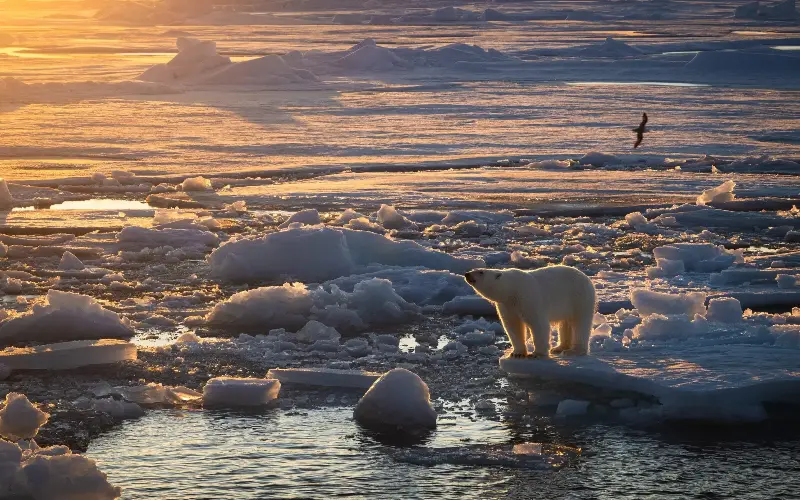
Polar bears are actually getting healthier despite shrinking sea ice, scientists have discovered in an unexpected finding.
For decades, researchers have warned that global warming-fuelled ice melt would prevent hunting opportunities for polar bears, leading to starvation and inevitable weight loss.
So they were surprised to find that polar bears on the Norwegian island of Svalbard are doing better than expected despite an increase in ice-free days.
Far from getting skinnier, after initial declines around 1995, both male and female animals have gained weight and body fat.
Researchers believe that improvements in the body condition could be down to the recovery of reindeer, walrus and harbour seals, which were previously over-hunted by humans.
They also suggested that sea ice loss may be driving ringed seals onto smaller areas of ice floes, which makes them easier to find and kill.
Jon Aars, from the Norwegian Polar Institute (NPI), one of the study authors, said: “The increase in body condition during a period of significant loss of sea ice was a surprise.
“If I had been told in 2003, the first year I started the work at NPI, that bears in Svalbard would have access to sea ice two months less on average from 2000 to 2019, and was asked what I would predict, I would say bears would likely be skinnier, and maybe that we would see effects on survival and reproduction, and the start of a population decline.
“And we see the opposite, bears are now in better condition, even though they are forced to be on land much more of the time, without the ability to hunt ringed seals.”
He added: “The most likely explanation why they still do well is that they are able to compensate for a shorter period on the ice by being able to use the resources on land.”
There are around 2,650 polar bears in the Barents Sea region surrounding Svalbard, and the population has remained steady, even though the temperature has been rising two degrees Celsius per decade since 1980.
Experts said mothers appeared to still be raising cubs successfully and there was no evidence of a decline in populations of young bears as might be expected during times of dwindling resources.
Polar bear populations
The findings differ from studies of other polar bears, which show Arctic sea ice loss affecting their condition and populations.
Report co-author Andrew Derocher, from the University of Alberta, said the study highlighted how different polar bear populations could be from one another.
“Bears in this region (Svalbard) appear to be experiencing short-term buffering to climate impacts because they hunt in areas with diverse and new types of prey, which helps explain why adult body condition has remained stable so far despite rapid sea ice loss.”
But he warned the resilience was temporary and said polar bears were making the best out of this situation, but were not adapting genetically.
For the study, the researchers used data gathered in 1,188 records of 770 adult polar bears, who were sedated and body measurements taken between 1992 and 2019, to compare changes in the “body composition index”, which indicate fat reserves and body condition.
Commenting on the research, Dr John Whiteman, Chief Research Scientist at Polar Bears International, said: “These results are positive in the short term: the body condition of Svalbard bears showed little overall change during 1995-2019 despite substantial sea ice loss.
“Several factors unique to the region could be helping the bears; they have a diverse prey base, giving them choices as conditions change, and allowing some of them to maintain remarkably small home ranges, reducing their energetic needs.
“Overall, while the big picture for conservation remains clear – polar bears need sea ice, which is disappearing due to climate change – this new study helps illustrate the substantial variation in how ice loss has affected bears thus far in different areas.”
The research was published in the journal Scientific Reports.