



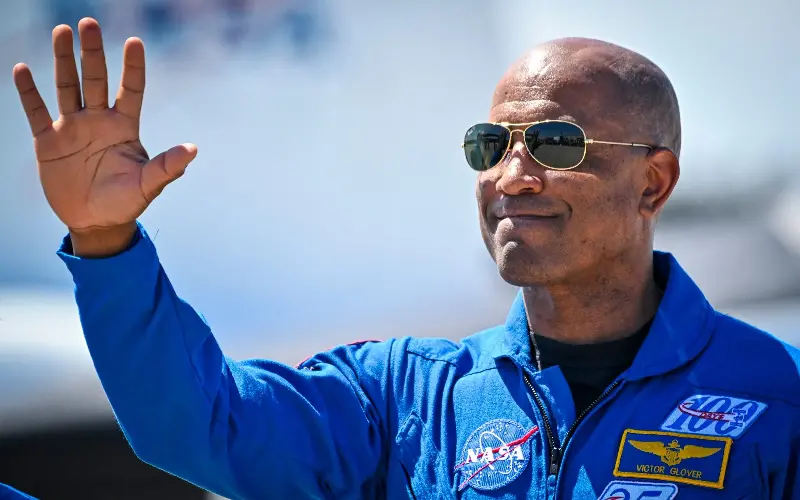
Nasa’s first black astronaut to the Moon says he’s making “human history, not black history”.
Victor Glover, the pilot for the Artemis II mission, which is set to launch to lunar orbit this week, said he wanted to “push in the other direction” so “we don’t have to talk about these firsts”.
The mission will send the first black person to the Moon, the first woman, Christina Koch, and the first Canadian, Jeremy Hanson.
Mr Glover, a former US Navy captain and test pilot who has flown 24 combat missions, said: “It’s about human history. It’s the story of humanity, not black history, not women’s history, but that it becomes human history.”
In recent years, Nasa has vowed to bring greater diversity to its exploration efforts, and acknowledged that all its previous crewed missions had been undertaken by white men.
Mr Glover added: “I live in this dichotomy between happiness that a young woman can look at Christina and just physicalise her passion, or her interest, or even if it’s not something she wants to do, she can just be like ‘girl power’ And that’s awesome.
“And that young black boys and girls can look at me and go: ‘Hey, he looks like me, and he’s doing what?’ And that’s great, I love that.
“But I also hope we are pushing in the other direction, and that one day we don’t have to talk about these firsts, that one day this is just human history.
“It’s about human history. It’s the story of humanity, not black history, not women’s history, but that it becomes human history.”
Launching its ‘Equity Action Plan’ in 2022, Bill Nelson, the previous administrator, promised to “identify and remove the barriers that limit opportunity in historically underserved and under-represented communities”.
But last March, Nasa dropped its public commitment to land the first woman and person of colour on the moon, in response to Donald Trump’s directives to eliminate diversity, equity and inclusion (DEI) practices at federal agencies.
Ms Koch said that Mr Glover’s words “resonated” with her, but warned the “firsts” did not tell “the whole story”.
“It’s not about celebrating any one individual,” she said. ‘If there is something to celebrate, it’s that we are at a time when everyone who has a dream gets to work equally hard to achieve that dream.
“And we’re at a time where we’ve recognised the importance of, if we are not going ‘for all’ and ‘by all’, we aren’t truly answering all of humanity’s call to explore. That, to me, is what’s worth celebrating.”
Reid Wiseman, the mission commander, also told reporters that the crew were “not doing this for the superlatives”, and that the team was selected based on their unique perspectives and capabilities.
“We’re doing this because it’s a unique opportunity,” he said. “We are going for all, and by all. This is what Nasa embodies.
“Each one of the four of us carries a whole lifetime of experiences and perspectives. The way I was raised as a child is different than the way they were raised, the different influences on our lives, different mentors, different heroes, different interests.
“So honestly, for me, it’s just an honour to get to watch the way everybody brings their unique perspectives. We always say that, you know, we are not doing this for the superlatives.
Canadian Jeremy Hanson also said that he hoped everyone in the Commonwealth felt part of the mission.
“I hope others outside of Canada feel part of this too, because my presence is just an acknowledgement that anybody who shows up and is able to contribute something meaningful to our future endeavours can be part of this mission.
“And so I hope the Commonwealth feels or sees itself in this mission. I hope all the international partnerships see themselves flying on this mission because they truly are.”