



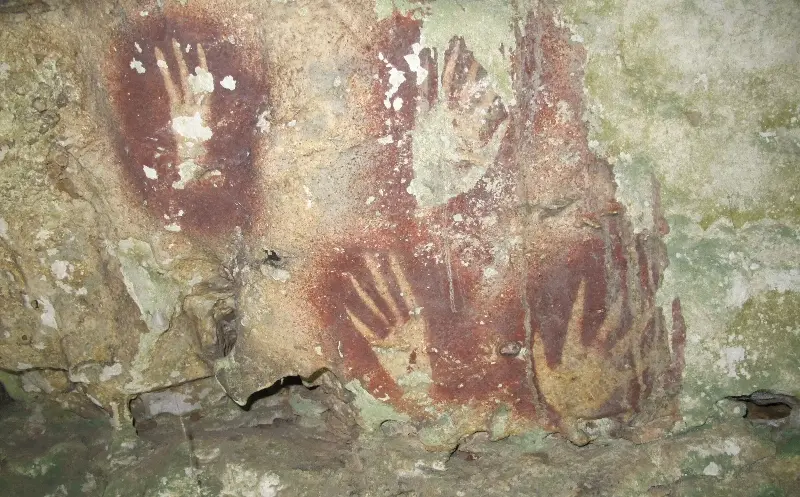
An ochre hand stencil found in the jungles of Indonesia is the world’s oldest known cave painting, researchers believe, a finding that robs Europe of its claim to have the most ancient art.
The stylised red handprint was discovered on the island of Sulawesi and is believed to be at least 67,800 years old.
That makes it at least 1,100 years older than the previous record for a cave painting, a hand stencil in a cave in Spain attributed to Neanderthals.
The Indonesian handprint was made by a person using his or her mouth to spray ochre pigment around a hand pressed to the wall of the cave, leaving a negative image or outline.
The image was then reworked so that the fingers of the hand were elongated and made narrower in such a way that the hand appears claw-like.
“This is the earliest evidence we have for humans creating cave art of any kind, which is a really exciting discovery,” said Adam Brumm, one of the senior authors of the research, which was published in the journal Nature.
The discovery not only challenges the previous, Eurocentric view that art and abstract thinking emerged in Europe during the Ice Age and then spread to other parts of the world.
It also suggests that creativity was innate to humans and flourished in locations across the world – and that if people were making relatively sophisticated art in Indonesia nearly 70,000 years ago, they may well have reached neighbouring Australia earlier than previously thought.
It has long been thought that humans arrived in Australia about 50,000 years ago, but the Sulawesi discovery indicates that they may have arrived thousands of years before.
Contested archaeological evidence has suggested that humans may have arrived in northern Australia as early as 65,000 years ago.
“If our species was present there 67,800 years ago making rock art, it makes it considerably more likely that the evidence we find for humans in Australia by 65,000 years ago is correct,” said Prof Brumm, from Griffith University in Queensland.
The hand stencil was discovered by scientists in a limestone cave known as Liang Metanduno on the island of Muna, which lies off the much larger island of Sulawesi. The cave is already well known for paintings that are around 4,000 years old.
The ancient hand stencil was found hidden behind those more recent drawings, including one that appears to depict a chicken.
When the hand image was created, sea levels were lower and Muna island would have been joined to Sulawesi.
Scientists were able to date the stencil by analysing the calcium carbonate deposits that had formed on top of the painting.
“We didn’t know what we had until we got to the lab,” said Maxime Aubert, an archaeologist at Griffith University and senior researcher on the new paper.
The calcium carbonate deposits were crucial in dating the art, said Prof Brumm.
“These early people came along, made the cave art, and in some cases where we are very fortunate, geological features started to form naturally on top of the art. They then provide a way that we can date the art itself,” he said.
Given that the deposits form on top of the rock art, the dating to 67,800 years ago may be an underestimate. “It’s possible that it could be a little bit older,” he said.
Susan O’Connor, an archaeologist at the Australian National University, who was not involved in the research, said the discovery of the artwork in Sulawesi added weight to the theory that humans arrived in Australia earlier than 50,000 years ago.
“These paintings are clearly the oldest evidence of creative expression in the world – earlier than the rock art in Spain at Maltravieso attributed to Neanderthal,” she told the Australian Broadcasting Corporation.
“This new dating of rock art in Sulawesi to at least 67,800 years old is incredibly significant both in terms of the global implications and in the context of the dating of earliest Australian settlement.”
Adhi Agus Oktaviana, of Indonesia’s national research and innovation agency, said: “It is very likely that the people who made these paintings in Sulawesi were part of the broader population that would later spread through the region and ultimately reach Australia.”
The team that found the hand stencil are keen to return to the area and continue their hunt for evidence of early human occupation.
“Two years ago, we went exploring further up that river. There’s another limestone [area] there … we want to go back and do a big project,” Prof Aubert said.
“There’s something special happening in that region. Humans were really advanced and we know there’s a lot more rock art there.”
The long-held view that Europe was the sole crucible of early humans discovering how to express themselves through art has also been challenged by the discovery of abstract marks and engraved ochre from sites in southern Africa.