



Travellers love waterfalls. They are like hyperactive rivers that ramble and climb, crash and thunder, as suggestive of geological drama as volcanoes – but a lot safer – and make for superlative backdrops for romantic photos and, less cutely, selfies.
The falls that shift the most water are not always the most eye-catching. High and wide cataracts usually go to the top of bucket lists. A jungle setting adds beauty, but waterfalls in tree-less Iceland can also be awesome.
Here are the world-class waterfalls everyone should try to see in their lifetime. Please let us know your favourite falls in the comments.
1. Angel Falls, Venezuela
With new hope for an improvement in Venezuela’s security situation, this colossal natural wonder may soon return to mainstream travel itineraries. Angel Falls is 3,212 feet high, with two drops. One of these is 2,648 feet, the world’s highest uninterrupted waterfall. It tumbles from a peak called Auyán-tepui in Canaima National Park. The extraordinary table-top tepuis inspired Sir Arthur Conan Doyle’s The Lost World.
To reach it, you must board a prop plane from Ciudad Bolívar, then take a canoe up the Carrao and Churún rivers, followed by a short jungle trek to the base. There are basic campsites and a lodge to make the trip more of an experience, and the tropical jungle is a habitat for macaws, toucans, monkeys and dart frogs.
The waters of Angel Falls flow into the Orinoco system and the rivers of Guyana; a great holiday – once Venezuela is safe to visit – would be to stop here before continuing into Guyana.
The Foreign Office (FCDO) advises against all travel to Venezuela.
2. Victoria Falls, Zambia/Zimbabwe
When Livingstone first saw this magnificent waterfall in 1855 he wrote in his journal: “Scenes so lovely must have been gazed upon by angels in their flight.” On the Zambia and Zimbabwe border, Victoria Falls is perhaps Africa’s most celebrated natural wonder – which is quite something, given the competition.
The falls are easily reached by plane, with plenty of nearby accommodation from five-star hotels to backpacker lodges. As well as helicopter flights that drop right into the gorge, there are exhilarating white-water rafting trips, and boats on which to sip sunset cocktails.
While not the tallest by height alone, Victoria Falls is one of the largest waterfalls in the world by sheer volume. Extraordinarily wide (5,604 feet) and very high (up to 360 feet), the curtain of falling water and billowing mist is known by locals as the “smoke that thunders”. It can be seen and heard from over 25 miles away.
How to do it
On the Go has a Namibia, Botswana and Victoria Falls tour for £3,035 per person, not including international flights.
3. Bowen Falls (Hineteawa), New Zealand
Milford Sound (Piopiotahi) is one of the wettest places in New Zealand, averaging 182 days of rain, and 6,813mm, a year. Despite this, many small waterfalls run empty during dry periods and only two are officially year-round falls. Lady Bowen, at 531 feet, is the tallest, and its setting – a classic hanging valley in the Darren Mountain Range – is one of Fiordland’s most photogenic backdrops.
If there’s been heavy rain during the day before your visit, you’ll see the fall at its most majestic. You can admire Bowen Falls from a boat, a scenic flight, a kayak trip, or on a short walk through native bush from the wharf at Milford Sound. The river and waterfalls were given their English name after Diamantina Bowen, the wife of the fifth governor of New Zealand. The other permanent drop is Stirling Falls (Wai Manu).
How to do it
A Milford Sound day cruise costs £75.25.
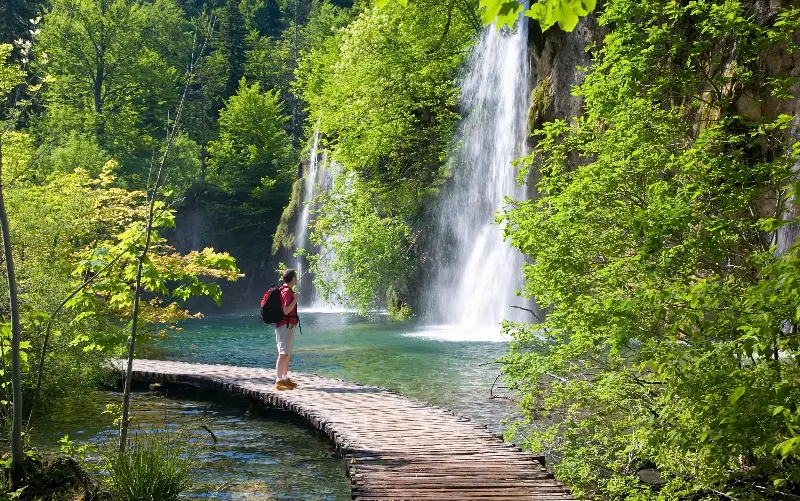
4. Plitvice Lakes National Park, Croatia
Aerial shots of this Unesco-listed park in central Croatia – near to the border with Bosnia-Herzegovina – show a luxuriant and Eden-like ballet of dozens of small lakes leaping from ledges and pools.
Waters flowing over limestone and chalk have, over many thousands of years, created natural dams which have evolved into beautiful lakes, caves and waterfalls. These geological processes continue today. The forests in the park are home to bears, wolves and rare bird species.
How to do it
Trailfinders has an eight-day tour combining the Plitvice Lakes falls with Zadar and Split, from £1,179 per person, including flights.
5. Iguazú Falls, Argentina/Brazil
Shared by Argentina and Brazil (where the spelling is Iguaçu or Iguassu), some 275 individual falls plunge from their namesake river into the mighty Paraná on an almost two-miles-wide horseshoe cloaked in tropical rainforest.
Many of the falls are named. The Devil’s Throat – the highest, noisiest fall – is almost 500 feet wide and 270 feet high. Swifts dart in and out of the thundering brown-hued cascades and thousands of butterflies flit in the mist.
The falls lie at the northern tip of Argentina’s Misiones Province, named for the Jesuit missionaries who settled in the region in the 17th century. The surrounding Iguazú National Park is home to bright-billed toucans, raccoon-like coatis and howler monkeys, as well as harder-to-spot jaguars, ocelots, tapirs and giant anteaters.
Walkways above and beneath the falls make access easy, and while bathing is proscribed, there’s plenty of opportunity to get up close, and soaked, on a boat trip or by standing at the base of the falls.
How to do it
Every Latin American tour specialist operating in the UK has tours that include Iguazú. See lata.travel for a list of operators. You can also do it independently. The entrance fee is AR$45,000 (£23.50).
6. Niagara Falls, Canada/USA
On their “discovery” in 1678 by Father Louis Hennepin, a Frenchman searching for China, early reports put the height of Niagara at more than 500 feet. Which just shows how impression trumps science. In fact, the highest section, Horseshoe Falls – on the Canadian side – is 187 feet high and some lesser drops are 70-100 feet. What thrills here is the volume of water: 700,000 gallons per second.
In 2014, the US side of the falls froze over due to extreme conditions created by a polar vortex – a low-pressure system of frigid air that kept the cold contained over a large area.
How to do it
Niagara City Cruises offer a choice of trips, including the Voyage to the Falls Boat Tour, where you hear the roar of Horseshoe Falls up close. Another way to experience its raw power is the Journey Behind the Falls walking tour, which takes visitors through 130-year-old tunnels to an observation deck behind the falls.
7. Kaieteur Falls, Guyana
As the Potaro river plunges 741 feet from a rocky shelf in the Guyana rainforest, it gives birth to a record holder: the world’s greatest single-drop fall by volume, with an average flow rate of 23,400 cubic feet per second. It’s a Biblical quantity of water, and a rare occurrence in lofty, single-drop systems.
Reached via a tiny airstrip or a multi-day hike, this majestic, coffee-coloured waterfall feels cut off, secret, special. It’s said to be named by an unlucky indigenous chief who canoed over the edge to his death in order to protect his people.
How to do it
Undiscovered Destinations has a 13-day Nature of Guyana group tour, including Kaieteur Falls, from £5,850 per person, excluding international flights.
8. Nong Khiaw, Laos
Why make do with one when you can ogle 100? The so-called 100 waterfalls is a nickname for a region of Northern Laos known for its many falls and streams that has become a popular trekking circuit. First explored by non-locals in 2008, it has now caught the attention of travellers.
The route can be tackled on a day walk or taken more slowly. It’s a jungle area and you can hear water cascading as you hike along riverbeds, past rice paddies and up steep slopes, some of which have bamboo ladders fixed in place. Swimming in the pools around some of the falls is permitted.
How to do it
Audley has a 14-day Vietnam and Laos tour including a trek in Nong Khiaw, from £4,810 per person, including flights.
9. Gullfoss, Iceland
A star attraction of Iceland’s Golden Circle – three iconic sights you can see in a day trip from the capital, Reykjavik – Gullfoss is a photogenic two-tiered waterfall, fed by the glacial Hvítá river, that plunges 105 feet into a rugged canyon. There’s no entrance fee to visit the site, which is a protected nature reserve.
The other two must-sees in this seismically active part of the world are Thingvellir National Park, a rift valley between the North American and Eurasian tectonic plates that’s also the site of the world’s first parliament (the Althingi), and the Geysir geothermal area, with its bubbling sulphur-scented mud pools, steaming vents and shooting geysers.
Gullfoss routinely freezes in winter, its cascades transformed into stunning ice formations and shimmering curtains; the main flow rarely stops completely, with the most dramatic freezing occurring in the coldest months.
How to do it
Discover the World’s seven-night Essential Iceland fly-drive tour, including Gullfoss, starts from £1,098 per person, excluding flights.
10. Swallow Falls (Rhaeadr Ewynnol), Wales
Swallow Falls is promoted as “the highest continuous waterfall in Wales” but is actually a series of weaving, spurting mini-falls that move down step-like rocks on the River Llugwy, about two miles west of the hiking-hub village of Betws-y-Coed.
The original name for the attraction was Rhaeadr Ewynnol, which means “foaming waterfall” in Welsh. It was later renamed Swallow Falls after the birds that can be seen swooping over it during the summer months. Visitors can enjoy the falls, bordered by beech, birch and conifer trees, from a viewing platform.
How to do it
Parking is free in the laybys and in the T’yn Llwyn car park. From the latter there’s a lovely 2.2-mile walking trail. The viewing platform is open throughout the year and costs £2 to access.