



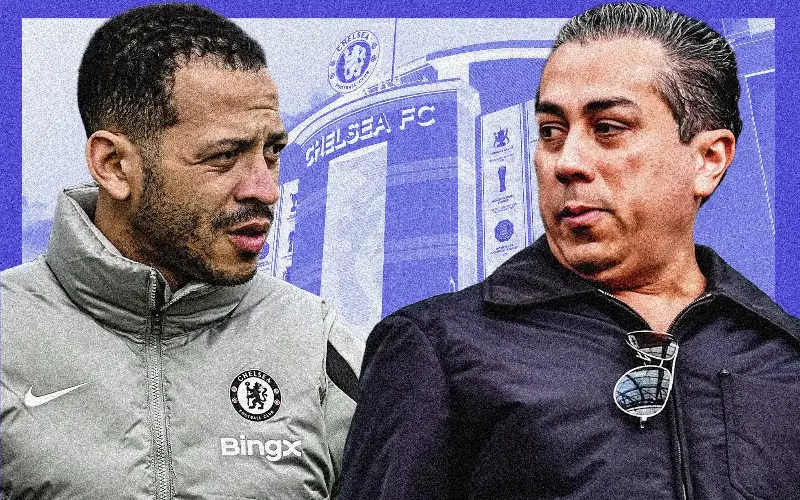
When it came to appointing Liam Rosenior in January, in the aftermath of another major Chelsea managerial meltdown, there was a rationale within the BlueCo structure that if they did not appoint him then he might just leave anyway for another Premier League club.
There was intelligence that he could be Thomas Frank’s successor at Tottenham Hotspur, and that there were other Premier League possibilities for a manager who had overseen a decent first season at RC Strasbourg. At least, that was what Behdad Eghbali and his five-strong group of sporting directors had heard and perhaps there was an incentive to believe. Certainly it made it easier for them to take that leap to appoint a 41-year-old with no obvious qualifications for one of the biggest jobs in world football.
Enzo Maresca, the Chelsea group reasoned, had been plucked by them from the Championship and won a Club World Cup. It was the conviction that the club could make the manager a success, rather than the other way around. Just 107 days later, with Rosenior the subject of a humiliating sacking and BlueCo apologising to a Chelsea support in outright revolt, that gamble backfired spectacularly. That is before one even considers the indignity visited on Strasbourg who, having lost their captain to the senior club in the BlueCo group, then lost their coach – who subsequently did not even make it to the end of the season.
There was a hope that Rosenior might just be the confident, sophisticated young coach that Chelsea needed, but at a club where the manager is subordinate to the sporting directors and the owners it barely came close to working.
At the top of the day-to-day running of Chelsea is Eghbali, who comes back and forth to London from his base in Los Angeles – a driven man who runs around $90bn of investors’ money in Clearlake Capital funds. He demands much of his employees, and at the top of that are his co-sporting directors Paul Winstanley, and Laurence Stewart. Then come their colleagues Joe Shields, director of recruitment and talent; Sam Jewell, director of global recruitment and Dave Fallows, director of scouting and recruitment.
Between them they run the show at Chelsea under Eghbali’s guidance. Winstanley, for example, who began his post-playing career as a Wigan Athletic analyst, hired the former rugby league centre Willie Isa as a motivation specialist – or “cultural architect” – for the first team. Isa, a New Zealander who retired last year after four Super League titles at Wigan Warriors, was thrust into the dressing room under Maresca. Such was the power of the sporting directors that Isa remains in place through a second managerial sacking.
It was Isa’s idea for the huddle that eventually came to engulf referee Paul Tierney on the centre-spot at Stamford Bridge before the defeat to Newcastle United on March 14 – another one of those moments that hinted at the weirdness going on at the club. Rosenior’s “respect the ball” remark in defence of the huddle also, many suspect, came from Isa. The manager sought to buy into the culture, but as events started to spiral out of control, it was Rosenior who paid with his job.
There was some tactical innovation in the early days, including a corner routine in the first leg of the Carabao Cup semi-final against Arsenal, which ended in defeat. There was a run of five wins in January including a comeback against Napoli – a run that would turn out to be the high point of Rosenior’s Chelsea time. The last of those five against West Ham on January 31 would be his last win at Stamford Bridge in the league. A failure to go for it against Arsenal in the second leg of the Carabao Cup semi-final was confusing for fans.
Behind the scenes, this was not an easy group to manage with Enzo Fernández, the team’s £106m Argentinian World Cup-winning midfielder among the most belligerent. Rosenior’s backroom team was notably short of gravitas. He inherited Calum McFarlane, the former Under-21s manager who had been the interim manager for a game after Maresca and has now been reinstated. He was closely allied to Shields, whom he had known from their days at the south London youth development organisation Kinetic.
From Strasbourg, Rosenior brought with him Kalifa Cissé, whom he had played alongside and was in France chiefly to translate. There was also Justin Walker, a former professional whom Rosenior had met when they were coaching at Derby County, and Ben Warner, who also came from Strasbourg. They joined Ben Roberts, a goalkeeper coach who had been at the club since 2022 and Bernardo Cueva, the set-piece coach appointed from Brentford. It was, to say the least, a strange combination.
In the 1-1 home draw with Burnley, featuring an injury-time equaliser for the away side, Rosenior said that one of his defenders failed to follow the plan. He refused to name the individual in question although all clues pointed to Josh Acheampong and Rosenior’s remarks were enough to prompt the social media witch-hunt.
Nevertheless, there was one more big win, away at Villa Park on March 4 before the wheels came off. At that point Chelsea were in fifth and three points off Villa and Manchester United immediately above them. Chelsea have not earned another point since and the gap is now 10 points and five places to Villa in fourth. That night was also the first ill-fated centre-circle huddle which would become such a bone of contention against Newcastle three weeks later.
Championship side Wrexham took Chelsea to extra-time in the FA Cup fifth round. Paris St-Germain spanked Chelsea home and away to end their Champions League interest. There was the farce of the Newcastle huddle which prefaced the first of five straight Premier League defeats that ultimately cost Rosenior his job. Chelsea collapsed at home to Manchester City two weekends ago and the ownership became twitchy about a BlueCo protest featuring both Chelsea and Strasbourg fans on Saturday night. By the end of the game, the anti-Eghbali sentiment could be heard in the stadium. During Tuesday’s defeat at the Amex Stadium, fans turned on Rosenior himself.
The unearthing of some of Rosenior’s guileless historic interviews, which would otherwise have just gathered dust in a corner of the internet, have not helped. His rationale behind his new perspective on the word “manage” – “if you split the two words, it’s man [and] age; you’re ageing men” – was greeted with a universal wince. Wesley Fofana’s outward defiance to Rosenior’s staff in Saturday’s defeat contributed to the sense of a manager who was being outgunned by a powerful and disenchanted dressing room.
That came after Fernández and Marc Cucurella were both explicit on international duty about their doubts over the club’s direction. That prompted a two-match ban for the Argentine, which encompassed the critical City Premier League game.
Taken in isolation, all these moments were innocuous but together and combined with results they were potent. Once it started to go wrong for Rosenior, neither he nor his staff had any way to arrest the slide.
On Tuesday night he finally changed his position post-match and attacked his players for their attitude and effort. Even then they were defiant, with Trevoh Chalobah saying in his post-match interview that that the players had “run their socks off”. “It’s nothing to do with effort,” Chalobah said. That response from a low-key member of the dressing room said it all. Who was in charge? It was, as ever at Chelsea, hard to say – but it was certainly not Rosenior.