



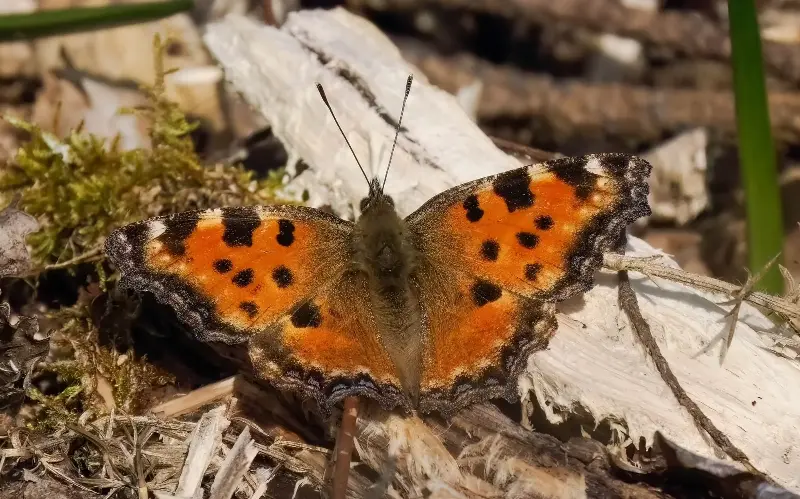
If you go down to the woods today, an unfamiliar beauty may be watching you from a tree’s sun-kissed bark. You may clap eyes on what resembles the familiar small tortoiseshell butterfly. But look again. If this orangey-red Nymphalid seems larger, with no white markings on its tigerish forewings and just a flicker of metallic-blue trim, you could be looking at something really rather rare.
But hurry. The large tortoiseshell butterfly – this summer’s comeback kid – will soon be creeping into your woodpiles or sheds, or squatting in a woodpecker’s artfully drilled abode, to begin a hibernation that will last until next spring.
Once a fixture of British woodlands, the large tortoiseshell faded away after the Second World War. It was declared regionally extinct in the 1960s, and was last recorded as a breeding species in the UK in the 1980s. No more could they be seen supping the spring nectar of Salix flowers, nor ovipositing bands of eggs, delicate like pearl bracelets, around the twigs of a favoured elm.
Their decline has been linked to Dutch elm disease, which has ravaged our woodlands from the 1970s. But the disappearance was well underway before this, and its caterpillars are just as capable of feeding upon willow, cherry and poplar leaves.
According to Professor Richard Fox of the charity Butterfly Conservation: “It’s not possible to say definitively why the large tortoiseshell disappeared from Britain, although historically its populations tended to boom and bust, for reasons that are not clear.”
Fresh sightings
Now, like Lazarus, it has been reappearing in our broadleaved woodlands. Since early spring, sightings have been reported across Kent and Sussex, and all the way down in Cornwall. These sightings have led Butterfly Conservation to declare it once again a resident breeding species: Britain’s 60th.
A likely driver of this resurgence is migrant butterflies from Europe winging it over the Channel. “In recent years, there has been a significant growth in their population in Central Europe, leading to a major increase in numbers in the Netherlands (where it was also once extinct) and France. Butterflies from these increasing continental populations have flown across the Channel and become residents. Now it is probably established in England’s southern counties,” says Fox.
East Sussex is proving a particular hotspot. So in late June, I boarded a train to Brighton on a very important personal mission.
During one helter-skelter summer in 2005, I travelled the length and breadth of Britain, a juddering 8,500 miles, and managed to see every one of our 59 butterfly species. I saw them atop Dartmoor’s tors and in Midlands hedgerows, beside Yorkshire’s limestone pavements and Norfolk’s sleepy Broads. I slept in my car in lay-bys when it rained, and ate far too many supermarket meal deals. More than 20 years later, I had one more species to tick off.
A love reignited
My amateur lepidoptery – which unpoetically means “scaly wings” in Greek – was a passion born through escapism. Prior to journalism, I wanted to help preserve our wildlife so began a career in countryside management. After a few years in the Cotswolds patching up drystone walls, litter-picking and erecting access signs, my love for the countryside was waning.
Then, one summer I took responsibility for monitoring a country park’s butterflies. Every week, I walked a transect, and counted each species I saw. I began to recognise their flight patterns, the flowers they preferred, where to find their eggs and how to count like a supercomputer when swarms of meadow browns bimbled around tall grasses.
I fell in love with their science-fiction existence. A safari to see them is multi-dimensionally more interesting than watching lions in the Serengeti lazing around until they get hungry. Their metamorphism via molecular rearrangement felt like a metaphor for positive change.
Now I feel their unshakable mystery reignited by the large tortoiseshell’s surprise reappearance on our shores. In Brighton, I met Graham Hubbard, a volunteer with Butterfly Conservation, and we drove 40 minutes east to the Forestry Commission’s 890-acre Abbot’s Wood, near Polegate, gifted to Battle Abbey in the 12th century by Henry I.
Hubbard likewise found salvation in butterflies after retiring six years ago from a career in automotive design, working on brands such as McLaren. “I love their sheer beauty and almost spiritual connection with nature,” he told me.
As we headed into the oak, sweet chestnut and hornbeam thickets, Hubbard explained that he first saw a large tortoiseshell here on March 3. In early spring, they emerge from hibernation to breed, so we were seeking their offspring, theoretically on the wing for a few weeks around early July. “They could be ones arriving from across the Channel, although their wings will look tattier,” he told me.
Seeking them soon opened my eyes and senses to the nuances of this aged woodland. We stopped by a monastic pond with flowering yellow water lilies to check the damp-loving willow their larvae may feed on, and we followed broad rides (vital wildlife corridors cut through the woodland) as imposingly straight as the Champs-Élysées, where butterflies and dragonflies probed flowering brambles, marshmallow-pink mallow and yellow loosestrife, in the chiaroscuro light. Screeching jays echoed down the tracks.
We counted 15 species: one-quarter of the UK’s butterfly fauna. White admirals slalomed between trees like mad skiers. Large skippers’ deltoid-shaped wings resembled prototypes for jet-fighters. Marbled whites were patterned like chequerboard art deco floors and by mid-afternoon, the fiery orange flashes of silver-washed fritillaries – one of our largest species – were setting the rides ablaze.
In Gillridge Wood ride, where Hubbard first photographed large tortoiseshells in March, a sizeable, darkish butterfly suddenly flashed by on an aerial flypast. Hubbard’s eyes lit up and we hurriedly followed, but it melted into the woodland brash. “That was typical of a large tortoiseshell’s flight, as it always gives the impression it has somewhere to be in a hurry,” he said. “I’d say that’s an 80-85 per cent sighting.”
Alas, one never did reveal in full its mercurial beauty on a mature tree, where they typically sunbathe and watch for rivals or suitable mates. Not to worry. A quote wrongly attributed to the 19th-century writer-philosopher Henry David Thoreau proclaims: “Happiness is like a butterfly: the more you chase it, the more it will elude you, but if you turn your attention to other things, it will come and sit softly on your shoulder.”
My quest for the elusive insect didn’t bear fruit, but afforded me a forensic insight into the woodland it may once again be sharing. And besides, when next spring comes, and the large tortoiseshell wakes from its liminal state, I will return to East Sussex and try once again to welcome it home.
My five favourite British butterflies
Brown hairstreak
A mercurial, late-summer emergent around the blackthorn hedgerows of southern England and Wales. When they open their forewings the splash of orange is like the rising sun.
Large blue
Successfully reintroduced to south-west England, their caterpillars fool ants into taking them into their underground colonies by emitting an irresistible honeydew secretion – and then they devour the ant’s larvae.
Purple emperor
Tipsy from supping oak sap, these violet purple stunners can be seen chasing all competitors away from the treetops of mature southern English woodlands.
Swallowtail
The UK’s largest butterfly is a powerful beast with fanciful twin tails. It is also a rarity, found in eastern England’s wetland reserves.
Marsh fritillary
Resembling a flying stained-glass window, these pretty fritillaries seek out the UK’s damp western margins and their larval host plant: devil’s bit scabious.
Butterfly Conservation is Britain’s foremost charity protecting butterflies. A single annual membership of £45 maintains a network of UK reserves, and it offers butterfly walks to the public.