



Why is Georgian architecture so good? Why do people visit it? It is the humility.
Classical architects had the humility to copy, to adopt patterns from the past and from abroad. Its history is a succession of tourism with consequences: Christopher Wren’s visit to Paris, James Gibbs’s apprenticeship in Rome, James “Athenian” Stuart’s Greek travels.
Georgian architects understood that the “function” of their buildings was only part of their purpose. William Chambers, Robert Adam and John Soane all had the humility to imagine their buildings as ruins many years hence, ranging far beyond “the brief” in a way no modernist architect could conceive.
Georgian architects had the humility to write pattern books for country masons to “rip off”. They weren’t precious, delighting in illustrating facades, doors and windows for local architects to make their own. Works such as Colen Campbell’s Vitruvius Britannicus or James Gibbs’s A Book of Architecture meant that any village landlord or small-town speculator had a decent chance of erecting a beautiful building. The true genius of Georgian architecture was that anyone could do it.
How can one possibly pick the greatest examples? Selecting the richest fruit in the cornucopia invites disagreement. Here, though, roughly chronologically, are 10 favourites that rise above pleasing elegance to steal the breath.
Castle Howard, North Yorkshire
John Vanbrugh and Nicholas Hawksmoor (1699-1727)
No building could be less typical of the dour Yorkshire temperament than the 3rd Earl of Carlisle’s flamboyant, almost megalomaniac, domed palace. It is too princely to be convincingly English, but I defy you not to be struck dumb by the sight of it.
Vanbrugh and Hawksmoor’s first collaboration and masterpiece (less pompous than Blenheim Palace) has a bathetic history, however. Unfinished until 1811, diarist “Chips” Channon, visiting in 1923, recalled, “signs of decaying magnificence”. Appropriately, Castle Howard has an on-screen alter ego as Evelyn Waugh’s tragic Brideshead, in the 1981 series and 2008 film. Nearly gutted in 1940, it has been renaturing ever since, most recently the glorious new Tapestry Drawing Room by Francis Terry.
St Mary Woolnoth, London
Nicholas Hawksmoor (1716-1727)
Christopher Wren’s City churches are pre-Georgian, but Hawksmoor was as adept as Wren at squeezing sumptuous interiors into modest spaces.
Choosing the greatest of his “Commissioners’ Churches”, funded by a coal tax to renew the Church of England, is impossible. I adore Christchurch and St George’s Bloomsbury, both recently well restored. St George-in-the-East is unique: pepper pots against the sky. But St Mary Woolnoth’s high pavilions and two-storey rustications are astonishing, like a Renaissance Roman fortress. A late Victorian public outcry saved it from demolition. The crypt is now Bank Tube Station.
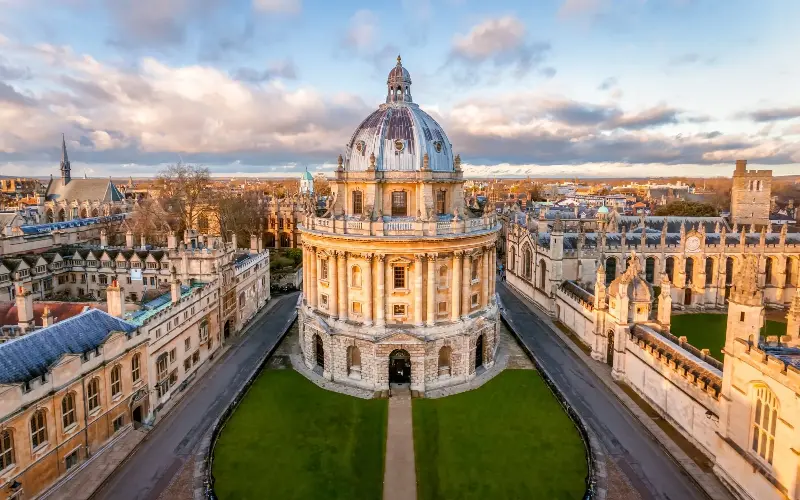
Radcliffe Camera, Oxford
James Gibbs (1737-48)
James Gibbs is the architect whose name you should know better. His St Martin-in-the-Fields, combining for the first time a steeple with a temple portico, is the 18th century’s most influential church design, emulated across England and North America.
However, his apotheosis is Oxford’s domed Radcliffe Camera, England’s first circular library and a hymn to learning in honey-hued limestone. The exquisite rotunda and giant Corinthian columns might even be by Michelangelo. Its urban setting, balanced between Brasenose, All Souls, the Bodleian and the University Church, heaps perfection upon perfection.
The Pantheon and Temple of Apollo, Stourhead, Wiltshire
Henry Flitcroft (1753-4, 1765)
No English garden is greater than Stourhead. Its owner, the banker Henry Hoare – inspired by Italian landscapes and French painters – sought, like Alexander Pope, the “genius of the place in all”. So he dammed a river, made a lake and sprinkled its banks with classical temples to better approximate the utopia he desired.
Henry Flitcroft’s mini-Pantheon is visible as you arrive. Apollo’s temple only reveals itself later as a joyous surprise.You’ve seen it in films.Who can blame the film-makers?
Kedleston Hall, Derbyshire
Robert Adam (1760s)
If you like the outside, wait until you see the Marble Hall with its Italian marble and pink alabaster columns. England may have no richer room. That Robert Adam, little over 30 when he designed Kedleston, had the ability to recreate so many antique Roman details is hard to comprehend. He, too, had spent four years in Italy observing, drawing and measuring. Adam’s work at Syon House is just as good.
When Lord Curzon became Viceroy of India in 1899, he reportedly felt at home as Calcutta’s former Government House was partly modelled on Kedleston Hall.
The Royal Crescent, Bath
John Wood (1767-75)
I could as well have named Queen Square or The Circus by John Wood’s father down the hill. Together they resolved the tensions between housing many Georgian tourists besides Bath’s Assembly Rooms and doing so with order and sinuous dignity. The Royal Crescent is the pick with its semi-elliptical form and views over the Avon valley. On a sunny late spring morning, with the grey rain clouds rolling away, England has no more beautiful street.
Georgian Bath is the greatest act of town planning in British history. Modernist urban “design” is malpractice besides it.
Piece Hall, Halifax
Architect unknown (1770s)
When Halifax’s cloth merchants decided to build a hall for the trading of pieces of cloth, either the brief or some instant of genius from the nameless architect led to the creation not of a single building but of a town square, a quadrangle of Doric arcades behind which 315 merchants’ rooms sat ready for business, a heady mix of souk, forum and fell.
What lifts it from the superb to the sublime is the location, the gently sloping topography and the Pennines rising behind. Here is capitalism of the merchant prince not the robber baron.
Belmont, Lyme Regis
Architect unknown (c.1785)
Perhaps “great” is pushing it for this pink jewel of a building, but this over-ornamented delight is a joyful rebuke to modernism’s sanctimonious tedium. It has the added advantage that you can stay there overnight, courtesy of the Landmark Trust.
Urns, an exaggerated swagged frieze and ludicrously vermiculated rustications over each round-headed window make this more like a toy than a town house. All are in artificial Coade stone for this was the country retreat of Eleanor Coade whose important Patent Artificial Stone Manufactory on the River Thames provided architectural decoration from Bedford Square to Buckingham Palace.
Norris Castle, Isle of Wight
James Wyatt (from 1799)
James Wyatt was the Georgian architectural magpie par excellence, adopting Greek, Roman, Byzantine or Gothic patterns as his mood or clients demanded. His highest building, Fonthill Abbey, collapsed, but Norris Castle, overlooking the Solent, somehow combines castellations and British flint with the tones of seaside villa and Palladian retreat. It is unique and also, uniquely for this list, currently for sale.
Sir John Soane’s Museum, London
John Soane (1792-1824)
John Soane was one of England’s greatest architects. His personal patterns of incised lines, pendentive domes and vaulted top-lighting somehow simplified the classical languages without reducing them. Tragically, nearly all of his oeuvre is lost, much consumed by fire alongside the medieval Palace of Westminster in October 1834.
Dulwich Picture Gallery, Moggerhanger House and Pitzhanger Manor all deserve visiting but are inescapably anaemic besides the evocative interiors, mirrors, plaster casts and secret doors of Soane’s house-cum-museum in Lincoln’s Inn Fields. Soane sought to create what he termed “the poetry of architecture”. He succeeded.
Nicholas Boys Smith is the founder and chairman of Create Streets. His history of London’s streets No Free Parking is available from Bonnier books.