



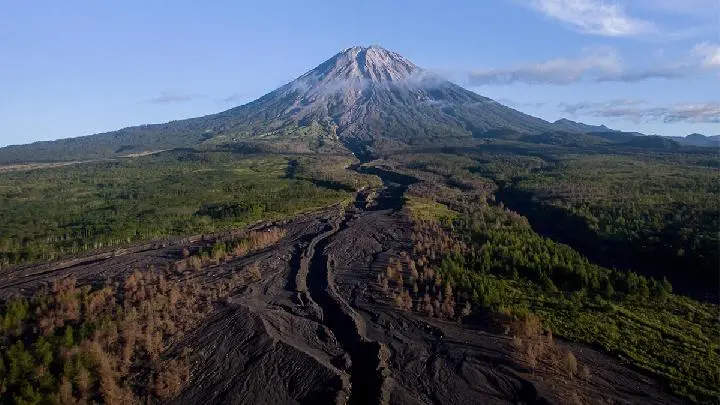
TEMPO.CO, Jakarta - Mount Semeru's consecutive eruptions were reported from after dawn until this morning, Wednesday, February 4, 2026. The first seven consecutive eruptions were reported at 4:58 a.m. Western Indonesian Time (WIB) and continued until 8:02 a.m. Western Indonesian Time (WIB).
The Semeru Volcano Observation Post (PGA) in Lumajang reported that the eruption column was observed to be approximately 300 to 800 meters above the summit. The ash column was observed to be white to gray in color, with a thin to thick intensity, extending toward the northeast. The eruption was recorded on a seismograph with a maximum amplitude of 22 mm and a duration of up to 138 seconds.
Seismicity reports during the observation period from 12:00 a.m. to 6:00 a.m. Western Indonesian Time (WIB) indicated 20 eruption earthquakes with amplitudes of 10-22 mm and durations of 72-152 seconds. One avalanche earthquake with an amplitude of 5 mm and a duration of 76 seconds was also recorded.
Seven gust earthquakes were recorded, with amplitudes of 3-7 mm and durations of 40-101 seconds. Four distant tectonic earthquakes were also recorded, with amplitudes of 5-30 mm, S-P of 13-41 seconds, and durations of 33-147 seconds.
"The activity level remains at alert," said Edi Slameto, Acting Head of the Center for Volcanology, Mitigation, and Geological Hazard Mitigation (PVMBG) of the Geological Agency, in a written report on Wednesday morning, February 4, 2026.
At this Level III activity level, the PVMBG issued recommendations, including not conducting any activity in the southeastern sector along Besuk Kobokan, within 13 kilometers of the summit or eruption center.
Beyond this distance, the public should refrain from activities within 500 meters of the riverbank along Besuk Kobokan due to the potential for spreading pyroclastic flows and lava flows up to 17 kilometers from the summit. Furthermore, the public is advised to avoid activities within a 5-kilometer radius of the crater/peak of Mount Semeru due to the risk of ejected incandescent rocks.
The public is also advised to be aware of the potential for pyroclastic flows and lava flows along rivers and valleys that originate at the summit of Mount Semeru, especially along Besuk Kobokan, Besuk Bang, Besuk Kembar, and Besuk Sat, as well as the potential for lava flows in small rivers that are tributaries of Besuk Kobokan.
Read: Mount Semeru Emits Hot Clouds for Two Days, Alert Level Remains High
Click here to get the latest news updates from Tempo on Google News