



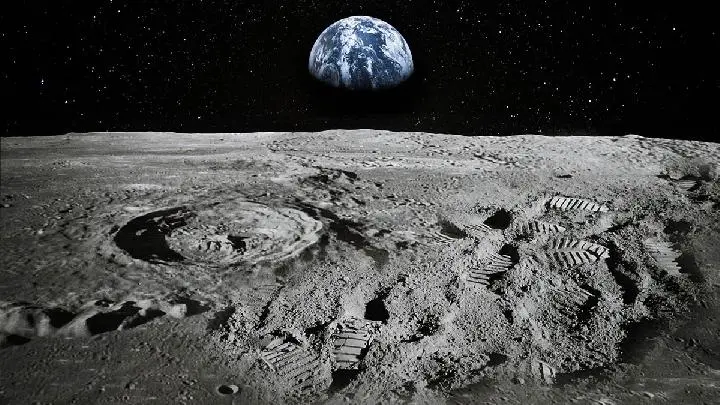
TEMPO.CO, Jakarta – The phenomenon of the Moon slowly moving away from Earth often sparks various speculations, ranging from climate change to its impact on human life. Sonni Setiawan, a lecturer in the Department of Geophysics and Meteorology at IPB University, explained that this phenomenon is related to the Moon's orbit, which is elliptical, not perfectly circular.
"The effect of the Moon moving away from Earth is a consequence of the Moon's elliptical orbit around Earth. There are times when the Moon is closest (perigee) and farthest (apogee) during each lunar revolution," he said in a written statement on Wednesday, February 4, 2026.
A similar phenomenon also applies to Earth's orbit around the Sun, with perihelion occurring in January and aphelion in July each year.
Sonni stated that this astronomical phenomenon is a natural process and should not cause excessive concern. Regarding the impact on humans, the effect is not direct, but rather occurs through certain mechanisms on Earth. For example, ocean tides are the result of the Moon's gravitational force. Sea level rise due to tides can impact fishing activities and coastal areas.
This phenomenon also doesn't have a direct impact on the climate system. "It doesn't have a direct impact on the climate system, because the duration of climate change ranges from years to decades," said Sonni.
According to him, one of the external factors that has a greater influence on climate related to Earth's orientation to the Sun is fluctuations in the eccentricity of Earth's orbit, changes in the obliquity (tilt of Earth's axis), and changes in the precession of Earth's rotational axis. These three fluctuations in Earth's orientation to the Sun are known as Milankovitch Cycles.
According to him, each of these component changes has a period. Changes in Earth's orbital eccentricity occur every 100,000 to 400,000 years, changes in Earth's obliquity occur every 41,000 years, and changes in Earth's precession occur every 26,000 years.
"These changes in Earth's orientation cause changes in the solar radiation received by Earth, the primary energy source for Earth's climate. These changes influence Earth's climate on a timescale of thousands to hundreds of thousands of years," he said.
In addition to changes in Earth's orientation to the sun, planetary constellations in the solar system can alter Earth's atmospheric conditions. When the planets are in conjunction, the resulting large gravitational force can affect Earth's atmospheric conditions.
"Planetary constellations in conjunction can cause water vapor to rise, increasing the potential for cloud formation. Because planetary conjunctions occur on the order of hundreds of years and have global effects, this can cause changes in the climate system," he said.
Read: February 2026 Skywatch: Solar Eclipse, Full Moon, and Planets
Click here to get the latest news updates from Tempo on Google News