



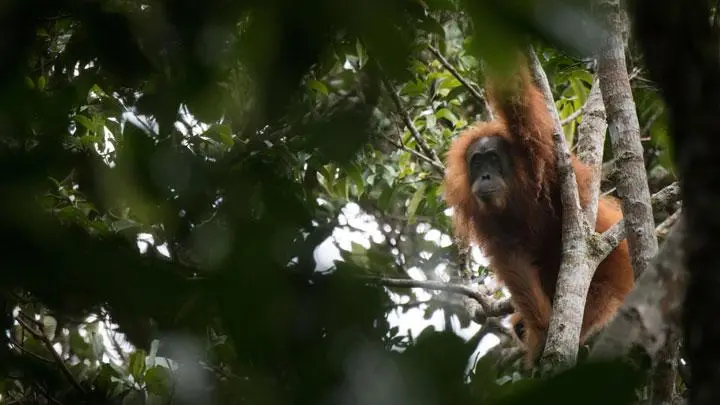
TEMPO.CO, Jakarta - The flash floods hitting the Batang Toru forest upstream in late November 2025 devastated residents across South, Central, and North Tapanuli, and Sibolga. The disaster also struck the Tapanuli orangutan, a critically endangered species endemic to the region.
A study published on December 15, 2025, estimated that 33 to 54 Tapanuli orangutans died in the disaster. This figure represents 6.2 to 10.5 percent of the population in the Batang Toru Western Block, the core habitat for the species.
The research, "Extreme Rainfall Event in Sumatra Caused Critical Habitat Loss and Lethal Impacts to the Critically Endangered Tapanuli Orangutan," appeared on Preprints.org on December 15, 2025. It involved 14 researchers from institutions in Indonesia, Brunei, the UK, the Netherlands, Belgium, France, and Germany.
"The demographic shock imposed by this event is consistent with an extinction-level disturbance," said Erik Meijaard, a researcher from Borneo Futures who led the study. He stressed that for a species with fewer than 800 individuals, such a loss is critical.
The disaster followed extreme rainfall from Tropical Cyclone Senyar between November 23 and 28, 2025, across northern Sumatra. Batang Toru recorded 564 millimeters of rain during that period, with two peak days reaching 207 and 204 millimeters. "This is very likely to correspond to at least a century-scale event," Meijaard said.
Rainfall intensity and existing deforestation triggered massive landslides on steep slopes. Satellite imagery from Sentinel-2 and Planet Scope showed 3,964 hectares of forest destroyed, with an estimated 2,487 additional hectares obscured by clouds.
Meijaard noted the devastated areas were the most productive orangutan habitats. "The lowland river valleys that were lost are habitats with the highest orangutan densities," he said.
Forest areas below 300 meters typically hold densities of 1.04 individuals per square kilometer. Post-disaster, orangutans moved to higher ground with lower quality habitat or toward agricultural land, increasing the potential for conflict.
At least one orangutan carcass was recovered from flood debris with severe injuries. "Given the scale of landslides, we expect that many more orangutans were killed or severely injured," Meijaard said.
Tapanuli orangutans have a birth interval of 6 to 9 years. Losing one percent of the population annually is enough to drive the species to extinction. Researchers urged the government to enforce a permanent moratorium on habitat-damaging activities and designate Batang Toru as a National Strategic Area.
"This would provide a stronger legal basis for long-term protection and ensure that national spatial planning prioritizes ecosystem integrity," said Panut Hadisiswoyo, a researcher at the Sumatran Orangutan Conservation Programme - Orangutan Information Centre.
Identified as a separate species in 2017, fewer than 800 Tapanuli orangutans remain in three fragmented blocks. It is the world’s rarest great ape.
A study by Kew and Imperial College London found human-induced climate change increased extreme rainfall intensity in the Malacca Strait by 9 to 50 percent. "The study further finds that in northern Sumatra, the wet season (December to February) is expected to become wetter, with more frequent extreme events," said climate researcher Friederike Otto.
David Gaveau from The TreeMap said remote sensing allows for swift responses. "We can accurately see the scale of damage, but more importantly, how this information is used for conservation," he said.
Meijaard urged the international community to provide support for recovery. "Without immediate intervention, the Tapanuli orangutan faces the imminent risk of becoming the first great ape species to go extinct in modern history," he said.
Read: Police Uncover Decades of Illegal Logging in Aceh Forests
Click here to get the latest news updates from Tempo on Google News