



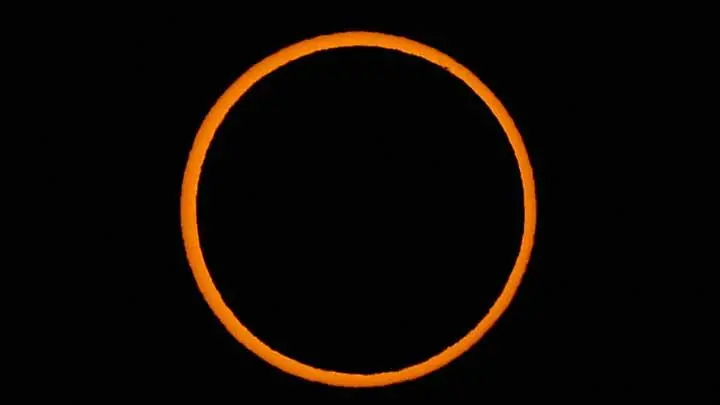
TEMPO.CO, Jakarta - A number of astronomical phenomena will occur during February 2026, including an annular solar eclipse. "There will be an annular solar eclipse, but it won't be visible from Indonesia," said Avivah Yamani, an astronomy activist from the Langit Selatan Bandung Community, on Sunday, February 1, 2026.
The annular solar eclipse on February 17 will be the first eclipse of the year, coinciding with Chinese New Year. However, this event will only be visible to observers in Antarctica. Observers in other regions, such as southern Argentina, Chile, and Africa, will only be able to see a partial solar eclipse.
In addition, there will be encounters between the Moon and planets. Avivah cited Saturn as an example, which will be visible above the western horizon after sunset on February 19. The Moon will also pass over Jupiter on February 27 in the northwest sky from sunset until just after midnight.
According to the Langit Selatan website, the Moon will appear full, aka a full moon, on February 2. The Moon will reach its farthest point from Earth, or apogee, on February 10, at a distance of 404,576 kilometers. The new Moon will occur on February 17, after which it will reach its closest point to Earth, or perigee, on February 25, at a distance of 360,348 kilometers.
In addition to planets, the Moon will also appear to pass by several stars, such as Antares on February 11 in the east-southeast sky just after midnight. Then, it will pass by the Pleiades on February 24 in the northwest sky after sunset until just before midnight.
The Moon will appear very close to the star Elnath or Beta Tauri on February 25 in the northwest sky. Both can be observed after sunset until around 2:00 a.m.
Meanwhile, several planets will be visible, namely Mercury and Venus, after sunset. Both begin to become clearly visible in mid-February above the western horizon. Jupiter and Saturn appear to be in the west-northwest direction after sunset. Meanwhile, Mars will be absent, while Uranus and Neptune will be too dim to be seen directly, requiring a telescope.
Read: Four Eclipses to Occur in 2026, Only One Seen from Indonesia
Click here to get the latest news updates from Tempo on Google News