



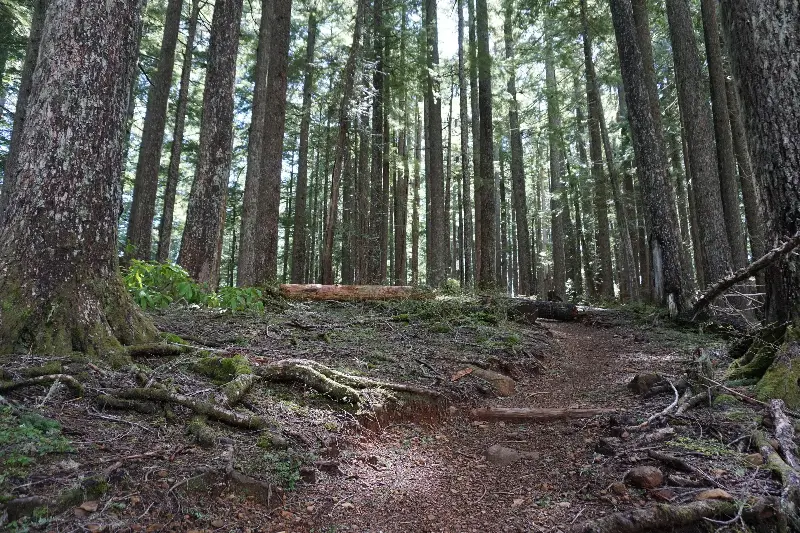
MOUNT ELLINOR, Olympic National Forest, Wash. — My first clue the Beast of Big Creek wasn’t an ordinary trail race? The trio chatting in Basque as they passed my campsite on their warmup jog.
Washington has a fervent competitive trail running scene, with over 200 races annually. Our temperate climate means there are races year-round, from low-elevation coastal routes in the damp winter to courses that cruise through the snow-free alpine in high summer.
Marquee events like the Cascade Crest 100, White River 50 and Chuckanut 50K are nationally competitive, but last month the Evergreen State hosted its first-ever global race bringing elite runners from 11 countries to the Olympic Mountains for a stop on the Merrell Skyrunner World Series.
Their task: Run up and down Mount Ellinor as fast as possible, covering a distance of 15 miles and 5,300 vertical feet. Their reward: Notching points to climb the leaderboard for a share of 100,000 euros (almost $117,000) in prize money.
For the Skyrunner World Series, the U.S. return was a chance to grow a niche sport in North America. For foreign athletes, the Aug. 1 race was an introduction to Pacific Northwest mountain culture. And for local runners, it was a rare chance to lace up next to some of the world’s top athletes.
“I never thought that there’d be a world series race here, let alone in Hoodsport,” said Robin Vieira Brower, marketing director for Seattle-based running brand Oiselle, who has traveled to Austria, Ireland and Switzerland to compete in skyrunning races. “Nothing beats running in the ferns then going up to an amazing summit.”
What is skyrunning?
Skyrunning is a subset of trail running with a focus on climbing over distance, often at high altitudes. Italian mountaineer Marino Giacometti conceived of the sport in the early 1990s with races in the Alps through technical, glaciated terrain. Straight up, straight down.
In the 30-plus years since that first race, the discipline has become more organized. There is now an International Skyrunning Federation that certifies courses, which must have an average incline greater than 6%, cover at least 20 kilometers and gain at least 1,300 meters. Those stats translate to courses with punishing climbs and unforgiving descents, where the technical agility to run downhill on uneven terrain matters as much as a marathoner’s endurance training. The most hardcore races might include scrambling over rocky ridges, ascending via ferrata or grabbing fixed ropes. Beast of Big Creek is tame by comparison — mostly on easy-to-run trail, no helmets required.
Since 2004, there’s been a world series that spans the globe. This year’s 19 races have ranged from high-altitude Tibetan trails in China’s Sichuan province to rocky ridgelines and mountain passes throughout Europe. Finish four races with at least one top 20 finish, and you qualify for the finals.
Rarely does North America feature on the race calendar: The last time the series came was in 2018 for The Rut 28K in Big Sky, Mont. The most iconic mountain races on North American soil focus on distance, like the Western States 100 and Hardrock 100 ultramarathons.
But as trail running grows by leaps and bounds — the U.S. industry estimates it has grown 8% annually over the last five years — there might be room for this European-style spin on mountain running to find its Vibram-soled footing in the North American market.
For one, Skyrunner relaunched its USA Series this year for the first time since 2019. Beast of Big Creek was the second of four stops, with runners tackling the Skeetawk Skyline Scramble in Hatcher Pass, Alaska, on Aug. 30 before finishing off in New Hampshire. Meanwhile, the decade-old La Sportiva Cirque Series, which organizes similar races at ski resorts, returns to Crystal Mountain for the second straight year on Sept. 19.
With Beast of Big Creek as part of the global circuit, said Etienne Rodriguez, Skyrunner World Series managing director, “We’re establishing a footprint here again.”
The Mount Ellinor effect
Mountain running may not command NFL-level fandom, but some 100,000 people, a mix of athletes, spectators and running industry insiders, descended on Chamonix, France, recently for the Hoka Ultra-Trail du Mont-Blanc. Ever since Ironman Group, the company behind the global triathlon series, began producing the sport’s highest-profile competition and affiliated races in 2021, the event has grown unwieldy — to the extent that Chamonix’s mayor has clamped down on this year’s festivities.
Early August in Hoodsport, Mason County, was tranquil by comparison, just another summer day on Hood Canal. Even though athletes coming from abroad booked up several short-term rentals — professional mountain running still veers more dirtbag than tennis pro, but elite sponsored competitors could at least count on a step up from pitching a tent like the local amateurs — the Skyrunner World Series is a long way from taking over the town. Were it not for signs at the entrance to Big Creek Campground, hikers heading for Mount Ellinor’s picturesque summit would never have known they were about to share the trail with elite runners who can sprint uphill and practically skip down.
The series feels scrappy compared to behemoths like UTMB (2025 revenue: 30 million euros, a little over $35 million) and live-on-TV competitors like the Salomon Golden Trail World Series. While Skyrunner’s organizers intend to grow — there’s talk of a continental series next year that would expand beyond the U.S. to incorporate Canada and Mexico — the technical nature of skyrunning will keep racer numbers in the low hundreds.
“You cannot have too many people on a ridgeline where if you fall, you die,” Rodriguez said.
The indie vibe means that dedicated Washington trail runners had the chance to share the trail with top athletes on race day and glean training tips over slices of watermelon under a national forest campground gazebo. In years past, that included the likes of Kilian Jornet, the closest thing to a mainstream celebrity in mountain running, who won the Skyrunner World Series four times.
“At the World Cup, you don’t get the chance to kick the ball with Messi,” Rodriguez said.
So, how did Beast of Big Creek end up on this global elite sporting calendar? For Olympia-based race director Mathias Eichler, of Rock Candy Running, the rationale was simple: “Yes, it’s part marketing, but it’s also a good way of bringing the trail running community together.”
That attitude stands somewhat at odds with other North American race directors, who have historically been less enamored of the international racing circuit. In 2017, directors of nine U.S. races, including the Cascade Crest 100, issued an open letter explaining why they refused to pay fees to count as qualifiers for the UTMB. (Beast of Big Creek, Leavenworth Ski Hill 50K, Skyline 25K and North Bend Skyline 30K are UTMB Index races, meaning competitors earn points that grant privileges when registering for UTMB majors.)
Victory on home soil
Sizing up the field of competition the day before the race, Rodriguez explained how the global nature of the Skyrunner World Series plays into varying strengths and weaknesses.
“South American athletes kill it because they all live at elevation,” he said. “A lot of Americans come from a track background and might have a big advantage here because they have a little more leg speed than Europeans will have. Then you go to Europe where they are very used to running on technical stuff and have a significant advantage there.”
For the current world series men’s leader and presumed favorite, José Manuel Quispe, there was a distinct drawback to racing in the Olympic Mountains: They’re too short. The 38-year-old Peruvian lives at 11,000 feet above sea level and regularly trains on peaks that crest 16,000 feet. It took him three days of travel, including a 20-hour bus ride from his village to Lima’s airport, to reach Hoodsport.
“I don’t feel well when I run at too low of an altitude,” he said. “It’s too humid.”
With most of the Mount Ellinor trail shrouded in forest, only bursting above the canopy close to the summit, Quispe lagged behind Colorado-based Morgan Elliott, the only U.S. runner in the world series men’s top 25, after mile two. The 34-year-old underdog’s track background and shorter travel time to the race worked in his favor — he crossed the finish line in 2:05:27, with the Peruvian favorite a little over four minutes behind. British runner Eve Pannone of team Brooks took the women’s race.
“I needed the points,” Elliott said, when asked what motivated him to best his Merrell teammate. His previous best finish had come at the first race of the season in Argentina, and he’d suffered heat exhaustion at Malaysia’s Penang Skyrace in April. A better showing on Mount Ellinor would bump his ranking heading into the finals.
Quispe, who won his home continent races in Argentina, Chile, Ecuador and Peru, said the highly runnable course with little to no scrambling was an opportunity to test his speed rather than a must-win competition. “I left some in the tank,” he said.
With a race win on home soil under his belt, Elliott has moved up to third place on the leaderboard and now sets his eyes on the SkyMasters Final. The two Western Hemisphere teammates will face off against Europe’s finest in the sport’s spiritual heartland, the Serra d’Espadà mountains of Spain, for 42 kilometers of rocky climbs and narrow ridgelines. When the Skyrunner World Series winner is ultimately crowned in November, for the first time the champion bib will come partly courtesy of the mossy, fir-lined trails of the Evergreen State.