



Once a market leader in China's AI sector, DeepSeek is slowing down due to lawsuits and competition, while MiniMax has become the top choice for investors.
DeepSeek is declining in the market of over a billion people. Photo: Reuters .
The artificial intelligence boom in China is entering a new phase. DeepSeek, once a global phenomenon with its incredibly low cost, is gradually slowing down due to legal troubles and fierce competition from domestic rivals.
Meanwhile, Chinese tech companies have just unveiled five entirely new AI models, boasting superior performance and resource optimization. With interest from UBS and major investors, the ranking of the billion-person AI market is being reshaped.
The new AI crown
Recently, Chinese tech companies have launched five new AI models, including Moonshot AI's Kimi K2.5, Zhipu AI's GLM-5, and Alibaba's Qwen. ByteDance has garnered attention with its Seedance 2.0 system. However, investment bank UBS has paid particular attention to the startup MiniMax and its M2.5 model.
An Openrouter report indicates that China has set a new record, surpassing the US in total global AI traffic. Four out of the five most popular AI models in the world today originate from China. MiniMax's traffic is now one-third that of Anthropic's Claude.
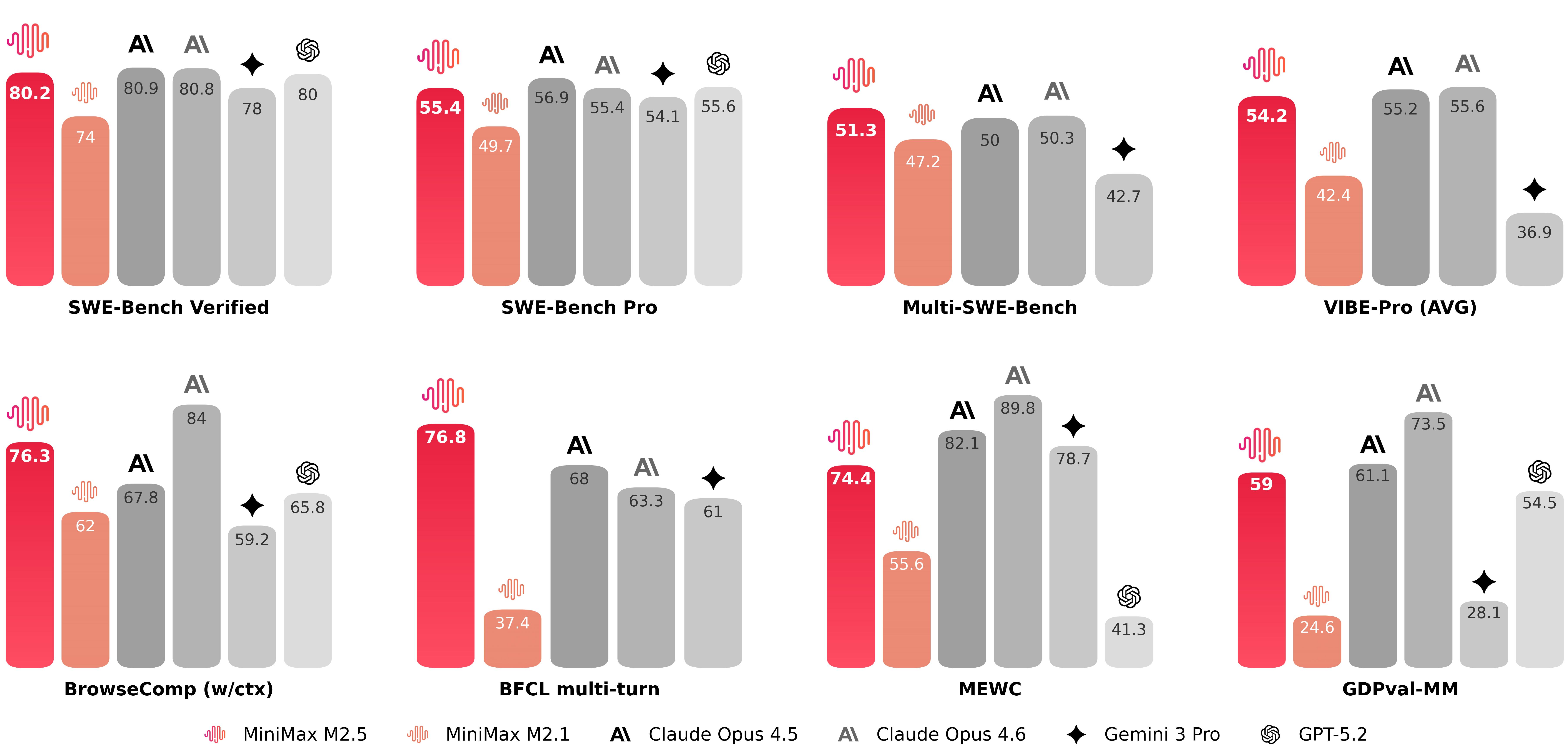
The M2.5 offers comparable performance to its rivals at a lower training cost. Photo: Minimax.
UBS highly values MiniMax's development strategy, which prioritizes cost-effective computing rather than simply copying expensive Western experimental models. Internal tests have demonstrated that the MiniMax M2.5 significantly outperforms the DeepSeek R1 in many tasks.
In particular, this system consumes only about 30% of the resources compared to DeepSeek. "With this competitive advantage, MiniMax is showing enormous appeal to developers and offers excellent cost optimization," a UBS analyst commented. Therefore, investment capital is rapidly shifting away from DeepSeek.
Alibaba is also achieving great success in the domestic business sector, with Qwen's market share nearly doubling in the second half of last year. Startups like Zhipu AI and Moonshot AI are also thriving in the programming and video creation niche.
The Kimi K2.5 is highly regarded for its ability to handle long texts, perfectly meeting the needs of the domestic market. Chinese developers are no longer dependent on a few major players or advanced chips from the US. They are constantly releasing updates with increasingly high quality, demonstrating intense competitive pressure.
A step backward for China's AI icon.
DeepSeek once shook the global tech world with its high-performance R1 model and very low training costs. The emergence of R1 even caused a decline in the stock value of many chip manufacturers.
But the situation has now completely reversed. The startup is becoming quiet due to global legal troubles, particularly the lawsuit from Anthropic.
DeepSeek and several other Chinese AI companies are accused of data copying. Photo: AIbusiness.
The company alleges DeepSeek illegally used "model distillation" techniques. According to the lawsuit, DeepSeek used the output of the Claude model to train its own AI and set up a sophisticated proxy network to conceal its data theft activities.
This network simultaneously managed over 20,000 fake accounts. This allowed DeepSeek to copy knowledge from Claude at a low cost. "They extracted capabilities from our model without our consent," an Anthropic representative stated. This lawsuit has stalled the development of new projects and damaged the company's international reputation.
Furthermore, DeepSeek's market strategy also revealed several weaknesses. The company decided to focus all its efforts on the domestic market. However, the Chinese AI market was facing competition in many areas at that time.
The Chinese AI market boasts numerous competitors such as MiniMax, Alibaba, and ByteDance, all with substantial financial resources. Unlike the US, where the game revolves around OpenAI, Anthropic, and Google, China has yet to develop a major "AI hub."
Censorship barriers, chip restrictions, and a sufficiently large domestic market allow multiple companies to coexist. However, delays in releasing updates have put DeepSeek at a disadvantage, and users are gradually shifting towards newer AI platforms.