



The transformation at Manchester United under Michael Carrick didn't come from tactical changes or immediate results, but from his management of the players and his ability to mend the broken bonds in the dressing room.
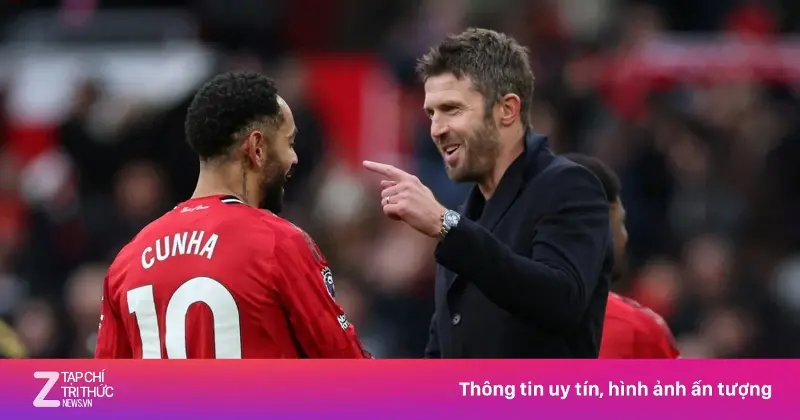
The 2-0 victory against Manchester City on January 17th held many layers of significance, but Michael Carrick's most notable contribution lay outside of the tactical board. In his role as interim manager, Carrick made coherent tactical decisions.
However, what truly set the dressing room ablaze was the way he spoke to the players—directly and closely enough. Carrick didn't build authority through distance; he chose clarity. The moment he put his arm around Benjamin Sesko after the derby is a prime example.
The Slovenian striker had scored three goals in the previous two matches, but was still benched and not brought on in the big game. Carrick didn't "indulge" the player by disrupting the plan. He maintained his decision to go without a striker to ensure the team's strategy.
The crucial part comes after the match: reassuring, explaining, and maintaining trust. A difficult decision must be closed smoothly, leaving no psychological void.
This approach contrasts with the era of Ruben Amorim. Amorim prioritized structure and discipline, placing faith in a self-regulating system and the selection of individuals. That approach is logical.
But in the context of Manchester United possessing many young and inconsistent players, it easily creates a communication gap. This is not because Amorim lacks decisiveness, but because the aspect of "making the players understand" has not been properly prioritized.
Carrick chose a different path. He made no promises, nor did he beat around the bush. Players might not get to play, but they always knew why they were left out and their role in the next phase of the game. At the highest level, that transparency is as valuable as tactics.

Carrick's coaching philosophy is demonstrated through action: helping each individual improve to raise the quality of the team as a whole.
The difference is also evident in how Carrick views the club system. He attends youth team matches, sending the message that the academy is not uninvolved in the project.
Carrick gave Kobbie Mainoo a chance in the Premier League after a period of limited playing time for the midfielder. This wasn't a matter of favoritism, but a choice based on his current abilities.
In Sesko's story, the management process is continuous. Previously, when Darren Fletcher was interim manager, the striker was given private conversations, shown videos , and instructed on how to move and when opportunities would arise.
Carrick didn't break that pattern. He maintained tactical discipline, but didn't cut off confidence. The result was a young player who understood his place, whether or not he played in a particular match.
Carrick's coaching philosophy is demonstrated through action: helping each individual improve to raise the quality of the team as a whole. He accepts difficult professional decisions, but always compensates with communication and timely presence.
Carrick is still in his early stages. A few wins or a few good managerial gestures are not enough to define his long-term future. But Manchester United have seen one important thing: when communication is in the right place, the team can stabilize faster. That's what Carrick is doing, and something Amorim hasn't had time to do at Old Trafford.