



The Paris subway system stands out as a masterpiece in the heart of the glamorous capital, rivaling the subway systems of London or New York.
Since the first metro line connecting Neuilly with Vincennes officially opened in 1900, the Metro system has gradually developed into an indispensable "underground network" of Paris. Not only does it meet the need for fast and efficient transportation in the bustling city, but this metro network has also become a standard of daily life for the capital's residents – where waiting more than four minutes for a train is enough to provoke complaints from even the most demanding passengers.
In addition to its role in transportation, the Metro is now considered a unique urban heritage, preserved and maintained by the Paris Public Transport Company (RATP) for generations.
306 stations spread across 16 lines
From the beginning of the 20th century, the subway quickly became a familiar mode of transportation for Parisians, especially for the working class, as it facilitated their convenient commute between their homes and the factories and workshops concentrated in the city center.
Paris's first metro line was modestly long, only about 10 km, and officially opened in 1900, coinciding with the city's hosting of the World's Fair. The Art Nouveau-style station entrances, designed by architect Hector Guimard, also appeared during this period, gradually becoming a distinctive architectural landmark and a familiar symbol of the Parisian capital.
By the early 1970s, the image of the subway had gradually become associated with the fast-paced yet monotonous urban life, clearly depicted in the famous slogan that is still passed down today: "Metro, Boulot, Dodo" - subway, work, and sleep.
Currently, the Paris metro system has a total length of approximately 227 km, comprising 306 stations spread across 16 independently operating lines and serving an average of 4.2 million passengers per day, making it one of the largest metro systems in the world.
The stations are typically spaced about 500 meters apart, making urban travel quick and convenient for residents. Most subway lines are still operated manually by train drivers who handle the opening and closing of doors to pick up and drop off passengers. Lines 1 and 14 are fully automated and do not require human operators, although staff are always on standby to intervene in emergencies.
The first line, Line 1 (yellow), lacked underground drilling technology and was built entirely above ground, inaugurated on July 19, 1900, running through Paris from east to west. In 1998, Paris witnessed a historic moment – Line 14, the final line to be inaugurated, became the world's first fully automated, driverless subway line, offering passengers exceptional safety thanks to its automatic doors.

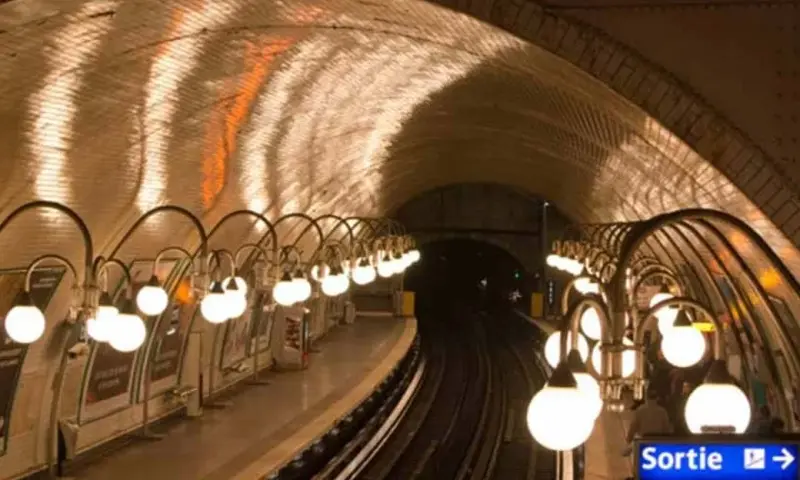
Inside a subway station in Paris, France. (Photo: Gilles)
During the 1920s, the population in the areas surrounding Paris grew rapidly, so the subway network was extended to several suburban cities, such as lines 1, 9, and 12.
Most of the walls and ceilings of the metro stations are tiled with square white ceramic tiles because they are reflective. Previously, due to a very weak lighting system—with only one 15-watt light bulb every 5 meters—a special wall coating was needed to prevent light loss. The average depth of the metro is between 4 and 12 meters. However, some stations reach depths of nearly 32 meters, such as beneath the Chaumont Hill (Buttes Chaumont), in the 19th arrondissement, north of Paris.
Ride the Paris-style subway.
The subway has long been an integral part of working life in the French capital. For locals, traveling by Metro is quite smooth, from transferring lines to finding exits, everything has become familiar.
However, for travelers, this system often becomes a "challenge." The biggest difficulty lies in the high density of passengers, especially during peak hours. At those times, the corridors and platforms quickly turn into dense lines of people rushing towards their destinations.
For first-time users, traveling on the Paris Metro usually begins with a few basic steps. First, passengers need to verify their ticket by inserting it into the slot of the turnstile at the station entrance. Then comes the journey of navigating the intricate network of underground corridors to reach the desired train line.
Under favorable conditions, train passengers know the direction of their destination station and choose the appropriate entrance from the start. However, for a truly Parisian travel experience, another detail is crucial: passengers need to know which carriage and door to stand in for convenient access to the station or transfer to another line, saving time and avoiding unnecessary crowds.

The most beautiful subway line in Paris.
Once inside the train carriage, passengers must adhere to basic rules of conduct on the Paris subway. Most importantly, avoid blocking the way when others are boarding or alighting, and refrain from pushing or shoving. If you feel uncomfortable due to the cramped space, the best option is to remain calm and wait for the train to stop at the next station.
Upon exiting the station, signs indicating "sortie" will help passengers find their way to the surface. However, finding the correct exit isn't always straightforward. Many Paris stations have numerous exits, sometimes dozens, so choosing the one closest to your destination is crucial. A single mistake can significantly extend your walk.
The most beautiful view of Paris from the metro is the stretch between the Passy and Bir-Hakeim stations on Line 6 leading to the Eiffel Tower. This is the only line that doesn't run entirely underground, but mostly on elevated walkways. The entire Eiffel Tower, with the Iéna Bridge and the two banks of the Seine River in the background, blend together to create a magical and enchanting scene.
Besides the stations considered beautiful and iconic, the Paris subway network still has many abandoned stations, often referred to as "ghost stations" because they no longer serve passengers.
The Paris metro system was built in a record time, from 1898 to 1914. In 1910, the first six metro lines were put into service. By the time of World War I (1914-1918), the network was 91 km long, comprising 10 lines.