


Eleven Moroccan players on the field, wearing crimson jerseys with a five-pointed green star in the center of the chest. Eleven players on a rectangular pitch in the center of the stadium with tens of thousands of fans... All broadcast on screens in many countries around the world . What could be more effective in promoting the image of a national team?
According to the French newspaper Le Point, the World Cup is consistently the most-watched event in the world, surpassing even the Olympic Games. Despite time zone differences (some matches are broadcast around 2-3 am), spectators flock to the stadiums, fan zones are packed, and viewership for channels that pay for broadcasting rights reaches record highs.
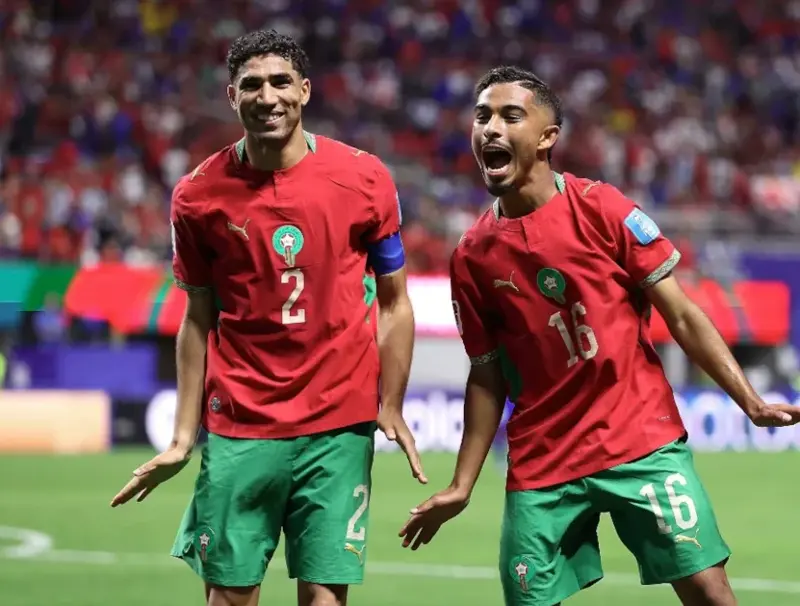
Players Gessime Yassine and Achraf Hakimi during the match between Morocco and Haiti on June 24. Photo: GETTY IMAGES
Over the past four years, Morocco has consistently achieved results befitting its ambitions: reaching the semi-finals of the 2022 World Cup in Qatar; hosting and winning the African Cup of Nations in late 2025; and reaching the quarter-finals of the 2026 World Cup in the USA before being defeated 2-0 by France this morning (July 10). This is a similar result to what happened in the World Cup semi-final four years ago. Previously, at the 2022 World Cup, the first time it was held in an Arab nation, Morocco brought an Arab-Islamic team to Qatar and reached the semi-finals. This result had a strong impact on football fans, showcasing the elegance and skill of the Moroccan team that was praised worldwide. In that semi-final, France beat Morocco 2-0, ending the journey of "The Lions" (Morocco's nickname) in Qatar.
At the 2026 World Cup, after making a strong impression against Brazil in their first match (1-1) and then successively defeating Scotland, Haiti, the Netherlands, and Canada..., Morocco was the only representative of 22 Arab countries, 54 African countries, and Muslim countries to reach the round of 16.
In European capitals, Morocco's victory sparked jubilant celebrations starting at 5:30 a.m. Car horns blared throughout Brussels (Belgium), Paris (France), and Palermo (Italy)... Moroccan communities abroad and second and third-generation immigrants took to the streets to cheer on the Moroccan team.
Although underdog teams often win the hearts of fans craving something new, four years after the World Cup in Qatar, Morocco has changed its status. They are now considered a formidable force, a nation that could become a football powerhouse in the future. The African nation is now aiming for the 2030 World Cup – an event co-hosted by Spain, Portugal, and Morocco.
As the 2026 World Cup draws to a close, construction has begun on Block 6 of the Casablanca Stadium, which includes 42 escalators, elevators, and moving walkways. The accompanying figures are spectacular: the stadium, shaped like a desert rose, will have a total capacity of 115,000 seats and will require a budget of 5 billion dirhams (approximately 470 million euros). In total, six stadiums will be built or modernized before the 2030 World Cup finals.
Although the funding allocated to the world's biggest football tournament remains controversial, it cannot challenge Morocco's ambitions in future World Cups. Therefore, despite losing to the French in this morning's quarter-final, the Lions still harbor ambitions of becoming a football powerhouse at the 2030 World Cup.