



3 supermoons, 13 full moons
Normally, there are 12 full moons each year; however, 2026 will see 13, with May having two. The second full moon in the month is called a blue moon, a phenomenon that occurs on average only once every 2.5 years.

A supermoon rises behind a Benedictine monastery in November 2025 in Kraków, Poland. (Photo: Getty Images)
In addition, this year there are three supermoons, in January, November, and December. The December supermoon is when the Moon is closest to Earth, only about 356,740 km away, making the full moon appear brighter and larger than usual.
The list of full moons in 2026 includes: Snow Moon (February 1st), Worm Moon (March 3rd), Pink Moon (April 1st), Flower Moon (May 1st), Blue Moon (May 31st), Strawberry Moon (June 29th), Deer Moon (July 29th), Sturgeon Moon (August 28th), Harvest Moon (September 26th), Hunter Moon (October 26th), Beaver Moon (November 24th), and Cold Moon (December 23rd).
Maximum meteor shower
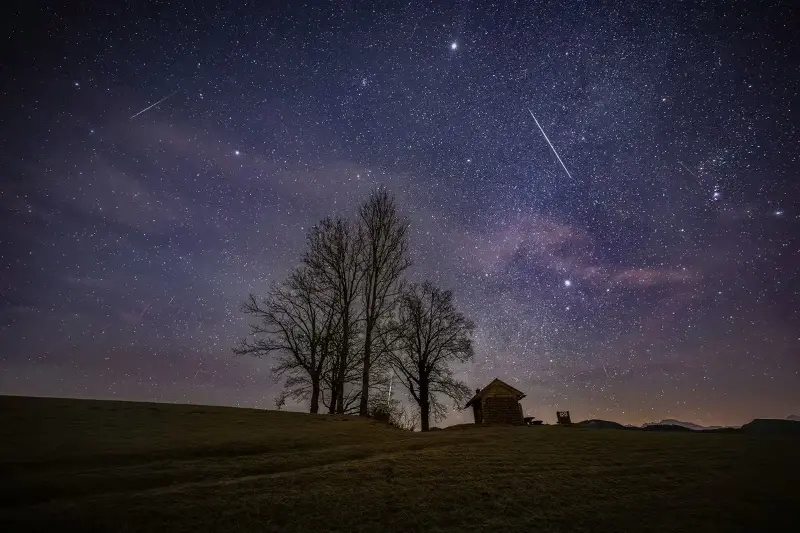
According to the American Meteor Society, 2026 will see more than 10 meteor showers reaching their peak, with the Perseid (August) and Geminid (December) considered the most spectacular.
Robert Lunsford, meteor reporting coordinator for the American Meteor Society, said this year's Perseid meteor shower peaked under favorable conditions, with almost no moonlight interference, increasing the chances of observing the bright streaks of stars stretching across the night sky.

The Geminid meteor shower peaks in the Austrian sky in December. (Photo: Shutterstock)
Meanwhile, the Geminid meteor shower is expected to maintain its strong intensity. In 2025, Geminid recorded a rate of up to 135 meteors per hour at its peak. According to astronomers, there is no indication that this intensity will decrease in 2026, especially with the early moonset, creating favorable conditions for observation.
Besides the two prominent meteor showers mentioned above, other notable phenomena this year include the Eta Aquariid (May), Southern Delta Aquariid and Alpha Capricornid (late July), Orionid (October), Taurid (November), and Ursid (late December), offering many meteor-watching opportunities for astronomy enthusiasts.
Two solar eclipses, two lunar eclipses
The year 2026 will see two solar eclipses and two lunar eclipses.
On February 17th, an annular solar eclipse occurred in Antarctica when the Moon was not large enough to completely cover the Sun, creating a "ring of fire" effect. A partial solar eclipse at the same time could be observed in some areas of Africa and South America.
On August 12th, a total solar eclipse will be visible in Greenland, Iceland, Spain, Russia, and Portugal. A partial eclipse may be observed in other areas of Europe, Africa, and North America. Experts advise people to use protective eyewear to avoid eye damage.

An annular solar eclipse observed in Puerto San Julián, Argentina, in October 2024. (Photo: Getty Images)
Meanwhile, a total lunar eclipse will occur on March 3rd, visible in Asia, Australia, the Americas, and the Pacific region. When the Moon enters the Earth's umbra (shadow), it will turn a deep red, a phenomenon often referred to as a "blood moon".
Additionally, a partial lunar eclipse will occur from August 27-28, visible in the Americas, Europe, Africa, and West Asia.
Six planets appeared simultaneously.
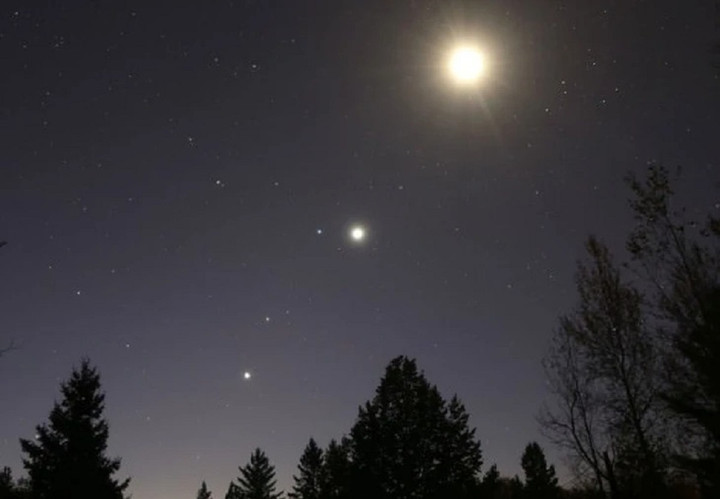
From top to bottom: The Moon, the dwarf star Regulus, Venus, Mars, and Jupiter. (Image: Universetoday)
In February 2026, the night sky will witness the simultaneous appearance of six planets. Venus, Mercury, Jupiter, and Saturn can be observed with the naked eye under favorable conditions, while Uranus and Neptune will require binoculars or a telescope.
Other notable phenomena include a crescent moon between Venus and Jupiter in May, followed by a planetary swap in early June, and then a brief eclipse of Jupiter by the Moon in October.
In the early morning of November 16th, the brilliant red glow of Mars will appear near Jupiter, creating a pair of glittering planets in the sky.