



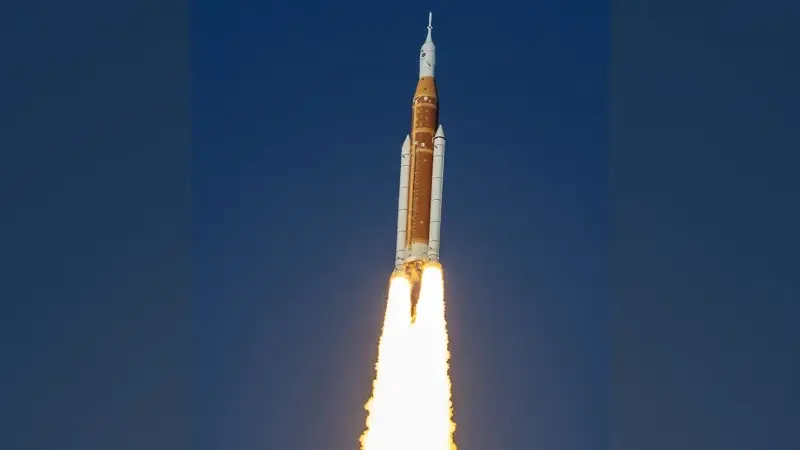
After more than half a century, the Artemis II mission has officially launched, setting unprecedented records in humanity's journey to take us further into space.
At 5:35 AM on April 2nd (Hanoi time), the Space Launch System (SLS) – NASA's most powerful rocket on the planet – lit up the skies of Florida (USA), launching four astronauts on a 10-day journey toward the Moon.
This was the first crewed flight toward Earth's natural satellite since the Apollo 17 mission in 1972.
The Artemis II crew will orbit the far side of the Moon in a "free return" orbit and will not land. However, the mission serves as a strategic "pivot," testing human survivability and operational capabilities beyond low Earth orbit.
Artemis II also set records in the journey to take humanity further into space.
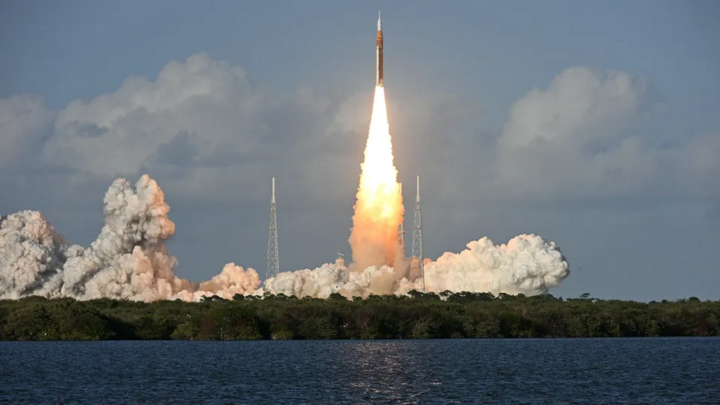
NASA launched the Artemis 2 spacecraft carrying astronauts to the Moon on April 1st. (Source: Getty Images)
The "firsts" in history
Onboard the Orion spacecraft, the four chosen individuals are not only outstanding astronauts but also symbols of equality and extensive international cooperation in this new era.
The Artemis II mission marked a historic milestone as, for the first time, a woman, Christina Koch, and a Black astronaut, Victor Glover, participated in a journey to the Moon, officially breaking down prejudiced barriers that had existed for decades.
Furthermore, the participation of Jeremy Hansen, the first Canadian to fly into deep space, along with the leadership of seasoned commander Reid Wiseman, demonstrated a strong and enduring space alliance.
Instead of being a solitary race for one nation, Artemis II is a symbol of human unity, where the most outstanding individuals from diverse cultures and ethnicities join forces to open the door to the vast universe.
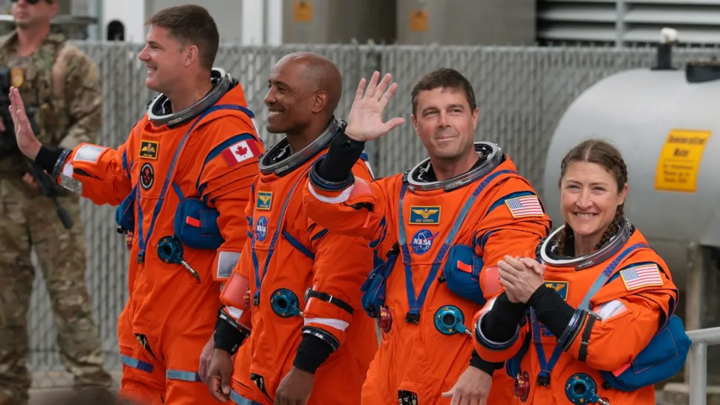
Four astronauts from NASA's Artemis 2 mission. (Source: Getty Images)
In addition to the human element, Artemis II also marks the first time the Orion spacecraft and SLS rocket have directly carried people into space.
In particular, the crew will perform manual control tests, a vital skill that simulates docking the spacecraft in tight spaces instead of relying entirely on automated systems.
Breaking the distance record.
Artemis II was not just a test flight, but also a place that set milestones in both range and mechanical power.
When orbiting the far side of the Moon, the crew will be approximately 406,841 km from Earth. This is the furthest distance ever achieved by humans in history, breaking the record held for over 50 years by the Apollo 13 mission.
To propel the Orion spacecraft beyond Earth's gravity and achieve this incredible distance, NASA used the Space Launch System (SLS) – the most powerful mechanical "monster" ever built.
This system boasts an enormous thrust of up to 8.8 million pounds (approximately 4,000 tons), 15% more powerful than the legendary Saturn V rocket from the Apollo era.
This power comes from the combination of two massive solid-fuel rocket boosters and four state-of-the-art RS-25 engines, allowing the Orion spacecraft and its crew, weighing nearly 30 tons, to launch directly into deep space at extremely high escape velocities.
Emily Nelson, Director of the Artemis II flight, commented: "The record-breaking distance is an interesting statistic, but what we learn about operating the life support system and engine stability in deep space is what's most important for future long-term missions."
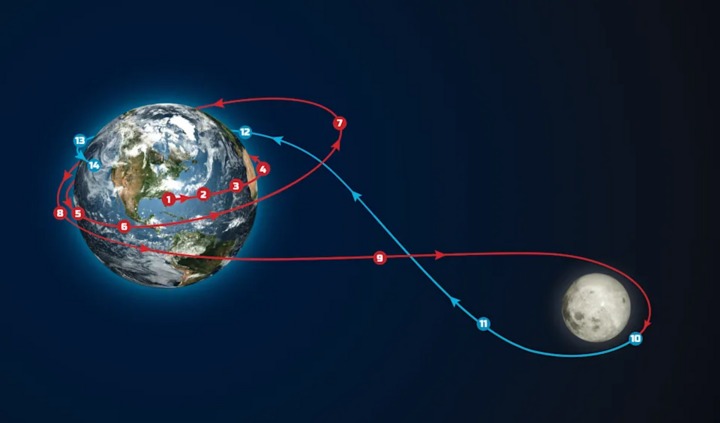
This diagram illustrates the flight path of Artemis 2, depicting the Orion spacecraft's journey from Earth around the Moon and back. (Source: Roen Kelly)
Industry 4.0 and Survival
The difference between Artemis II and the Apollo missions lies not only in the timeframe but also in a revolution in engineering thinking. While the navigation computer of Apollo 11 had only 64 KB of memory and a processing speed slower than even a modern-day calculator, the Orion spacecraft was a true "supercomputer."
Orion's control system boasts the ability to process millions of calculations per second, enabling the automation of most complex trajectories and instantaneous responses to events in space.
Instead of hundreds of densely packed mechanical switches like older spacecraft, the Orion cockpit is simplified with modern multi-touch screens, allowing astronauts to interact with the spacecraft more intuitively and precisely in zero-gravity conditions.
In particular, the "survival" factor has been elevated to a whole new standard with the introduction of the Universal Waste Management System (UWMS). This is not simply a zero-gravity toilet, but a multi-million dollar engineering masterpiece.
UWMS is designed to be 65% more compact and 40% lighter than systems on the International Space Station (ISS), specifically optimized to serve equally both male and female astronauts in the confined space of the Orion spacecraft.
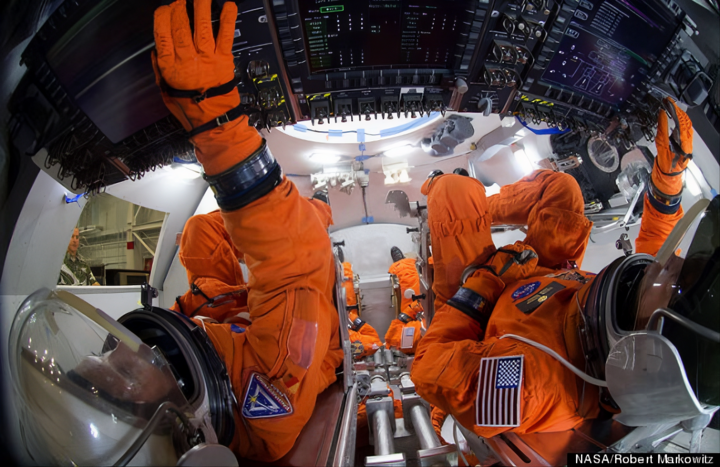
The Artemis 2 crew in the Orion cockpit. (Source: NASA)
A decade of preparation and missed opportunities.
To achieve this remarkable success, NASA had to endure a challenging journey spanning over 10 years. The Artemis project not only cost tens of billions of dollars but also faced immense pressure from technical hurdles.
This mission has been significantly delayed at least five times since its original plan in 2022. Problems arising from the Orion spacecraft's heat shield after the unmanned test flight (Artemis I), along with budget constraints and harsh Florida weather, pushed the timeline to April 2026.
However, the wait was worthwhile to ensure the absolute safety of the astronauts.
A stepping stone to bases on the Moon and Mars.
The mission takes place amidst a heating-up global space race. NASA Administrator Jared Isaacman emphasized the goal of returning Americans to the Moon by 2028 and establishing a permanent base by 2032.
"The difference between success and failure will be measured in months, not years," Isaacman asserted, emphasizing the urgency of competition from other space powers.
For astronaut Christina Koch, the Moon is a "Rosetta stone" for deciphering the universe. "It's a crucial stepping stone to Mars, where we have the highest chance of finding evidence of extraterrestrial life," she stated.
When the Orion spacecraft returns and lands safely in the ocean in the next 10 days, it will open the door to the Artemis III mission – a mission to actually put humans on the surface of the Moon in the near future.