



NASA says the Artemis II mission could launch as early as April 1, taking a crewed crew past the Moon for the first time in over half a century.
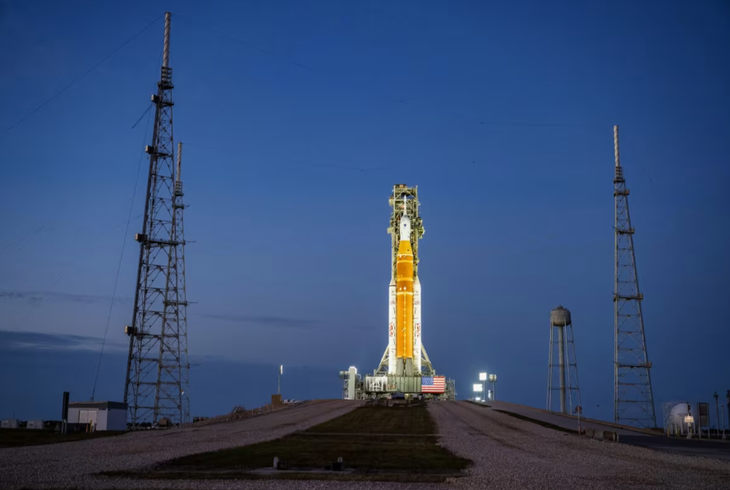
NASA's Artemis II SLS rocket and Orion spacecraft at NASA's Kennedy Space Center in Florida - Photo: Keegan Barber/NASA
On March 12, the US National Aeronautics and Space Administration (NASA) announced that the Artemis II mission could be launched as early as April 1, marking the first crewed flight past the Moon in over 50 years.
According to CNN, at a press conference, Lori Glaze, a senior NASA official, said the agency is aiming for a launch at 6:24 p.m. on April 1 (local time), after several technical issues caused a delay to the planned February launch.
NASA also reserved six additional launch dates: April 2, 3, 4, 5, 6, and 30.
"Our team of thousands of people has coordinated a tremendous amount of work to prepare for this flight," said Ms. Glaze.
"We had very thorough discussions – very open and transparent," she added. "The parties exchanged views extensively on the level of risk and the measures being taken to mitigate those risks."
Artemis II will be a crewed test flight to orbit the Moon without landing. The mission will include three American astronauts, Reid Wiseman, Victor Glover, and Christina Koch, and one Canadian astronaut, Jeremy Hansen.
According to the plan, after launch, the spacecraft will orbit the Earth before leaving orbit to head towards the Moon, making a flyby of the surface at a distance of 6,437-9,656 km, then return to Earth and land in the ocean.
Following Artemis 2, NASA plans to deploy Artemis III in preparation for landing on the Moon, while Artemis IV aims to make a landing mission in early 2028.
Also on March 12, NASA announced that the Van Allen Probe A spacecraft had re-entered Earth's atmosphere on the morning of March 12, much earlier than predicted. While most of the spacecraft's structure was expected to burn up upon re-entry, some parts may have survived.
The spacecraft was launched in 2012 to study the Van Allen radiation belts surrounding Earth, and operated until 2019 before running out of fuel.