



With its elegant design, harmoniously blending East Asian and modern styles, Japanese-style roofs have become a popular trend in Vietnam.
With its moderate slope and elegant design, the Japanese-style roof gives a feeling of luxury, durability, and coolness. However, in reality, many homeowners still make serious mistakes when building Japanese-style roofs, resulting in unsightly structures, increased costs, and reduced lifespan.
Incorrect calculation of slope
Japanese-style roofs have a moderate slope (30-40 degrees), requiring careful calculations to ensure proper drainage, especially in rainy conditions like those in Vietnam. Many buildings suffer from leaks and water accumulation on the roof due to excessively low slopes or poorly designed drainage systems. This is a serious technical error that directly affects the durability of the roof and the building's structure.
A slope that is too shallow will easily cause water to accumulate, while a slope that is too steep will ruin the "authentic Japanese" design and waste materials.
The roofing material is unsuitable.
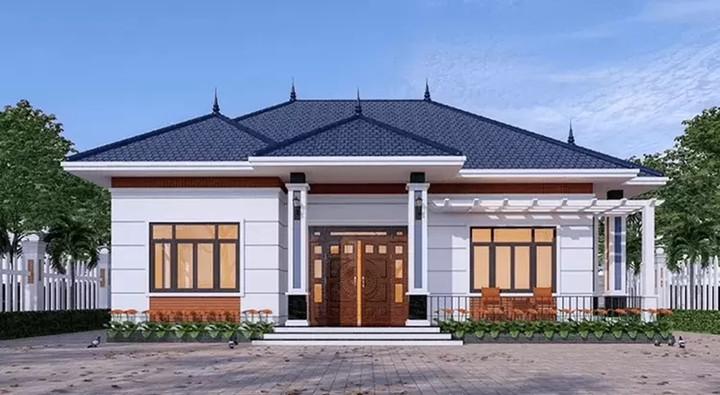
Japanese-style roofs are well-suited to colored tiles and lightly corrugated tiles. (Photo: Vinh Tuong)
Some homeowners choose roofing materials based on intuition or by prioritizing low prices, which may not be suitable for the structure of Japanese roofs. For example, using tiles that are too heavy for an unreinforced roof system, or using low-quality tiles that easily fade and crack after a few years of use.
Japanese-style roofs are typically suited to colored tiles or lightweight corrugated tiles, which are highly durable and offer good heat resistance. Choosing the wrong material not only reduces aesthetic appeal but also increases repair costs in the long run.
Inaccurate roof structure construction.
The roof structure is the "backbone" that determines the safety of a Japanese-style house. However, many constructions suffer from defects due to poor workmanship, deviations from the blueprints, or the use of substandard materials to save costs.
As a result, the roof sags, becomes misaligned, and cracks after a period of use, especially during heavy rainstorms. This is a difficult problem to fix and poses many risks.
Skip the detailed drawing design.
Many homeowners only request a general design, without going into detail. This leads to difficulties during construction and can even cause problems with the quality of the work. A detailed drawing helps to accurately identify each stage, from the roof and drainage system to the smallest details.
The cost estimate was unrealistic.
Japanese-style roofs are often more expensive than flat roofs due to their complex structure and materials. Many families initially estimate too low, only to find numerous unforeseen expenses during construction, such as foundation reinforcement, increased roof area, and material changes, significantly increasing their budget.
The lack of a detailed budget from the outset can easily put homeowners in a passive position, forcing them to cut back on other important items.