



The Moon is still contracting, creating thousands of young subsurface mountain ranges (SMRs) and posing a potential earthquake risk, directly impacting future Artemis missions.
Scientists have just published a comprehensive study showing that the Moon—Earth's natural satellite—is still contracting. As its interior cools, its single-layered crust is compressed, creating distinctive landforms such as lobed cliffs and small subsurface mountain ranges (SMRs). These are young geological features, spread across the lunar seas, and could become the source of future earthquakes.
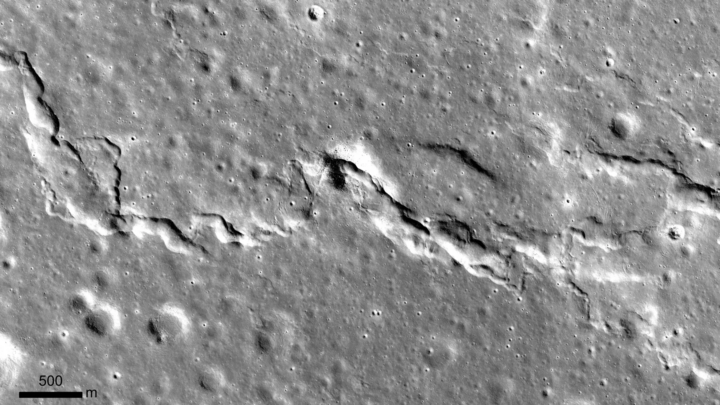
Small Mountain Range (SMR) in northeastern Mare Imbrium, photographed by the Lunar Reconnaissance Orbiter. (Source: NASA)
In a new study, a team at the Center for Earth and Planetary Studies at the National Air and Space Museum - Smithsonian Institution (USA) has created the first global map of subsurface mountain ranges (SMRs). They identified 2,634 subsurface mountain ranges, of which more than 1,100 were previously unknown. The average age of the SMRs is approximately 124 million years, nearly the same as that of the lobed cliffs (105 million years). This suggests that both are among the youngest structures on the Moon. Notably, many SMRs formed along the same type of fault as the lobed cliffs, reinforcing the hypothesis that they share a common tectonic origin.
The differences between lunar and Earth tectonics are also highlighted. Earth has plate tectonics, where tectonic plates move, collide, and create mountains, ocean trenches, or volcanoes. In contrast, the Moon has no tectonic plates, only a continuous crust. As stress builds up, it creates cliffs and small mountain ranges. These characteristics show that the Moon is still a dynamic celestial body, not "static" as many once thought.
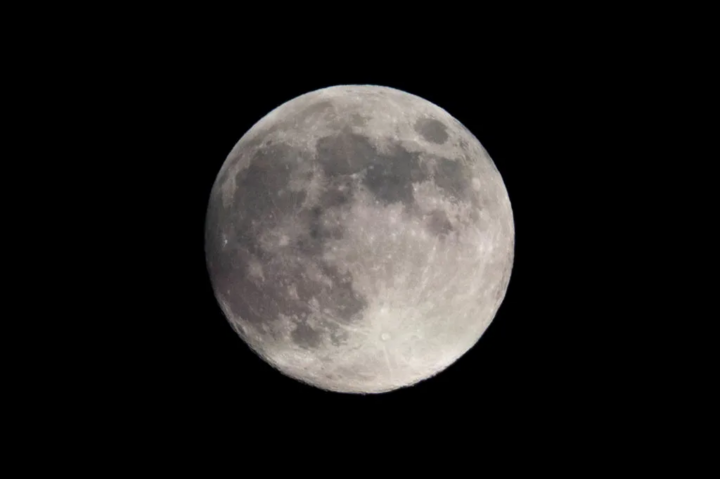
A panoramic image of the Moon showing clearly defined seas and impact craters. (Source: Getty Images)
This new discovery has significant implications for future exploration missions, particularly the Artemis program. Expanding the map of potential earthquake sources helps scientists predict seismic risks, thereby selecting safer landing sites for astronauts. Simultaneously, the research provides deeper insights into the Moon's internal structure and thermal history. As geologist Cole Nypaver shared, this work completes the global picture of a shrinking Moon, opening up new research opportunities and warning of potential risks for humans living long-term on its surface.
With over 2,600 recorded SMRs, this study confirms that tectonic activity on the Moon is still ongoing. This not only sheds light on the geological evolution of the natural satellite but also lays the foundation for ensuring safety in future space exploration missions.