



The disparity in intensity and physical fitness levels ultimately led to Real Madrid's 1-2 defeat against Bayern Munich in the first leg of the Champions League quarter-finals at the Bernabeu.
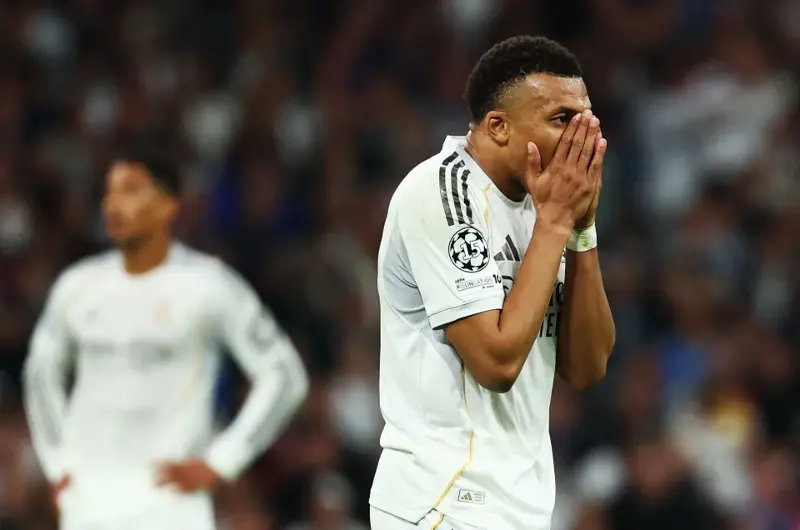
Top-level football is always decided by details. But at Santiago Bernabeu on the morning of April 8th, those details weren't in moments of genius, but in the dry statistics of distance covered and intensity of activity. Bayern Munich didn't just beat Real Madrid; they won with a simple yet ruthless weapon: physical fitness.
When physical strength becomes a tactic
In 90 minutes, the German team covered a total of 110.9 km. Real Madrid only covered 101.9 km. The difference of nearly 9 km is not a meaningless number. It reflects the overall picture of the match.
Bayern are quicker to get into tackles. They fill gaps faster. And most importantly, they maintain a tempo that Real Madrid can't keep up with.
The match was therefore quickly steered toward the course Bayern desired. From the first half, the visitors controlled the space better. Luis Diaz's opening goal in the 41st minute was the result of constant pressure. It wasn't a random moment, but the culmination of a series of pressing situations, ball recovery, and high-speed reorganization of attacks.
After the break, Bayern didn't slow down. On the contrary, they accelerated. Harry Kane scored the second goal almost immediately, putting Real Madrid in a chasing position. When Kylian Mbappe pulled one back to make it 1-2 in the 74th minute, hope flared up at the Bernabeu. But that was just a small spark amidst the storm of physical intensity that Bayern created.
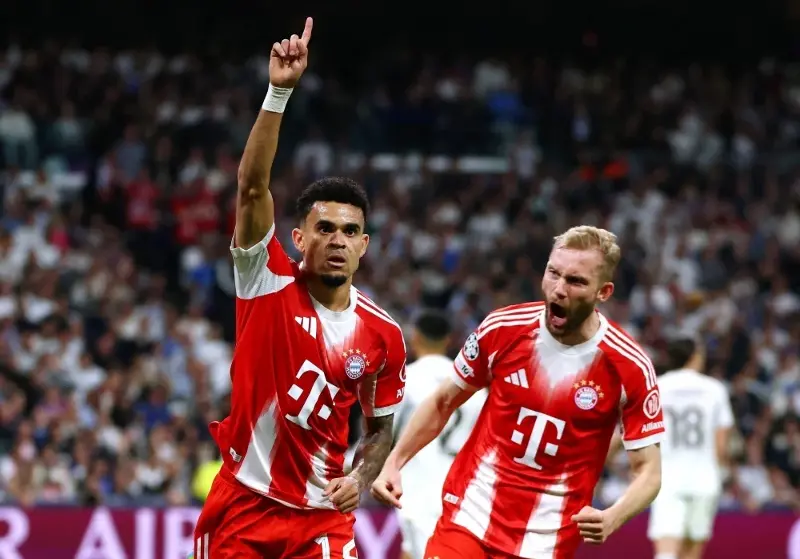
Bayern Munich had a convincing performance.
The key point isn't that Bayern ran more, but how they turned that distance into a tactical advantage. Vincent Kompany's team didn't run aimlessly. Every step was tied to a specific objective: pressing, recovering the ball, creating space, or transitioning the attack.
Bayern created 56 attacks, more than Real Madrid (52). They also had 11 corner kicks, a number that shows the constant pressure on the home team's defense. But more importantly, Bayern always had enough players at both ends of the field. When attacking, they pressed. When defending, they immediately retreated with incredible speed.
The balance of ball control (50%-50%) is just the surface. In reality, Bayern controlled the game through tempo. They had more accurate passing (90% compared to 88%), but what's noteworthy is their off-ball movement. Bayern's lines always maintained a good distance between them, making it difficult for Real Madrid to build up play.
Arbeloa's team doesn't lack technique. But they lack space. And when space is constricted, passes become ineffective.
Real Madrid completed 403 passes, but most of them didn't create any breakthroughs. Bayern forced their opponents to play the way they wanted: slow, passive, and vulnerable when they lost possession.
Bernabeu powerless against the German machine.
One of the biggest paradoxes of the match was that Real Madrid had 20 shots on goal, the same as Bayern. But the results were completely different. Bayern scored 2 goals. Real Madrid only 1. The difference lay in the quality of the chances and, once again, in physical fitness.
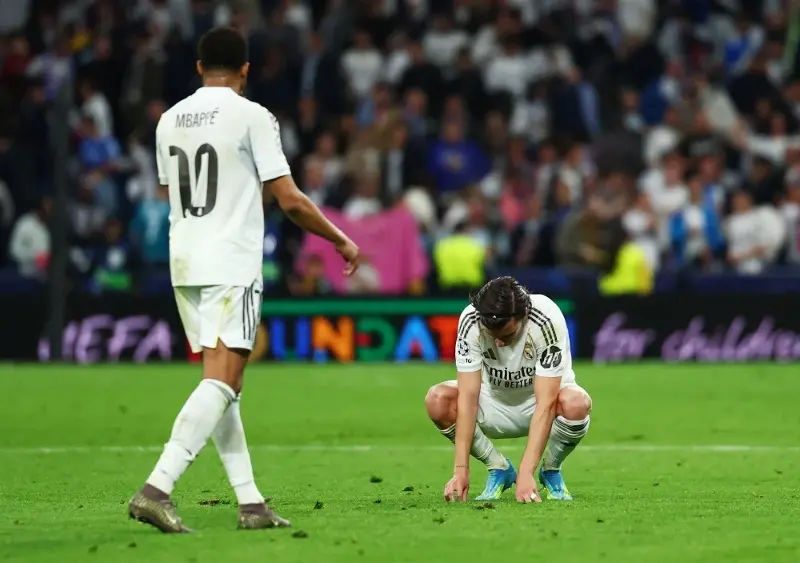
Real Madrid collapsed at the Bernabeu in the first leg of the Champions League quarter-finals.
Bayern goalkeeper Manuel Neuer made nine saves, an impressive number. But you can't just look at the individual. Bayern's defensive system worked as a unified unit. They recovered 27 balls, were only offside twice, and always maintained their concentration.
Even when Real Madrid pushed their lines forward after Mbappe's equalizer, Bayern held firm. They didn't panic. They didn't fall apart. Simply because they had enough energy to maintain their structure. That's something Real Madrid lacked.
Bayern's counter-attacks are the clearest evidence of this. Whenever Real Madrid lose possession, Bayern immediately switch to high-speed play. The 9km distance covered is not just a number; it's the foundation for Bayern to execute decisive bursts of speed at the end of the match, when Real Madrid are exhausted.
This defeat was not an accident. It was the consequence of a match where Real Madrid were drawn into a physical battle and couldn't break free. In modern football, technique and individual skill are still important. But without a corresponding physical foundation, everything becomes meaningless.
Bayern Munich proved that at the Bernabeu. They didn't just win a game. They sent a clear message: at this level, whoever runs more has control of the game.