



Sweden has just recorded a new breakthrough in addressing waste-to-energy with the launch of the Niels Bohr parking lot. This is the first project in Europe to use old wind turbine blades to create a facade, combined with an environmentally friendly vegetation system.
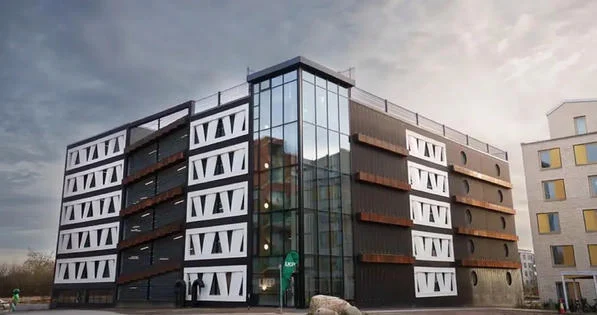
Located in the Brunnshög planning area of Lund, the new Niels Bohr parking garage makes a strong impression thanks to its unique structure. The building utilizes 57 wind turbine blades salvaged from the decommissioned Nørre Økse Sø wind farm of the Vattenfall energy group. Instead of being discarded, they were repurposed to create "screen walls"—a non-load-bearing cladding that encloses a large portion of the building's facade.
Anne Mette Traberg, Country Director of Vattenfall in Denmark, commented that this is a clever idea, creating an impressive look for the building owned by Lunds kommunala parkingsbolag (LKP) - the city's parking management company.
Wind turbine blades have long been the most difficult component to recycle because they are made from composite materials (fiberglass, carbon fiber) designed to withstand harsh weather conditions for decades. In many countries, their fate is often to end up in landfills. This reality prompted architect Jonas Lloyd to seek a solution after he noticed the enormous waste of resources from the American wind power industry.
When LKP commissioned a new multi-story parking garage, Lloyd and his team proposed using these old wind turbine blades as a key architectural element instead of discarding them as scrap. The result is a five-story parking garage with 365 spaces, including 40 electric vehicle charging points and a battery storage system.
Besides reusing the propeller blades, the building's facade is also covered in greenery with plants that aid in pollination. The roof is fitted with solar panels, connected to a battery pack to charge the vehicles at night.
Architect Lloyd expressed pride that the project has become a symbol of sustainability and hoped it would help "open the eyes" of the community.
For Vattenfall, one of Europe's largest wind power developers with over 1,400 turbines, the project is real-world proof that circular economy solutions are entirely feasible in terms of cost, schedule, and safety. The group is committed to recycling 100% of its wind turbine blades by 2030 and has banned their landfilling. In addition, they are reusing old blades to make insulation, solar panel frames, and skateboards.
Paul Myllenberg, CEO of LKP, said that although the initial idea was surprising, the board of directors supported the bold design.
With some wind turbine blades still unused, LKP has launched a contest to solicit ideas from the public, with a prize of one month of free parking for the best initiative.