



Ha Long Bay ( Quang Ninh province) is not only the place where the "dragon landed," but also hides ancient marine fossils, traces of prehistoric people, and strange "bays within bays."

Ha Long Bay is a World Heritage Site - a sketch by architect Phung The Huy
With its legendary beauty and World Heritage status, Ha Long Bay still holds many fascinating secrets that few people know about.

A corner of Cua Van fishing village - Painting by architect Nguyen Khanh Vu
The legend of "a dragon descending to help the people fight the invaders" is often mentioned, but in reality, the name Ha Long only became popular in the 19th and 20th centuries. Before that, this area was called Luc Chau, An Bang, or simply "the Northeast sea region".

Ha Long Bay has nearly 2000 islands - painting by architect Nguyen Khanh Vu
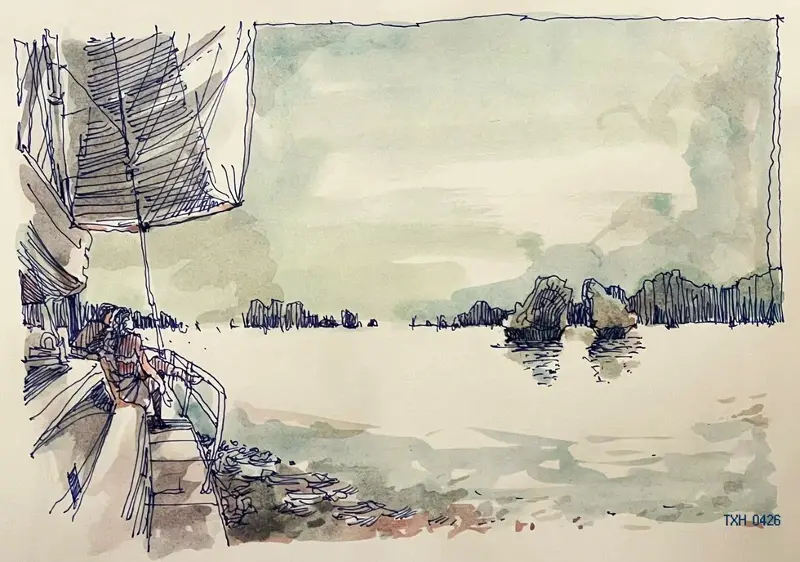
Tourists admire the Rooster Rock in Ha Long Bay - a sketch by architect Tran Xuan Hong.

The Rooster and Hen Islet in Ha Long Bay - a sketch by architect Duy Huynh.
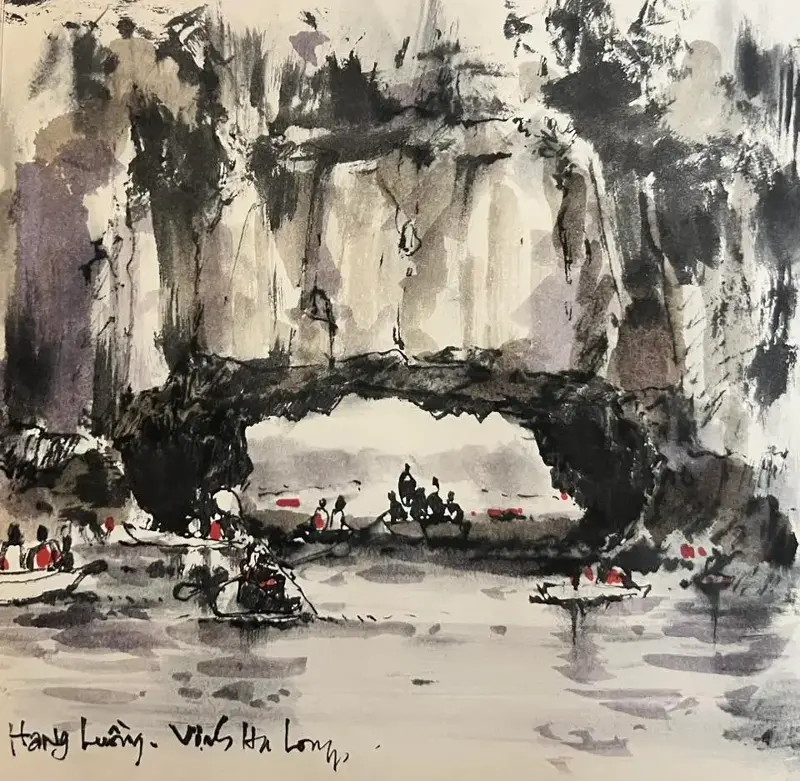
Hang Luon is a kind of "bay within a bay" in Ha Long Bay - a sketch by architect Phan Dinh Trung.
Ha Long Bay boasts nearly 2,000 uniquely shaped islands. Legend says these islands were pearls spat down by a dragon to deter invaders and help the people fight off foreign aggression. However, scientifically , the island system in Ha Long Bay is the result of three turning points: limestone accumulation at the bottom of the ancient sea approximately 500 million years ago; natural uplift and erosion, which transformed them into islands in the open sea as sea levels rose after the ice age; and erosion by wind and rain over millions of years, creating bizarre formations like Rooster Island and La Vong Island. On some limestone cliffs, fossilized coral and ancient marine life imprints can still be seen etched into the rock.

Sunrise over Ha Long Bay - painting by architect Hoang Dung
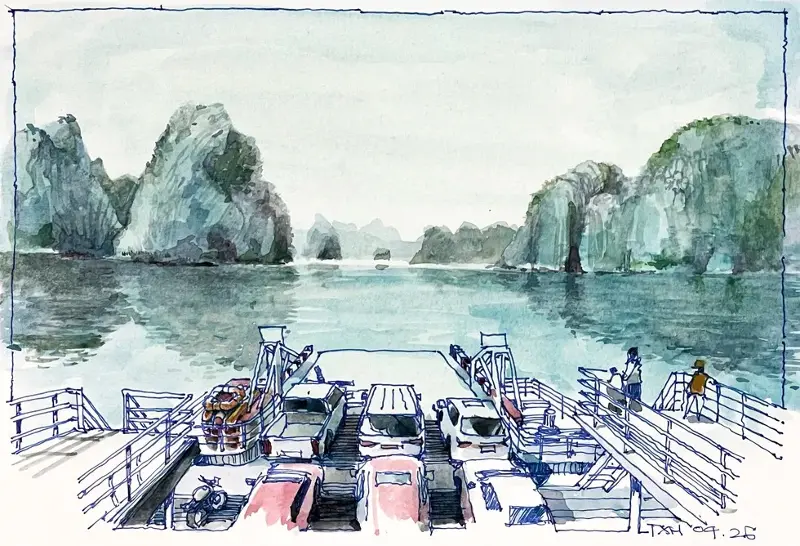
The Tuan Chau to Cat Ba ferry - one of the most beautiful ferry routes as it crosses Ha Long Bay - a sketch by architect Tran Xuan Hong.

Ha Long Bay can be considered a natural geological museum - a sketch by artist Tran Binh Minh.

Floating villages in Ha Long Bay - sketches by Phan Dinh Trung
According to the Institute of Archaeology, prehistoric relics discovered in Ha Long Bay (Trong Cave, Soi Nhu, Tien Ong, etc.) indicate that 3,500-5,000 years ago, humans lived there, gathering and fishing for seafood. It wasn't until 2014 that over 1,600 people living in Ha Long Bay were relocated to the mainland. Even so, tourists can still visit Cua Van fishing village. The entire living space: floating houses, school, library, etc., of the old fishing village has been preserved.

The islands in Ha Long Bay were formed from limestone over hundreds of millions of years - painting by architect Hoang Dung

Ha Long Bay - painting by architect Phung The Huy
Besides rocky islands rising from the sea, Ha Long also boasts areas of "bays within bays." Inside some of these rocky islands are isolated lakes (called angs) such as Ba Ham Lake and Dong Tien Lake. To access them, visitors must kayak through the caves. These are hidden paradises with tranquil waters, surrounded by sheer cliffs and a nearly pristine ecosystem.

Traditional sailboats in Ha Long Bay are characterized by their reddish-brown, bat-wing-shaped sails - a sketch by architect Bui Hoang Bao.

Ha Long Bay is a tourist destination that attracts many domestic and international visitors - painting by architect Duy Huynh.
Ha Long Bay also appeared in the blockbuster film Kong: Skull Island (2017) and has been listed as one of the most desirable travel destinations by many publications such as CNN Travel and The Guardian.
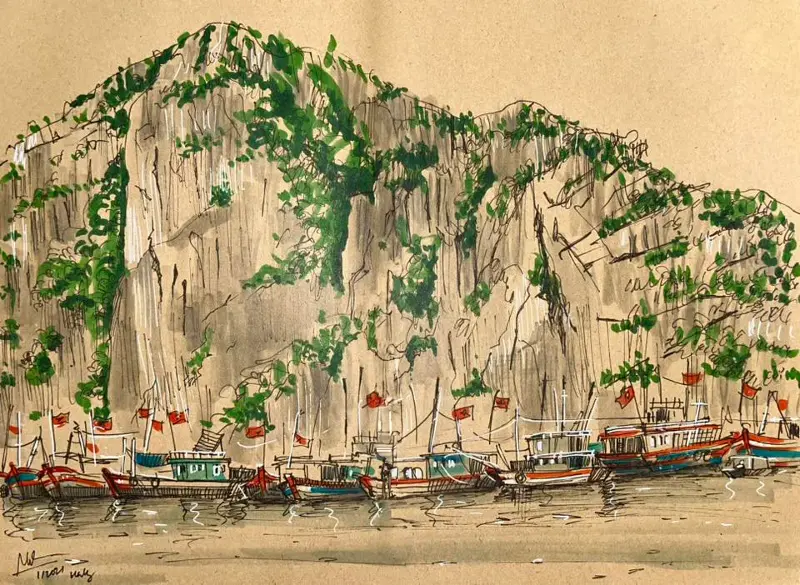
Bustling boats on Ha Long Bay - a sketch by artist Tran Binh Minh.

Millions of years of weathering have created islands with bizarre shapes - a sketch by architect Ha Vu.