



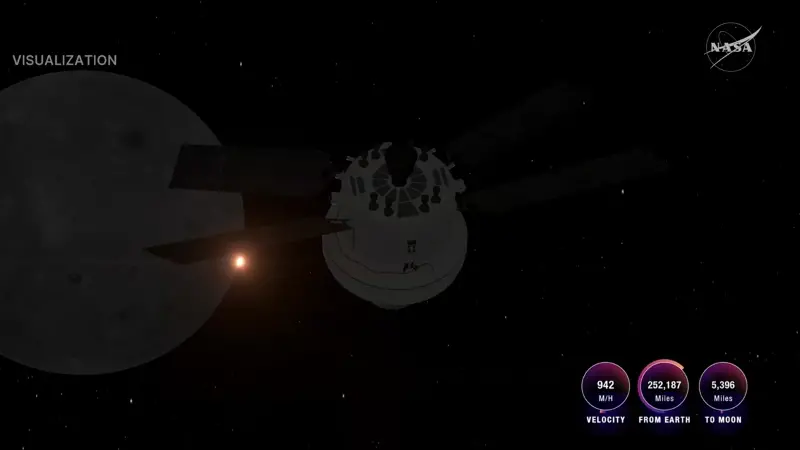
The Artemis II crew witnessed a total solar eclipse from the Orion spacecraft as it flew past the far side of the Moon, a view never before seen in history.
The moment the Sun was obscured began at approximately 8:35 PM ET on April 6th (7:35 AM on April 7th, Vietnam time), when the Moon moved in between the Orion spacecraft and the Sun.
Astronaut Victor Glover described the scene just before the eclipse reached its peak: “The Sun was hidden behind the Moon. The corona was still clearly visible, very bright, forming a halo around almost the entire Moon. It looked like a black sphere hovering right before our eyes.”
He said the crew was also able to see stars and planets behind the Moon: "It was a truly spectacular sight."
Video showing the solar eclipse as the Orion spacecraft flew behind the Moon, obscuring the Sun from view. (Source: NASA)
According to NASA, the Artemis II astronauts became the first to observe a solar eclipse from near the Moon. The phenomenon lasted nearly an hour, allowing them to study the corona, the outermost layer of the Sun's atmosphere, as well as record rare light phenomena.
Astronaut Jeremy Hansen said he had imagined the Moon would look pitch black against the dark backdrop of space, but the reality was far different from his imagination. "The entire Moon was illuminated from behind."
During the eclipse, the crew also had the opportunity to photograph nearby planets such as Mercury, Venus, Mars, and Saturn.
After the phenomenon ended, the lunar observation phase of the mission also concluded. Commander Reid Wiseman called it "an absolutely spectacular experience."
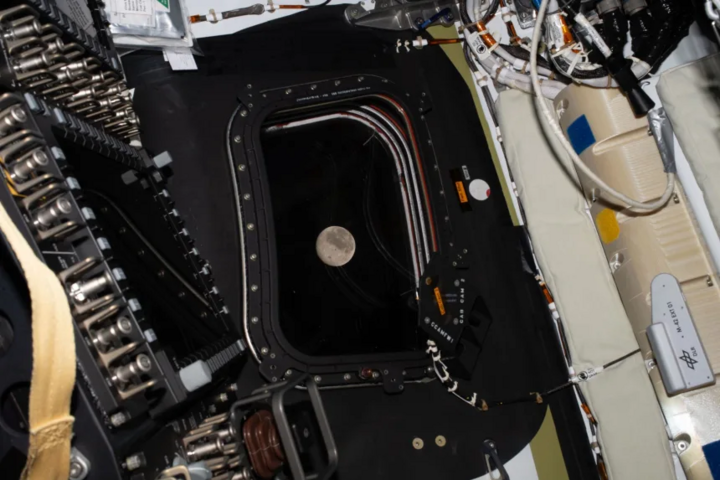
The Moon as seen through the window of the Orion spacecraft. (Image: NASA)
In a previous situation report from the Orion spacecraft, astronaut Jeremy Hansen also shared firsthand observations of the lunar surface.
"My eyes were just adjusting to the light; the moon was too bright. I was just inside the capsule and turned to look out the window," Hansen said.
Hansen said he observed many different shades on the surface, not just the familiar gray. "Right now, the Aristarchus crater… from this angle it’s quite difficult to see, but I notice it has a greenish tint. It’s very unusual; I haven’t seen any other color like that in this area of the Moon," Hansen added. "Besides that, I also see many brownish areas."
These descriptions align with Artemis II's scientific objective of searching for subtle color variations on the Moon's surface. According to scientists, these color changes could reveal information about its composition and geological history.
Kelsey Young, the mission's lunar science lead, said: "When you take the time to observe and let your eyes adjust, you notice very subtle colors, especially when you're as close to the Moon as we are now. The Moon moves me."
Meanwhile, astronaut Christina Koch called the observation experience "unbelievable." "There was a moment when I was truly moved looking at the Moon," she said. "It just pulled me into the scene and felt so real."
Koch further shared: "The Moon is truly a separate celestial body in the universe. It's not just an image hanging in the sky; it's a real place."
During its approximately 7-hour flyby of the far side of the Moon, the Artemis II mission crew temporarily lost contact for about 40 minutes when they entered the shadow region.
During this period, the crew reached their closest point to the Moon at an altitude of approximately 6,500 km, capturing rare images of the surface and geological structures such as the Orientale Basin.
A few minutes later, the spacecraft went on to set another record for the furthest manned space flight from Earth, reaching a distance of 406,771 km, 6,616 km farther than the Apollo 13 mission in 1970.
During the flight, the crew took turns observing, using cameras and their naked eyes to study the terrain, search for potential landing sites, and note color variations on the lunar surface.
After completing its loop, the Orion spacecraft returned to its orbit toward Earth thanks to the Moon's gravitational pull, and is expected to land in the sea on April 10th, ending its 10-day mission.