



Sperm whales do not give birth alone but receive active, organized assistance from the entire pod – a behavior previously considered unique to humans.
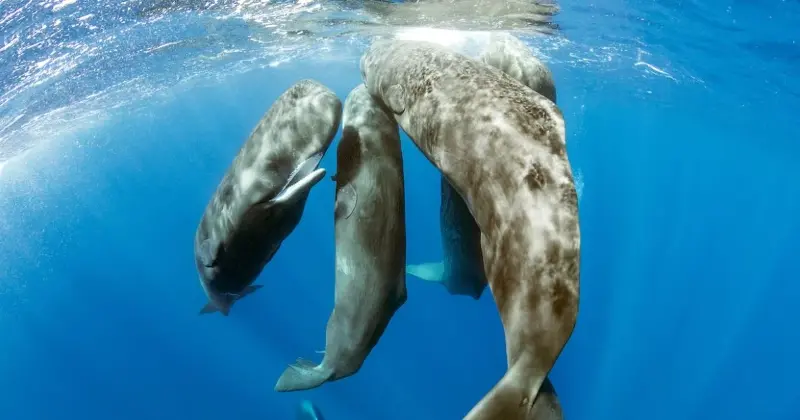
A groundbreaking scientific study published on March 27 in the prestigious journals Science and Scientific Reports reveals that sperm whales do not give birth alone but receive active, organized assistance from the entire pod – a behavior previously considered unique to humans.
Scientists from Project CETI captured an unprecedented scene in July 2023 when 11 sperm whales surrounded a mother whale named Rounder off the coast of Dominica. As soon as the calf was born, the entire pod coordinated seamlessly to lift the young whale to the surface for its first breath – a vital act.
What is particularly noteworthy in the scientific community is that as many as half of the whales involved in the rescue operation are completely unrelated to the mother whale.
This suggests that the helpful behavior doesn't simply stem from the instinct to preserve genetic lineage, but reflects a complex and sophisticated social support structure. Among the individuals involved were the female whale Lady Oracle, the sister whale Aurora, and even a juvenile male whale named Allan.
Alaa Maalouf, an expert from Project CETI, noted that while not entirely consistent with common human understanding, "there is certainly support and assistance available for both mother and child."
Marine biologist David Gruber, also from Project CETI, asserts that for sperm whales, childbirth is a collective experience, not a solitary journey.
Professor Wenda Trevathan, a biological anthropologist at New Mexico State University (USA), believes this finding is an important reminder that humans often assume many behavioral traits are unique to them, but scientific evidence consistently proves otherwise.
Behavioral ecologist Philippa Brakes of the International Union for Conservation of Nature (IUCN) considers this compelling evidence demonstrating the interplay between cultural behavior and instinct in specific survival contexts.
Project CETI's extensive database was built through continuous monitoring since 2005 by marine biologist Shane Gero, who painstakingly established the detailed pedigree of this whale pod over several decades.