



To distinguish between fake and real beef, consumers can check by touch, observing the color and texture of the meat, testing with water, or through the characteristic smell and taste of beef.
Recently, authorities have inspected and discovered many establishments using pork to counterfeit beef, distributing large quantities to the market. Using pork, industrial salt (sodium metabisulfite), pig blood, and coloring chemicals as raw materials, these individuals "transformed" the meat into beef, then packaged, frozen, and sold it on the market under the guise of beef.
According to Dr. Bui Hoang Bich Uyen, a specialist in Nutrition at Xuyen A General Hospital in Ho Chi Minh City, industrial salts such as Sodium Metabisulfite and many synthetic food colorings can cause harmful effects such as allergies, respiratory problems, and may even cause cancer, neurological disorders, or behavioral disorders with prolonged or repeated exposure, while normal consumption within regulated limits appears safe for most people.
Below are four ways to help consumers distinguish between chemically treated beef and pure beef:
Manual inspection
Use your finger to rub firmly: Press and rub your finger on the surface of the meat. If it's artificially colored meat, food coloring, or beef blood will stick to your hand. Real beef has a natural red color from the muscle tissue, so the color won't stain your hand.
Real beef: It has a firm texture; when pressed, it feels slightly sticky to the touch, and the meat fibers are fine and smooth.
Fake meat: It usually feels crumbly, with large, short muscle fibers (especially from sow pork), and lacks natural elasticity when pressed.
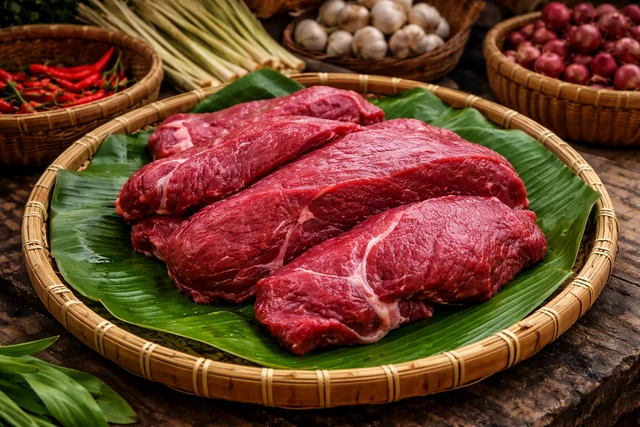
Consumers need to carefully inspect and choose meat for their families, avoiding meat that is bright red or too dark in color, or unusually cheap. ILLUSTRATIVE PHOTO: AI
Observe the color and texture of the beef.
| Characteristic |
Real beef |
Colored meat (fake meat) |
| Color |
A uniform bright red or dark red color from the outside in. |
The outside is a vibrant or very dark red, but when cut open, the inside is significantly lighter in color. |
| String |
Small, long, and smooth. |
Large, short, and not smooth (pork meat usually has larger fibers). |
| Fat color |
light yellow feature. |
The milky white color (pork fat) or beef fat is added using chemicals. |
Water test
You can ask the seller to cut a small piece and rinse it with clean water right there. If the water turns dark red and the meat gradually fades in color, it's definitely meat that has been treated with artificial coloring.
Distinctive flavor
Real beef has a naturally strong, pungent smell. Fake beef is often smeared with beef fat or blood to create the smell, but this smell is usually only superficial and easily dissipates. When cooked, real beef retains its rich, sweet flavor, while fake beef often tastes bland or smells of antibiotics (if it's from an old sow).
"Prioritize buying meat from reputable sources, sold at supermarkets, stores, and outlets. Avoid buying meat that is unusually cheap or uniformly bright red. Additionally, you should prioritize buying large, whole cuts of meat and ask the seller to cut it from a block instead of buying pre-sliced or marinated pieces, as these are the easiest to adulterate," the doctor advised.