



Climate change is not only causing sea levels to rise, but it is also slowing the planet's rotation, making each day longer at an unprecedented rate.
According to IFL Science, new research indicates that human activities are not only warming the Earth but may also be slowing the planet's rotation.
Although the Earth's rotation speed fluctuates slightly over time, research shows that the current slowdown is unprecedented in at least 3.6 million years.
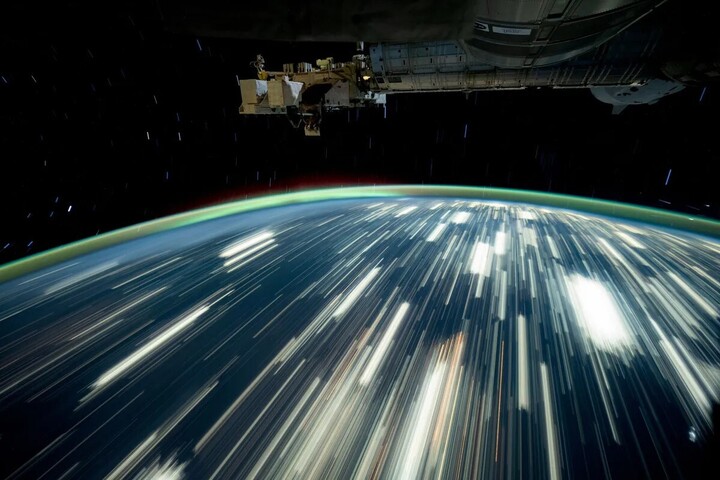
The shimmering streaks of light from cities around Earth were captured in a long exposure from the International Space Station. (Source: NASA)
In theory, one rotation of the Earth takes exactly 24 hours. However, in reality, the length of a day can vary by a few thousandths of a second (milliseconds).
The causes stem from several factors, including the Moon's gravitational pull, geophysical processes within the Earth's interior, and atmospheric circulation.
Most recently, in July and August 2025, the Moon's relative position caused the day on Earth to slow down by an average of more than 1 millisecond.
However, scientists believe that behind these short-term fluctuations lies a long-term trend related to human-induced climate change.
The "skateboarder effect"
The primary cause stems from the melting of polar ice sheets. As global temperatures rise, millennia-old ice at the poles melts and flows into the oceans. This water doesn't stay in one place but redistributes globally, concentrating more towards the equator due to centrifugal force.
This phenomenon is similar to how a figure skater spreads their arms wide to slow down a spin.
Similarly, for Earth, when the mass of ice is concentrated at the poles (near the axis of rotation), the Earth rotates faster. When the mass shifts towards the equator (away from the axis of rotation), the moment of inertia increases, causing the Earth to slow down and lengthen the day.
"The rapid melting of polar ice sheets in the 21st century is causing sea levels to rise and slowing the Earth's rotation," said scientist Mostafa Kiani Shahvandi of the Department of Meteorology and Geophysics at the University of Vienna (Austria) . "What we want to clarify is whether there has ever been a period in history where the climate caused a similar rate of change."
The research team concluded that, on average, the length of the day on Earth is increasing by about 1.33 milliseconds every century. This number may sound small, but it represents an unprecedented rate of change.
Professor Benedikt Soja, a specialist in Space Geodesy at ETH Zurich, emphasized: "The current rate of day length change is primarily due to human activity. By the end of the 21st century, the impact of climate change could affect day length more strongly than the tidal forces of the Moon."
Although humans cannot perceive changes of a few milliseconds in their daily lives, this is a serious problem for high-tech systems.
Professor Soja noted that precise space navigation, the operation of GPS satellites, and complex financial transaction networks all depend on extremely rigorous measurements of time.
Even a small deviation in the Earth's rotation cycle, if not corrected in time, can cause these systems to malfunction or produce serious errors.