



In late 2023, the remains of a fairly large ship (referred to as the Cam An ship) were unearthed in the Thinh My - Cam An coastal area (now part of Hoi An Tay ward, Da Nang city). Archaeological surveys and sample analysis initially indicate that this ancient ship dates back to the 14th-16th centuries and had a traditional East Sea design (a tugboat).
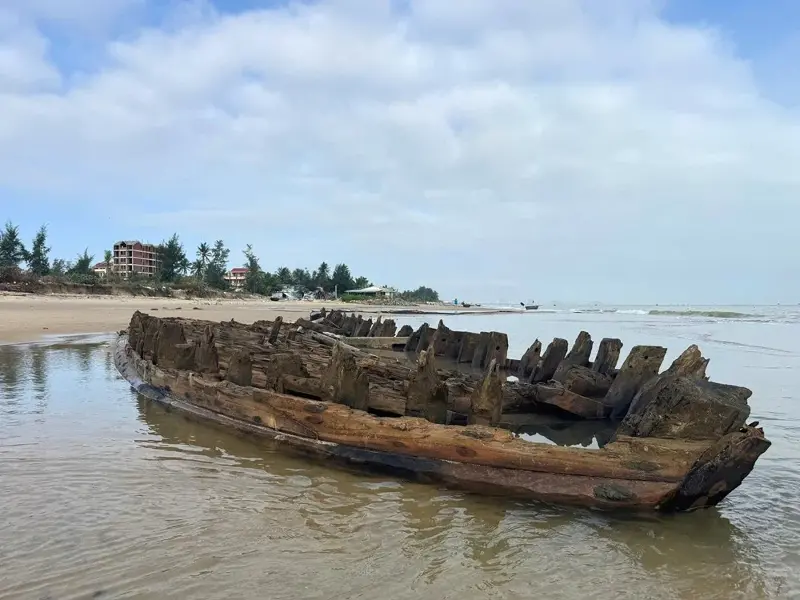
The ship is in relatively good condition, with its structure largely intact, and there is a high probability of restoring its structure if excavation and preservation continue.
To date, more than 20 shipwrecks have been discovered in Southeast Asian waters, identified as traditional East Sea vessels dating from the mid-14th to the 16th centuries. These are extremely important maritime treasures and heritage not only for Vietnam but also for the Southeast Asian region, serving as evidence of the vibrant maritime and trade history in the East Sea. During the survey of the ancient Cam An shipwreck, based on information from local people and artifacts obtained, the survey team made further research and discoveries about the existence of another shipwreck in the coastal area of Tan Thanh - Cua Dai.
In light of significant new discoveries for the research, preservation, and promotion of cultural heritage values in Da Nang city, in November 2025, the Da Nang Department of Culture, Sports and Tourism, in collaboration with the Hoi An World Heritage Conservation Center, organized a consultation seminar to gather opinions on the plan for the protection and emergency excavation of the ancient Cam An shipwreck.
Mr. Pham Phu Ngoc, Director of the Hoi An Heritage Conservation Center, said that the Center has proposed plans for the urgent excavation and preservation of shipwreck artifacts in the coastal area of Hoi An Tay ward. These are rare physical documents serving research on the history and culture of Hoi An; and are the only material evidence that can be used to study and clarify maritime activities and economic /trade operations in the Da Nang area in the past.
The plan involves conducting emergency excavations, relocating and preserving artifacts, and researching to clarify the archaeological and historical value of the shipwreck within the context of the Hoi An Ancient City World Heritage site. Based on this, a long-term preservation plan will be developed to promote the shipwreck's value for sustainable tourism development.
In addition, efforts to encourage the public to protect and donate artifacts related to underwater cultural heritage to the museum are regularly emphasized. Recently, some residents of Cam An donated 18 artifacts to the Hoi An Museum, many of which are related to underwater cultural heritage that fishermen recovered in the local waters, such as plates, bowls, anchors, rudders, fishing weights, and box bodies.
To date, the artifacts and relics related to underwater cultural heritage in Hoi An that have been discovered, researched, and displayed are still modest compared to the inherent potential of this port city. If there is a plan to continue researching, excavating, and preserving other shipwreck sites in the Hoi An sea area, connecting them with the exhibition of pottery artifacts excavated from the Cu Lao Cham shipwreck, it will greatly contribute to promoting the historical, cultural, and tourism value of Hoi An.
In the future, Hoi An needs to continue coordinating with central and international specialized agencies to conduct a comprehensive inventory and identification of the local underground cultural heritage, while also seeking resources to soon establish the long-awaited Merchant Ship Museum.
According to the 2001 UNESCO Convention, underwater cultural heritage “means all traces of human existence of a cultural, historical or archaeological nature that lie partly or entirely underwater, cyclically or continuously, for at least 100 years.” It is “an integral part of the cultural heritage of humanity, and at the same time a particularly important element for the history of peoples, nations, and the relationships relating to the common heritage.”