



Chinese robots have doubled their speed in just eight months, approaching Usain Bolt's record and are about to be tested in marathon races alongside humans.
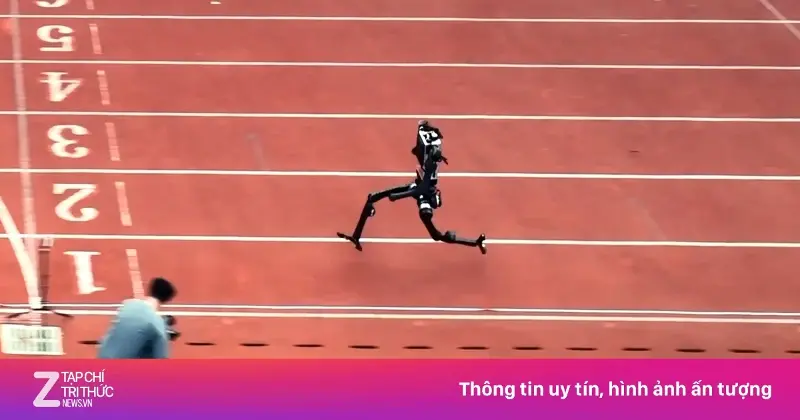
On April 11th, Unitree Robotics released a video of its H1 robot reaching a top speed of 10 meters per second on the track. This figure is close to Usain Bolt's world record for the 100m sprint, which is 10.44 meters per second. Just eight months prior, at the 2025 Robot Olympics, H1's maximum speed was only 5 meters per second.
This is preparation for a bigger event. On April 19th, more than 100 teams will participate in a half-marathon for humanoid robots in Beijing's Yizhuang Economic Zone, nearly five times the number from last year. Of these, almost 40% will compete in a fully autonomous mode, with the robots determining their own path via sensors without remote control.
However, Unitree Robotics notes that the H1's speed of 10 m/s was achieved under "reduced load" conditions, when it was not fitted with a head and arms, retaining only the torso and legs. In its full configuration, the H1's standard speed is only 3.3 m/s.
"This isn't a capability verified in the standard 100m race. It's proof that the robot has entered a high-kinematic speed phase, approaching the capabilities of top sprinters," said Liu Shaoshan, Director of the Sports Intelligence Center at the Shenzhen Institute of AI and Robotics.
The most notable change at this year's competition is the number of autonomous teams. In 2025, most robots will need a human guide to run alongside them. This year, nearly 40% of the teams have completely eliminated remote control, with robots independently recognizing paths, avoiding obstacles, and making decisions. Last year's champion, Tian Gong, with a time of 2 hours and 40 minutes, decided to abandon the semi-autonomous method and switch to fully autonomous in this year's competition. Unitree is also participating for the first time with 3 fully autonomous teams.
Technically, covering a distance of 21 km over complex terrain presented a much more difficult challenge than a sprint. Most of the team upgraded their joint systems with modular torsion and heat dissipation, improved autonomous navigation algorithms, and enhanced energy management.
Liu Shaoshan emphasized that the true value of high speed lies not in athletic competition. High kinematic mobility translates into practical operational capabilities, enabling robots to move quickly across complex terrain in rescue, patrol, and emergency response operations. The control, damping, and energy management technologies developed from high speed also improve stable walking, self-rescue after falls, and movement across challenging terrain.
The race on April 19th includes stages through city streets, an international car race track, and an ecological park, with a total length of 21 km. In addition, humans and robots will compete together on the same course.