



A study shows that the Earth's iron core is not just a mass of molten metal, but also a giant "reservoir," holding between 9 and 45 times more hydrogen than the total amount of water in all the surface oceans combined.
This discovery reinforces the hypothesis that most of the water was absorbed by Earth during its early formation, rather than arriving later through collisions with comets as some previous theories suggested.
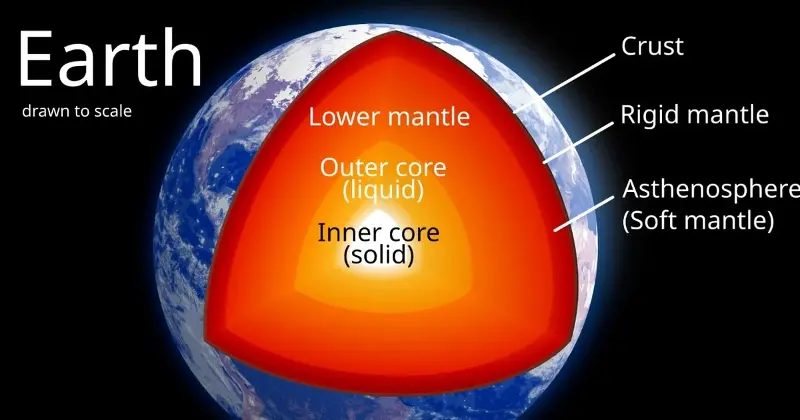
The study's lead author stated that the Earth's core may have contained the majority of water within the first few million years of the planet's history. According to him, after the core, the mantle and crust contain the most water, while the surface is where the least water is found.
Traces of hydrogen
Approximately 4.6 billion years ago, masses of rock, gas, and dust orbiting the Sun collided and coalesced to form the early Earth. Over time, this process formed the core, mantle, and crust. Deep inside, under immense pressure and temperature, the metallic core began to move and generate a magnetic field that protected the planet.
According to experts, hydrogen can only be incorporated into the liquid metal that makes up the core if it was present during the earliest stages of Earth's development and directly participated in the core formation process.
However, determining the amount of hydrogen in the core is a major challenge due to the inability to observe it directly and the difficulty in recreating the extremely high pressure conditions in the laboratory. Hydrogen is also the lightest and smallest element, making quantification beyond the capabilities of many traditional analytical methods.
Previous studies based on X-ray diffraction have yielded widely varying estimates, ranging from 10 parts per million to 10,000 parts per million by weight, equivalent to between 0.1 and over 120 "oceans" of hydrogen.
Observations at the atomic level
In the new study, the team used atomic tomography, a method that allows for 3D imaging and measurement of chemical composition at the atomic level. Iron samples were melted using lasers in a diamond compression chamber to simulate the temperature and pressure of the Earth's core.
The sample was then ground into a microscopic needle shape, subjected to high voltage for ionization, and the atoms were counted. The results showed that the hydrogen-to-silicon ratio in the iron nanostructure was approximately 1:1. Combining this with previous estimates of silicon content in the core, the research team calculated the corresponding amount of hydrogen.
However, scientists note that this method is still based on assumptions and has certain uncertainties. Some other chemical interactions may not have been taken into account.
If the results are confirmed, this finding would strengthen the hypothesis that hydrogen was present throughout the Earth's formation. In addition to gas from nebulae, water from comets and asteroids could also be a source of hydrogen for the planet.
Hydrogen is one of the essential elements for life, along with carbon, nitrogen, oxygen, sulfur, and phosphorus.