



The US National Aeronautics and Space Administration (NASA) has just astonished the world by releasing a photograph taken by the Orion spacecraft showing Earth gradually disappearing behind the Moon's horizon.
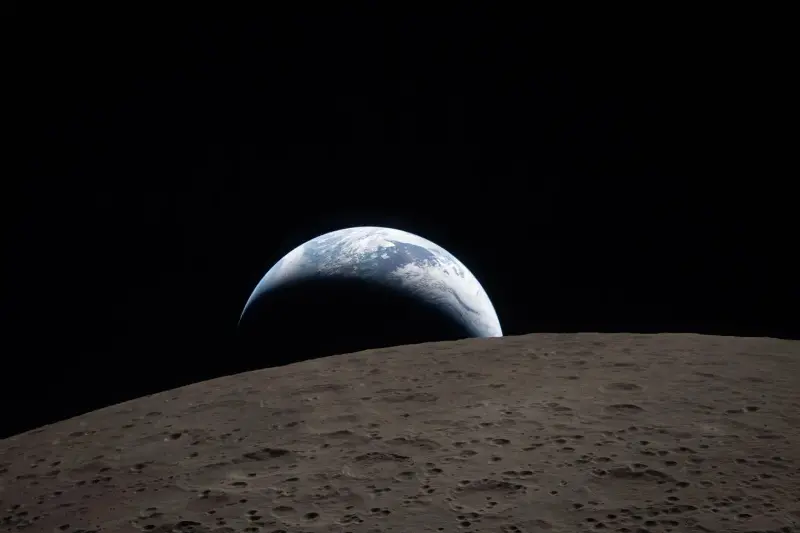
On April 6th (local time), during the Orion spacecraft's closest approach to the Moon, at a distance of 6,545 km, the crew captured footage of Earth disappearing behind the horizon.
This historic photo was shared by the White House on the social media platform X with the caption: "Humanity seen from the other side. The first photograph from the far side of the Moon, taken from the Orion spacecraft as Earth disappeared behind the lunar horizon," and was subsequently widely disseminated by NASA.
The agency said the moment strongly evoked the legendary image of the Earth rising, taken 58 years ago by Apollo 8 astronaut Bill Anders.
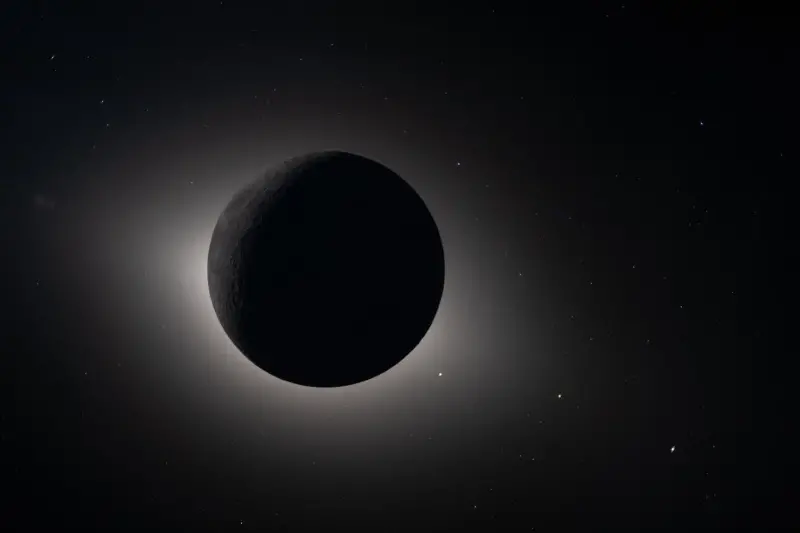
In addition, astronauts also had the opportunity to witness an extremely rare phenomenon: a total solar eclipse in space.
Specifically, at 8:35 PM on April 6th (equivalent to 7:35 AM on April 7th in Hanoi time), when the Sun passed behind the Moon as seen from the Orion spacecraft in the dark side, the crew recorded the scene of the Moon completely obscuring the Sun.
As the spacecraft moved behind the celestial body, all radio and laser signals were blocked, completely disrupting two-way communication with Earth for about 40 minutes. As soon as Orion emerged from the blind spot, communication was restored, and the crew was greeted by the sight of the blue planet reappearing from the edge of the Moon.
Notably, during this flyby behind the Moon, the Artemis II mission successfully surpassed the record set in 1970 by Apollo 13 for the furthest distance humans have ever traveled from Earth. The Orion spacecraft reached 406,771 km, approximately 6,616 km further than the previous record.
This journey officially began on the evening of April 1st (5:35 AM on April 2nd Hanoi time) when the Orion spacecraft lifted off, carrying the expectation of NASA's first crewed mission beyond low Earth orbit in 54 years.
The crew comprised four outstanding individuals: mission commander Reid Wiseman, pilot Victor Glover, and two mission specialists, Christina Koch from NASA and Jeremy Hansen from the Canadian Space Agency (CSA). This team was profoundly representative globally, marking a historic milestone as, for the first time, a woman, a person of color, and a non-American astronaut participated in a journey to the Moon.