



Hearing loss in children, if not detected and treated early, can seriously affect their language abilities, learning, and psychological development. Early recognition of signs of hearing loss and timely screening give children a chance of recovery.
Hearing loss in children is a condition of impaired or lost hearing ability that seriously affects language development, intelligence, and communication skills. If not detected and treated early, children may not regain their normal language abilities, leading to significant difficulties in learning, communication, and psychosocial development. Therefore, early screening and detection of hearing loss is especially important in a child's development.
Hearing loss is understood as a condition where a child's hearing is reduced compared to normal, meaning they cannot hear whispers or low-pitched sounds. Depending on the severity, hearing loss is classified into mild to moderately mild, moderately severe, severe, and deaf. This condition can be congenital, due to obstetric complications, or acquired after birth.
Causes of hearing loss in children
Congenital and genetic causes
Genetics is the leading cause of hearing loss in newborns, accounting for approximately 50% of congenital hearing loss cases. Children whose parents have hearing loss are at higher risk compared to children whose parents are healthy.
During pregnancy, if the mother contracts infections such as rubella, herpes, or syphilis, the child is at risk of hearing loss or deafness. The use of certain toxic drugs, such as antimalarial drugs, diuretics, aminoglycosides, and cytotoxic drugs during pregnancy, can also cause hearing damage in the fetus. Additionally, prenatal amniotic fluid infection or congenital defects in the ears, heart, and eyes are also risk factors.
Causes during childbirth
Premature and low-birth-weight babies (under 1,500 g) are at a higher risk of hearing loss compared to full-term babies. Babies with severe jaundice after birth due to increased free bilirubin may experience damage to the auditory nerve, leading to hearing impairment.
Oxygen deprivation or asphyxiation at birth is also strongly linked to the risk of hearing loss. When oxygen is lacking, nerve cells and cochlear ganglion cells are damaged, directly affecting hearing function.
Causes of postpartum complications
Several medical conditions can cause hearing loss in children, such as chronic otitis media. When fluid or pus accumulates in the middle ear, it obstructs the vibration of the ossicles, reducing the ability to transmit sound.
Meningitis is a serious condition, with approximately 10% of children experiencing hearing loss to varying degrees after infection. Children with purulent meningitis are at high risk of deafness, even within just a few days of contracting the disease.
Additionally, hearing loss can also be caused by trauma, noise, prolonged use of antibiotics, infections such as mumps and measles, earwax blockage, foreign objects in the ear, neurofibroma, or epilepsy.
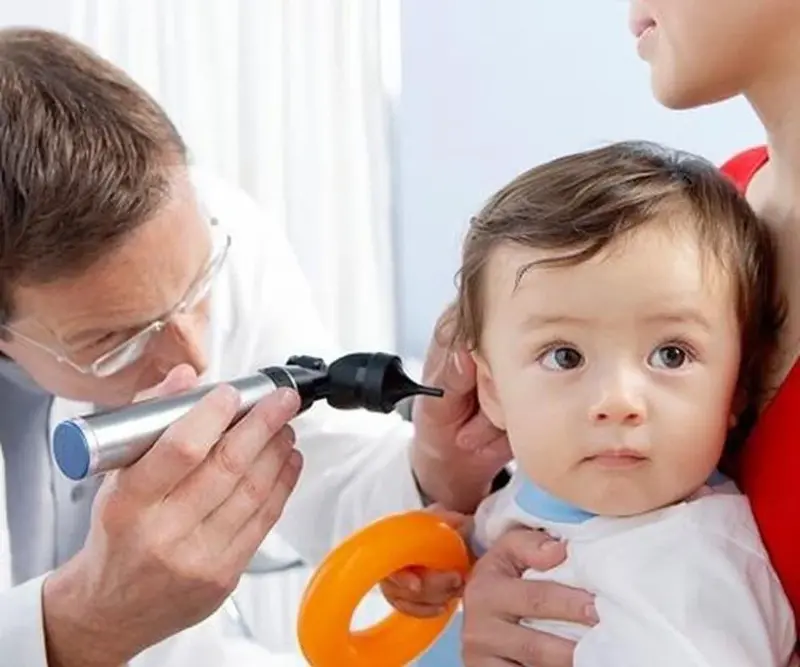
Hearing loss in children, if not detected and treated early, can seriously affect their language abilities. (Illustrative image)
How to detect hearing loss in children
If hearing loss in children is not detected and treated before the age of 2, the chances of language recovery will be very limited. Therefore, early hearing screening is crucial.
According to recommendations, hearing screening for newborns should be performed within 1 month of birth; a definitive diagnosis should be made within 3 months, and treatment intervention should begin within the first 6 months of life if hearing loss is detected.
In addition, parents can recognize early signs such as: the child does not react to sounds, especially loud sounds; does not turn their head when called; delayed speech or does not speak at all; and is not interested in what is being said.
More advanced methods commonly used include otoacoustic emission testing and brainstem auditory electrophysiology.
The importance of early detection and intervention.
The effectiveness of hearing loss treatment depends on many factors such as the cause, the degree of hearing loss, the timing of intervention, and family cooperation. Children with middle or inner ear conditions may be assisted with devices such as hearing aids or cochlear implants.
If detected late, children are at risk of delayed language and cognitive development, poor speech, and even permanent disabilities such as muteness or deafness. Therefore, parents need to closely monitor their children's development, proactively take them for hearing screening and specialist examinations when they suspect signs of hearing loss, in order to intervene promptly.
Risk factors for hearing loss in children
For infants under 28 days old:
- Family history of congenital or progressive hearing loss.
- Maternal infections during pregnancy (toxoplasmosis, rubella, CMV, herpes, syphilis, etc.)
- Birth weight under 1,500g
For children aged 29 days to 2 years:
- Parents or caregivers have hearing, speech, or language problems.
- History of purulent meningitis
- Risk factors from the neonatal period include cytomegalovirus (CMV) infection, prolonged mechanical ventilation, and genetic diseases.
- Head injuries, especially temporal bone fractures.
- Contracting infectious diseases such as mumps and measles.