



SpaceX's powerful Falcon Heavy rocket is about to take off for the first time in a year and a half, launching the 6.6-ton ViaSat-3 F3 broadband internet satellite into orbit.
In just under an hour, the Falcon Heavy rocket carrying the giant ViaSat-3 F3 communications satellite will be launched from NASA's Kennedy Space Center in Florida (USA), scheduled to begin at 10:21 AM on April 27th (9:21 PM same day Hanoi time).
The launch was streamed live on Space.com or SpaceX's media platforms.
On this mission, the Falcon Heavy rocket carried the ViaSat-3 F3 telecommunications satellite, which weighs approximately 6.6 tons.
According to the plan, just about 8 minutes after liftoff, the two booster rockets of the Falcon Heavy will separate and return to land at the Cape Canaveral Space Force Station (Florida, USA).
Meanwhile, the central booster stage, after completing its mission of ejecting the upper stage—carrying the satellite—from the atmosphere, will fall into the Atlantic Ocean. The upper stage continues its journey, placing ViaSat-3 F3 into geostationary transfer orbit and separating the satellite after approximately 5 hours of flight.
This ViaSat-3 F3 will be placed into geostationary orbit (GEO) 22,236 miles (35,786 km) from Earth. At that altitude, the orbital velocity matches the Earth's rotation speed, allowing the satellites to "hover" over the same area for continuous coverage.
ViaSat-3 F3 has a very wide coverage area. This satellite will provide high-speed broadband service to customers across the Asia-Pacific region.
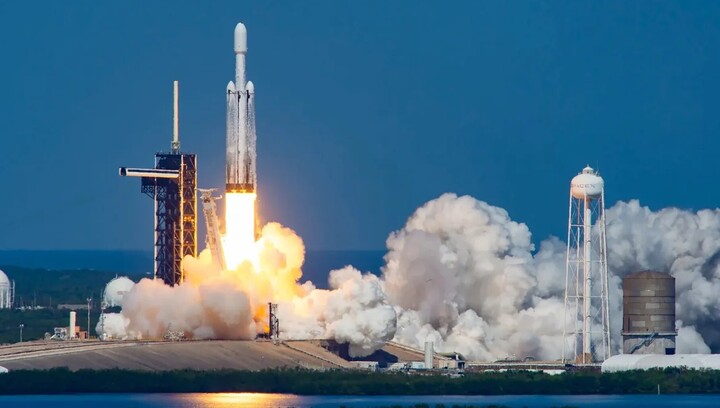
SpaceX's Falcon Heavy rocket launched NASA's Europa Clipper spacecraft from Florida on October 14, 2024. (Photo: SpaceX)
ViaSat-3 F3 will be the third ViaSat-3 satellite to be launched into orbit. ViaSat-3 F1 was launched by a Falcon Heavy rocket in April 2023, and ViaSat-3 F2 will follow in November 2025 on a United Launch Alliance Atlas V rocket.
Falcon Heavy launched in February 2018 with a test flight that put SpaceX founder Elon Musk's bright red Tesla Roadster into orbit around the Sun. Since then, the rocket has completed 10 more missions, all of them successful.