


Limitations in aviation infrastructure
Following the provincial merger, many travel businesses have proactively designed programs to bring tourists from Buon Ma Thuot to Tuy Hoa, aiming to leverage the advantages of the connection between the vast forests and the blue sea. However, these products are still not attractive enough to become a popular choice for tourists.
According to Ms. Pham Thi My Nuong, a tour guide with 15 years of experience in the Central Highlands and the Central Coast, among the groups she has directly led, tours connecting forests and beaches in Dak Lak only account for 30% of the choices, while the remaining 70% still prioritize traditional routes such as Kon Tum - Dak Lak - Lam Dong or Quy Nhon - Tuy Hoa - Nha Trang.
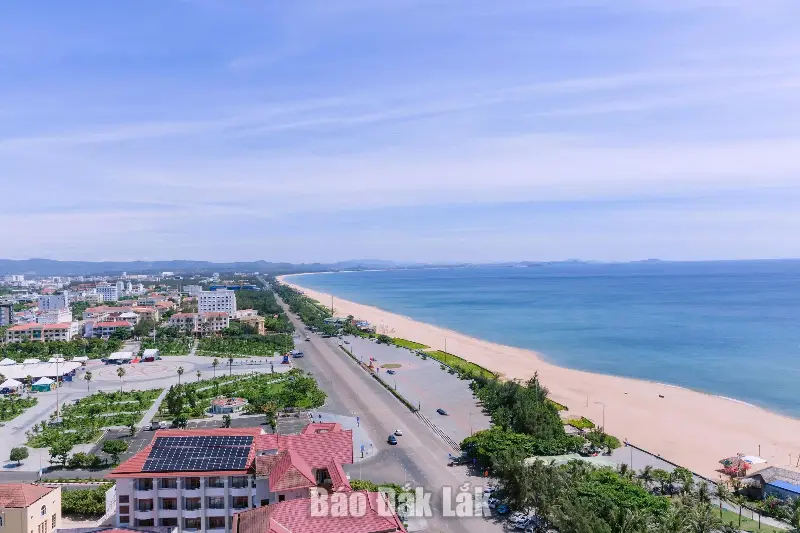 Coastal urban space in Tuy Hoa ward.
The biggest bottleneck in this tourism link lies in the aviation infrastructure. Although the province has Buon Ma Thuot Airport and Tuy Hoa Airport to form an East-West tourism axis, the actual operating capacity has not yet met the requirements for inter-provincial travel.
Currently, Tuy Hoa Airport only has flights to Hanoi and Ho Chi Minh City, and does not have direct connections to potential markets such as Da Nang, Hai Phong, and other localities. In addition, the low flight frequency, limited flight schedules, and generally high ticket prices make it difficult for businesses to design comprehensive tour packages.
Therefore, most tour groups wanting to experience the forest-sea route have to fly to Buon Ma Thuot and end their trip in Quy Nhon or Nha Trang for convenience on their return. Thus, Tuy Hoa only serves as a stopover point in the itinerary, not as the main accommodation or the final destination of the tour.
Due to the difficulty in organizing complete tours, the Buon Ma Thuot - Tuy Hoa route currently mainly serves local tourists or family groups on weekend getaways. The segment of tourists from other provinces, group tours, and international tourists has not yet been effectively exploited.
|
To transform the advantages of forests and seas into distinctive products, in addition to the efforts of businesses in developing tours and promoting services, a coordinated effort from local authorities is needed in planning development spaces, investing in infrastructure, and connecting destinations. |
Limited air connectivity also directly impacts business efficiency. Mr. Le Van Duc, Director of Elephant Hotel, said that the average length of stay for tourists in Buon Ma Thuot is only about two nights. After visiting destinations such as the Dak Lak Museum, the World Coffee Museum, Buon Don, Lak Lake, or Dray Nur Waterfall, tourists usually end their trip or move on to other provinces. If the forest-sea tourism route is effectively developed, the length of stay for tourists could be extended by one to two days, thereby generating additional revenue for accommodation, food and beverage services, shopping, and entertainment.
Lack of engaging experiences
If air connectivity is a prerequisite for establishing a tourist route, then the experience is the deciding factor in whether tourists choose this route or not. According to travel agencies, the current difficulty lies not in the 180 km distance between Buon Ma Thuot and Tuy Hoa, but in the fact that the tourist route still lacks attractive experiences to retain tourists.
According to Mr. Nguyen Duc Phuc, Director of Bazan Travel Service Trading Company Limited, current connecting tours mainly combine two destinations into one program. After finishing sightseeing in Buon Ma Thuot, the group travels directly to Tuy Hoa or vice versa, with very few activities designed along the route.
Due to the lack of connectivity between destinations, the Buon Ma Thuot - Tuy Hoa route remains primarily a journey. The prominent destinations are concentrated at either end of the route, while the connecting areas have not been developed into tourism products.
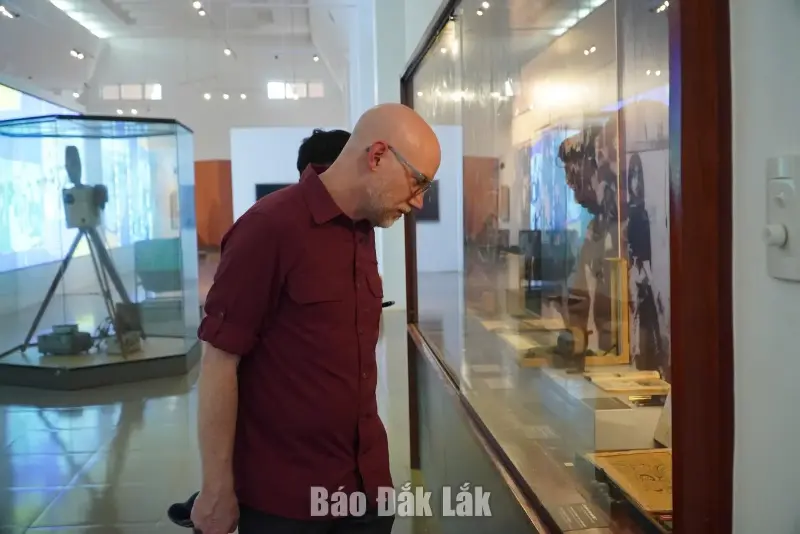 Tourists learn about history at the Dak Lak Museum.
As one of the tourists who recently experienced the Buon Ma Thuot - Tuy Hoa tour, Ms. Nguyen Thi Phuong Anh (Ho Chi Minh City) commented that if the route included more stops in villages to learn about local culture, agriculture, cuisine, and to shop for OCOP products and handicrafts, the trip would be much more interesting instead of just traveling from the forest to the sea.
According to travel businesses, to transform the advantages of forests and seas into distinctive products, in addition to the efforts of businesses in building tours and promoting services, a synchronized involvement of local authorities is needed in spatial development planning, infrastructure investment, and destination connectivity. More importantly, a change in approach to tourism development is necessary. If each locality exploits its potential in its own way, each doing its own thing, it will be difficult to create products with sufficient appeal. Only when businesses, people, and the government work together can the East-West tourism route form a complete and seamless chain of experiences.
The consolidation of administrative boundaries has opened up new opportunities for tourism development in Dak Lak. However, this advantage will only truly be realized when unique and attractive tourism products are created. When the Buon Ma Thuot - Tuy Hoa tour includes more stops, experiences, and stories to discover, the 180 km distance will no longer be a distance to overcome, but will become an integral part of the journey of exploring Dak Lak.
Nhu Quynh