


The research was conducted by analyzing the wind behavior in the atmospheres of seven extremely hot gas giant planets outside our solar system. Data was collected from telescopes located in Chile and Hawaii (USA).
The results show that these planets share a common characteristic with most planets in the solar system: the presence of magnetic fields. In the current solar system, six of the eight planets generate global magnetic fields, including Earth, Jupiter, Mercury, Saturn, Uranus, and Neptune.
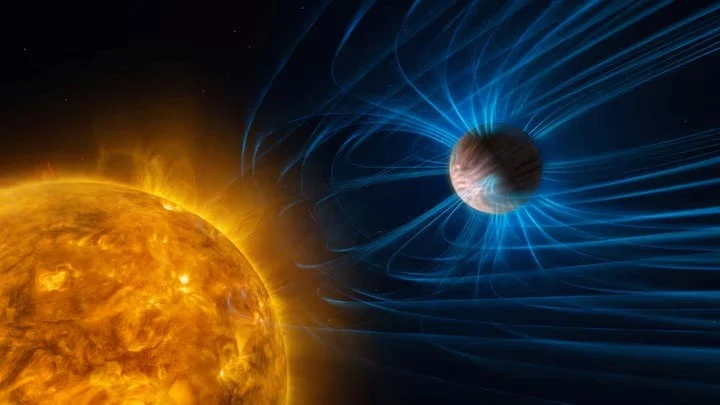
A magnetic field is an invisible force created by the movement of electrically conductive material inside a planet, often a molten metal core combined with its rotation.
Although none of the planets in the study are considered candidates for life, scientists believe the discovery is still significant. For rocky planets like Earth, magnetic fields could be one of the factors contributing to maintaining an environment capable of supporting life.
All seven planets studied belong to the "hot Jupiter" group – planets similar in size and composition to Jupiter but orbiting very close to their host star, resulting in extremely high temperatures.
They always face one side towards the star, while the other side is in shadow, similar to how the Moon always faces one side towards the Earth.
These planets have masses ranging from equivalent to more than three times the mass of Jupiter. Due to their proximity to their host star, the temperature on their illuminated sides is always extremely high. All of them are closer to their star than Mercury is to the Sun.
The large temperature difference between the two sides creates extremely strong winds, blowing from the hot side to the cold side. Wind speeds have been recorded reaching up to 25,000 km/hour, higher than even the winds on Jupiter.
However, it was these very wind currents that helped scientists detect something unusual.
According to Julia Seidel, an astronomer at the Lagrange Laboratory of the Côte d'Azur Observatory (France) and lead author of the study published in Nature Astronomy , the hotter a planet is, the stronger the winds in its atmosphere will be because it receives more energy from its host star.
However, observations revealed the opposite. The hottest planets had weaker winds than expected and less turbulent atmospheres.
According to Seidel, this suggests that the enormous amount of energy the star is transferring into the atmosphere must be dissipated through a different mechanism. The most plausible explanation is the existence of a magnetic field, which could interact with charged particles in the atmosphere and slow their movement.
Researchers believe that the detection of magnetic fields on exoplanets is not entirely surprising, as most planets within our solar system also possess this characteristic. However, gathering convincing evidence remains a significant challenge.
"We weren't just observing a single planet, but studying an entire group of planets, and we noticed a clear trend emerging," Seidel said.
According to the research team, the magnetic fields of these seven planets are weaker than Jupiter's enormous magnetic field, but generally comparable to the magnetic fields of other planets in the solar system.
Meanwhile, Venus and Mars no longer have a global magnetic field. Ganymede, Jupiter's largest moon, however, possesses its own magnetic field.
Scientists believe that magnetic fields play a crucial role in helping planets maintain their atmospheres for extended periods. Mars is a prime example. The planet once had a magnetic field, but it disappeared billions of years ago as its core cooled. As a result, much of its atmosphere was lost, leaving behind the arid and harsh environment we see today.
Bibiana Prinoth, an astronomer at the European Southern Observatory (ESO) in Germany and co-author of the study, said that magnetic fields do not directly determine a planet's habitability, as many people believe.
However, they may play a crucial role in the planet's long-term evolution. According to her, life as we know it depends on the atmosphere. The atmosphere helps maintain surface pressure, regulate temperature, and on Earth, it also provides the conditions for water to exist in liquid form.