



Troops of white-buttocked langurs – a rare primate species found only in Vietnam – are being isolated amidst highways, tourist routes, and quarries, resulting in habitat fragmentation.
During a drone survey conducted by a team of experts in the limestone mountains bordering Ninh Binh and the former Hoa Binh region in early May, images displayed on the screen showed a troop of white-buttocked langurs making their way along the cliffs before stopping in front of National Highway 21, the road running between Kim Bang forest and the Huong Son - Lac Thuy mountain range.
Below, a continuous stream of vehicles travels along the approximately 20-meter-wide highway. On the other side of the road, just a few dozen meters away, are limestone cliffs that were once seamlessly connected to the forest where the langurs live. Instead of crossing the gap below, the entire troop of langurs then turns back to the old cliffs, continuing their migration within an increasingly shrinking habitat.
Not far from this area are active or formerly operated quarries. The noise of trucks carrying stones, the deep cuts into the cliffs, and the newly opened roads are gradually fragmenting the once continuous limestone forest into many smaller sections.
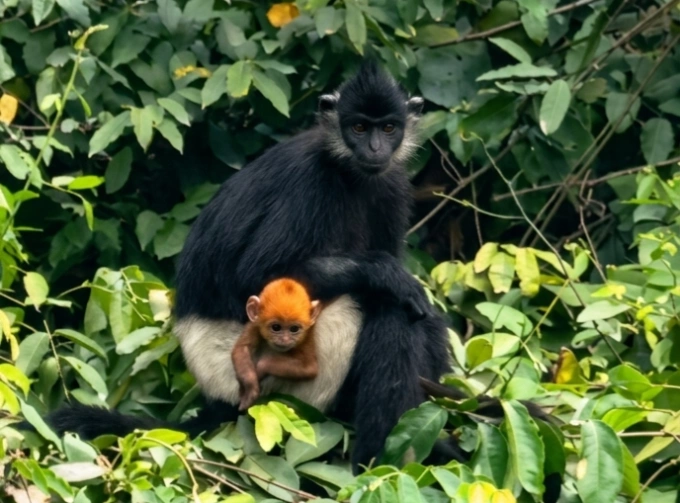
The white-buttocked langur is a primate species endemic to Vietnam, currently classified as "critically endangered" in the Vietnam Red Book and the IUCN Red List. This species was once quite widespread in northern and north-central Vietnam, but decades of hunting, road construction, and quarrying have led to a shrinking of its habitat.
Currently, the white-buttocked langur is concentrated in two large populations: the Van Long Nature Reserve - Dong Tam Forest (Lac Thuy district) with approximately 304-336 individuals and the Kim Bang Forest with 175 individuals. In addition, this species is also found in the Yen Mo - Tam Diep - Bim Son forest and the Huong Son Special Use Forest ( Ha Tinh province ) in small numbers but still capable of reproduction. The Pu Luong Nature Reserve (Thanh Hoa province) currently has only about 5-7 individuals, placing it among the most endangered species.
According to Trinh Dinh Hoang of the Wildlife Conservation Center in Vietnam (SVW), the biggest threat to the white-buttocked langur today is not just its low population but also the fragmentation of its habitat into "islands" by highways, tourist roads, residential areas, power lines, and quarries.
Unlike many primate species, white-buttocked langurs move almost exclusively on the ground, primarily clinging to cliffs and tree canopies. When mountain ranges are cut across by roads or quarries, langur populations lose contact with each other, leading to a risk of gene pool decline and long-term reproductive problems.
One of the most serious points of separation currently is the area along National Highway 21, where the approximately 20-meter-wide road cuts across the Kim Bang forest and the Huong Son - Lac Thuy forest strip. Just 200 meters from this habitat connection point is a quarrying area, further shrinking the langurs' living space.
What can be done to save the langurs?
To address the fragmentation, scientists propose constructing an ecological bridge made of concrete with a green canopy to create a corridor for langurs to move between the two forests without having to descend to the ground. This is not simply a transportation structure, but a "living corridor" that will allow the remaining langur populations to continue exchanging genetic resources and expanding their living space.
Besides National Highway 21, several other isolated areas have been identified as requiring restoration of ecosystem connectivity, such as the dam area connecting Dong Quyen and Hang Tranh in Van Long, the tourist route connecting Huong Pagoda with Bai Dinh, the newly opened road into Dai Dong Valley, and areas previously used for stone quarrying in Kim Bang forest. The proposed solution is to build overpasses and underpasses combined with planting trees to create green corridors connecting the fragmented limestone mountain ranges.
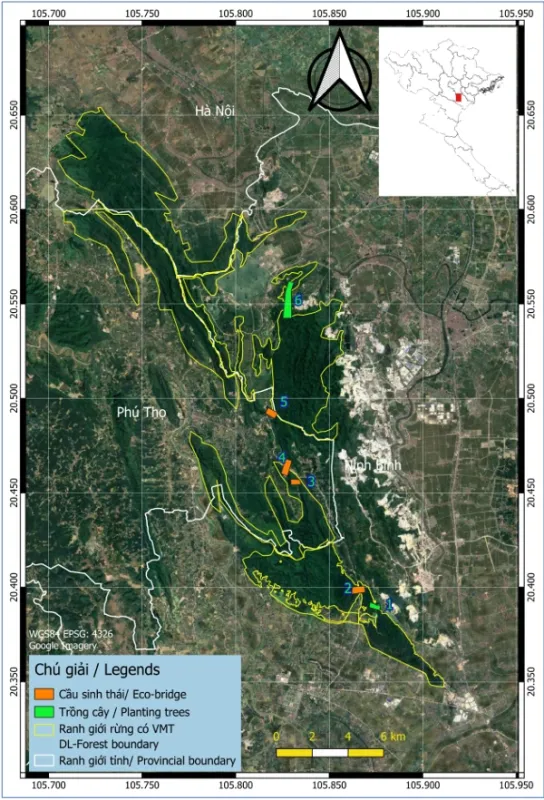
Besides transportation, quarrying continues to be considered the biggest pressure on the habitat of the white-buttocked langur. The limestone mountains are not only a habitat but also a "natural fortress" that has helped this primate species survive for decades.
Mr. Tang Xuan Hoa, Deputy Head of the Ninh Binh Forestry and Forest Protection Department, said that the province has included the conservation of the white-buttocked langur in its development planning adjustments and has directed the completion of the dossier for establishing the Kim Bang white-buttocked langur species and habitat conservation area before June 30, 2026.
According to Mr. Hoa, in recent times, forest rangers, along with conservation organizations such as Fauna & Flora International and CCD, have coordinated surveys, patrols, and protection of many rocky mountain areas with high biological value, preventing exploitation despite significant pressure from the demand for construction materials.
"We are determined to protect areas directly related to the habitat of the white-buttocked langur, special-use forests, and limestone mountain forests," Mr. Hoa said.
Experts believe that if the Kim Bang white-buttocked langur reserve is established, along with a system of overpasses and ecological corridors connecting the limestone mountain ranges, it will be a major turning point in the effort to conserve one of the world's most endangered primate species.
Amidst limestone mountain ranges fragmented by highways and quarries, troops of white-buttocked langurs still cling to the remaining cliffs. For conservationists, preserving the langurs' current habitat is also preserving the last chance of survival for a primate species found only in Vietnam.
According to vnexpress.net