



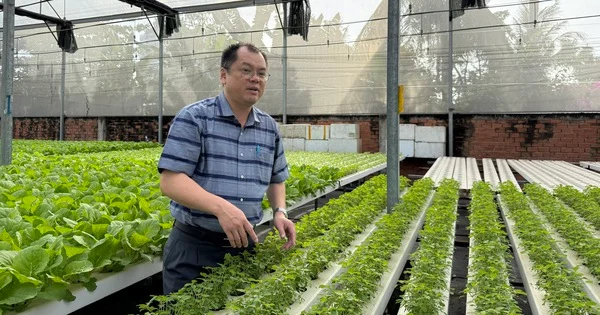
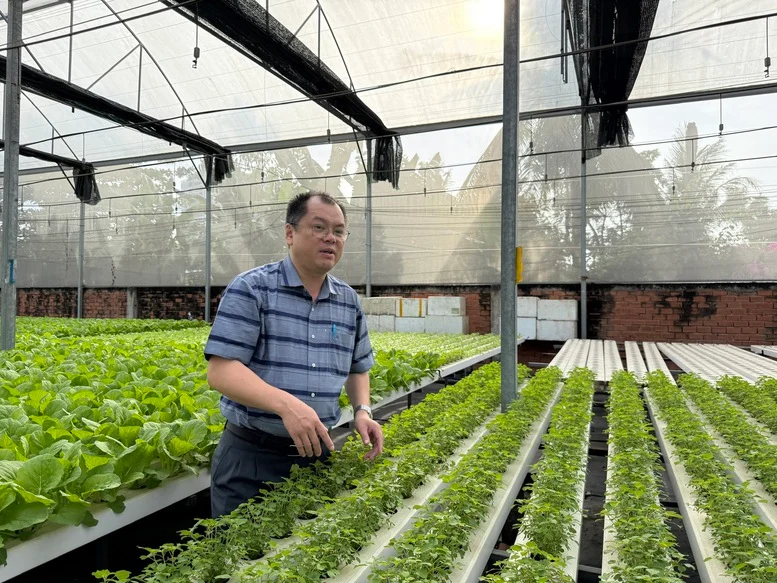
The model of growing clean vegetables using water-saving irrigation technology helps ensure consistent yield and production - Photo: VGP/Do Huong
Green transformation - from grand policy to grassroots action.
With a series of policies and projects implemented synchronously, the development of green, ecological agriculture and reduced emissions in Vietnam is strongly shifting from orientation to concrete action.
The Ministry of Agriculture and Environment has determined that green transformation in agriculture aims not only to increase productivity or export value, but more importantly to reduce climate risks, protect ecosystems, improve the quality of life in rural areas, and enhance the position of Vietnamese agricultural products in the international market. This approach reflects a shift in thinking from purely production-based to agricultural economics, from chasing quantity to focusing on quality, efficiency, and sustainability.
In reality, green transformation does not happen all at once but is realized through specific models, starting from production areas, cooperatives, and individual farming households. It is at the grassroots level that the economic , environmental, and social benefits of green agriculture gradually become clear, encouraging producers to change their long-standing farming practices.
In Tan Thanh ward, Ho Chi Minh City, the Hac Dich Green Pomelo Cooperative is a prime example of the transition from small-scale production to systematic, green farming with a linked value chain. Thanks to favorable natural conditions, the cooperative applies techniques to stagger fruiting, maintaining a stable supply year-round. On average, the cooperative supplies 60-100 tons of green pomelos to the market each month.
According to Ms. Nguyen Thi Thuy Dung, Director of the cooperative, previously, grapefruit growers mainly produced in a fragmented manner, lacking coordination and depending on traders. The overuse of chemical fertilizers and pesticides not only degraded the quality of soil, water, and air but also led to unstable prices and inconsistent output. These limitations became evident when the COVID-19 pandemic broke out, as farmers lacked legal standing to sign contracts with businesses and supermarkets, leading to difficulties in sales.
Based on this reality, the households unanimously agreed to establish a cooperative, aiming to build a concentrated production area with a unified and transparent process. Upon joining, members receive guidance on production according to VietGAP standards, and are supported by technical staff and local authorities in pest and disease control. Thanks to the application of the new process, grapefruit yield increased from approximately 20 tons/ha to 30-35 tons/ha.
Processes such as pruning, flowering treatment, production logbook keeping, and pesticide withdrawal periods are standardized, helping to control fruit quality and appearance. VietGAP also helps cooperatives ensure transparency of origin, meeting the traceability requirements of partners and supermarket chains. As a result, the selling price of pomelos is 2,000-3,000 VND/kg higher than before.
Simultaneously, the cooperative applies various solutions such as water-saving irrigation, soil moisture and pH management, and mechanization of pesticide spraying to reduce labor and costs. Notably, the model of releasing yellow ants to control mealybugs instead of chemical pesticides helps reduce input costs, while also contributing to reduced emissions and protecting the orchard ecosystem.
The model in Hac Dich is just a glimpse into the green transformation of the agricultural sector. Nationwide, farming is being reoriented towards resource conservation and greenhouse gas emission reduction. Models such as the "1 must, 5 reductions" approach and alternating wet and dry irrigation in rice production are considered important solutions to reduce methane emissions while saving water and input costs.
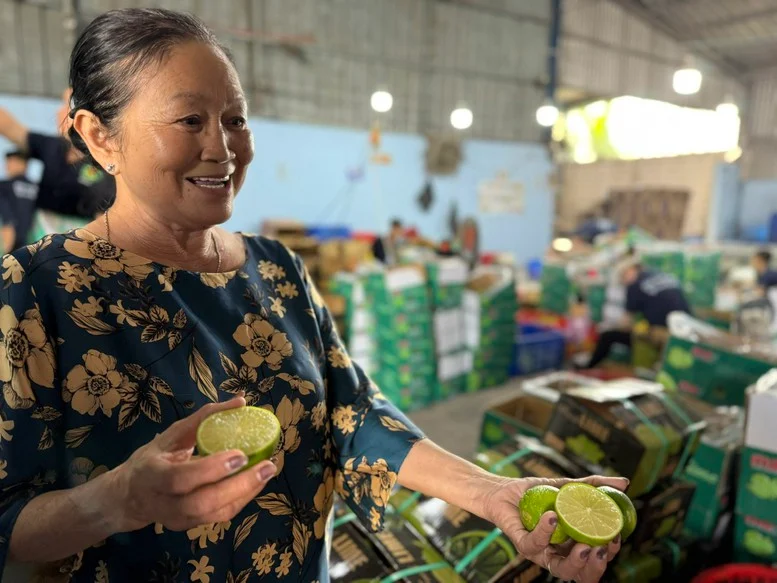
Farmers growing seedless lemons for export help people in barren areas still achieve high yields and economic efficiency - Photo: VGP/Do Huong
The model of rice cultivation with reduced emissions is spreading.
Reducing emissions from rice cultivation – a pillar of food security – is considered a strong emphasis in the development of low-emission agricultural production models. The project "Sustainable Development of One Million Hectares of High-Quality, Low-Emission Rice Cultivation Linked to Green Growth in the Mekong Delta by 2030" has been piloted. Many models have shown a 10-20% reduction in production costs, reduced seed usage, more rational use of fertilizers and pesticides, while improving rice yield and quality.
Deputy Minister of Agriculture and Environment Tran Thanh Nam affirmed that the most important result lies not only in the reduction of emissions or the increase in profits, but in the change of mindset of farmers: from agricultural production to agricultural economics, from individual work to linkage along the value chain, from focusing on output to meeting market demands.
Starting with rice, emission reduction solutions are spreading to many other sectors, including coffee – one of Vietnam's key export commodities. In Lam Dong province, sustainable coffee projects are being widely implemented in many localities such as Di Linh, Lam Ha, Nam Nung, Quang Phu, and Quang Son, helping people access farming practices that meet green growth criteria.
According to Mr. Lang The Thanh, Director of Thanh Thai Fair Agricultural Cooperative, the quality of farmers' coffee is the decisive factor in their ability to participate in the value chain. Low-emission farming models help produce more uniform coffee beans, meet technical standards, and fulfill traceability requirements, thereby expanding opportunities to access domestic and international markets.
Not only Lam Dong, but also coffee-growing provinces like Dak Lak and Gia Lai are expanding certification programs such as Rainforest Alliance, UTZ, Fair Trade, and Organic, aiming for responsible use of inputs and access to high-end market segments.
In livestock farming – a sector with significant emissions – many farms have adopted biogas digesters, microbial waste treatment, and feed adjustments to reduce nitrogen and methane emissions. Solid-liquid separation, manure reuse for composting, and the use of biogas for electricity generation are forming circular farming models that both reduce emissions on-site and improve economic efficiency.
In the forestry sector, the role of carbon absorption and total emission balancing is increasingly being affirmed. Local authorities are promoting sustainable forest management, developing large timber forests, issuing sustainable forest management certifications (FSC or equivalent), protecting natural forests, and digitizing forest areas using remote sensing technology. Simultaneously, the REDD+ mechanism continues to expand, gradually preparing for participation in the carbon credit market.
According to Mr. Ngo Xuan Chinh, Director of the Center for Research and Transfer of Agricultural Technological Advancements (Southern Institute of Agricultural Science and Technology), due to the impact of climate change, agricultural production, especially fruit, is strongly shifting towards VietGAP and organic farming. This requires rebuilding the entire technical process, reducing chemical pesticides, increasing organic fertilizers and biological products, and bagging fruits… in order to meet export requirements and protect the environment.
Minister of Agriculture and Environment Tran Duc Thang emphasized that green agriculture and the circular economy are not just guidelines, but have become concrete actions, yielding clear results in production, processing, and export. In the coming time, the Ministry will continue to improve institutions, develop the carbon market and green credit, encourage businesses and farmers to expand low-emission production models, thereby enhancing the competitiveness of Vietnamese agricultural products and making a practical contribution to the nation's green growth goals.
From specific models at the grassroots level to regional and national-scale programs, it is evident that green agriculture in Vietnam is gradually deepening. Its effectiveness is measured not only by growth figures, but also by the sustainability of the ecosystem, stable income for farmers, and the growing market confidence in Vietnamese agricultural products.
Do Huong